TB Joshua-Synagogue Church
By CHARLES KUMOLU& Bose Adelaja
LOCATED in the heart of Ikotun Egbe, a popular suburb in Lagos, this building stands out not only in the area but the entire Africa. Its architectural design and finishing is such that would leave the masters of architecture marvelling.
Being super aesthetic could make it pass for a 21 century castle, but that mistake should not be made. The cynosure is the church auditorium of the Synagogue Church of All Nations,SCOAN, —a pentecostal church of international repute, famed for the healing miracles recorded there under its founder Snr. Prophet Temitope Joshua.

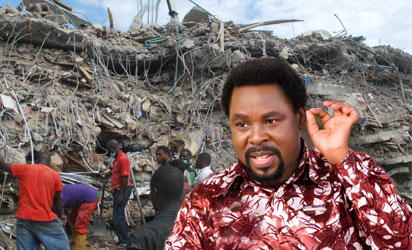
The site of the collapsed building at the Synagogue Church, Ikotun-Egbe, Lagos.
Beside the auditorium on Segun Irefin Street, are other adjoining buildings owned by SCOAN which are also architectural spectacles.
These structures serve different purposes for the multitude of worshippers, who daily troop into the church for miracles.
Until September 12, 2014, all that the five-storey edifice, sited immediately after the SCOAN auditorium, was known for was that it served as a guest house for foreign miracle seekers, who come from all corners of the globe.
Sadly, that could not be said of the structure any more, following its sudden collapse that fateful day, leaving many in tears, sorrow and agony.
There were different accounts as to why the building located at the New Land area of the church caved in.
Tears, sorrow and agony
VanguardFeatures,VF, gathered that the structure was initially a two storey building before it was converted to a five storey edifice. It was being raised to a five-storey building before it collapsed killing at least 45 people as at Monday morning.
Those who were trapped under the debris included foreigners, some kitchen staff and construction workers.
The SCOAN incident has once again brought to the fore, the rising incidence of building collapse in Lagos.
Whenever any structure goes down, there are usually doubts as to the quality of construction materials used, and questions on whether the developer adhered to the original building plan approved by the state government.
And a similar situation played out in the case of SCOAN, as people are in a hurry to know whether the Lagos State government approved the construction of the ill-fated structure.
On hand to respond to that poser, was a saddened state Commissioner for Physical Planning and Urban Development, Mr. Olutoyin Ayinde, who said that though investigation is still on-going, there is no proof that the church obtained a permit to add additional structures.
“We have no proof that there is a permit,” he said, adding thus: ‘’We have asked the engineering team to meet us because we have questions to ask,”.
For Olutoyin, the building was not professionally constructed.
“Even if the building doesn’t have approval, it ought to be built professionally,” he added.
Olutoyin’s damning verdict has prompted more questions regarding the government’s regulatory role in that respect.
Approval questions
Particularly, many want to know why the addition of additional floors to an existing building, has become a trend when there is a government that is statutorily mandated to prevent such occurrence.
Further investigations however, revealed that the laws of the state are not silent on the matter, just as it is not ignorant of it.
In fact, it was gathered that the state government had come out with a strategy to stem the tide, but the workability of that framework remains a headache.
Speaking to VF in that respect, President of Building Collapse Prevention Guild, BCPG, Mr. Kunle Awobodu said: ‘’It is not that the government is not aware of it.’’
Continuing, he said: ‘’ To checkmate this unprofessional manner of erecting buildings, the Lagos State Government in 2010 enacted a law. The Urban and Regional Planning development Law 2010 was signed top prevent what happened recently at Synagogue.
For it to be workable, the law was divided into three. The plan has to be studied and approval given if is suitable. Another agency is also expected to come to the site to ensure that the builder conforms with the law. It is important to checkmate those who will raise their buildings.’’
While insisting that the practice is an aberration, Awobodu explained thus: ‘’When you add another structure to an existing one, you are adding another load to the building.
The structure will start experiencing deformity as a result of that. What we are saying is that it is unacceptable. In this case we learnt that construction was ongoing. We are all aware that there is a law that regulates construction of houses in Lagos, the major challenge is observation of the laws.’’
Observation of the laws
In addition, he said: ‘’It is because of this trend that the building control agency was formed. But it is a new agency. It will not be easy to cover the whole Lagos. Synagogue is secluded and they live in a world of their own where they can do and undo. I am not sure they got the approval of the state government.’’
Perhaps the total disregard for the laws by property owners, informed the the birth of a coalition aimed towards supporting the existing legislation.
Expatiating on that, the BCPG boss added thus: ‘’For the laws to be observed, we established the Building Collapse Prevention Guild. People asked us how we can make our objectives work. We brought the primary stakeholders together and divided ourselves to ensure that we cover the 57 councils in the state.
We also tried to bring in artisans to ensure that they start paying attention to what the law says. It is important that we realise that the situation requires that we do this for it to be effectively checkmated.’’
Further findings also confirmed the existence of legislation against unprofessional manner of constructing buildings in Lagos.
Fallout of frequent building collapses
Accordingly, the law which was signed by the state governor, Babatunde Fashola in 2010, is a fallout of frequent building collapses recorded across the state.
The law requires that landlords with buildings above two floors must obtain certificates of fitness from the Building Control Board, and it harmonises agencies such as the Lagos State Physical Planning and Development Authority ,LASPHDA, the Lagos State Building Control and the Lagos State Urban and Rural Agency, LASURA.
It also also provides that all buildings being constructed in the state must take cognizance of the physically challenged, while provision for the role of insurance firms in the construction of buildings right from the outset by visiting construction sites, was also accentuated in the law.
Though Awobodu had explained the constraints in making the law workable, VF gathered that concerned authorities had not done much in the area of enforcement.
Constraints in making the law workable

A survivor of the Synagogue Church Of All Nations building collapse being wheeled out
‘’When the state government came out with the law, we were relived. Unfortunately, the law only exist in the statute books of the state. Enforcement has not been done properly. I am not saying that they don’t do anything in that line, my concern is that they can make the law work effectively,’’ Mr. Erasmus Badmus a property developer, told VF.
But the General Manager Lagos State Emergency Management Agency LASEMA, Femi Oke-Osanyintolu would not accept that.
Oke-Osanyintolu said: ‘’Though we have been going round to sensitise residents, we need encouragement from them to report hazardous cases before they get out of hand. There are agencies that are monitoring this. And we are always calling on the people to cry out and report such cases to the government.’’
In addition, he said: ‘’People should do the right thing by being empirical. They should invite professionals to ascertain whether any structure is viable or not but the problem is that our people have been cutting corners. Take for instance, many people usually handle building projects outside official hours, especially in the evenings, during the night or weekends when professionals are not in sight. Anyway, I am happy that there are laws to handle this type of situation so that we don’t continue to endanger lives of our people.’’
On the way out, Oke-Osanyintolu suggested thus: ‘’The way out is community policing. Residents should be vigilant and be at alert at all times. Also, they should report to appropriate authorities, especially to their local government. Lagosians should be vigilant and report this type of atrocity in their environment, they should not keep quiet when things are not done the right way because if something harzardous happens, definitely it will affect those living in such environment.’’
Building control agency
VF recalls that the Lagos State Building Control Agency, LASBCA, was established to ensure standard in the industry and called for an inter-ministerial collaboration between ministries of Physical Planning and Urban Development, Housing and Environment on measures that will curb the unfortunate incidence of building collapse.
The functions of LASBCA include inspection of building works and the certification of various stages of building construction and keeping of such records, removal of illegal and non-conforming developments, identification and removal of distressed buildings to prevent collapse and the issuance of Certificate of Completion and Fitness for Habitation.
Others are provision of building services such as material evaluation and testing, fire and public health control; establishment of District Development Control Offices for the discharge of these functions; conducting research in building construction and control; cooperating with the Development Permit Authority to achieve zero tolerance of illegal developments; enforcing the provisions of the new law and any regulations that may be made under the law for inspection of building, verification and certification of building insurance, among others.
Disclaimer
Comments expressed here do not reflect the opinions of Vanguard newspapers or any employee thereof.