By Augustina Anyaegbu
The recent recommendation by the House of Representatives concerning cement standardisation which tallied with a recent recommendation by the Standards Organisation of Nigeria, SON, has generated a huge controversy among cement manufacturers and key industry stakeholders. This dust is not unexpected, given the pivotal role played by cement in the nation’s construction industry.

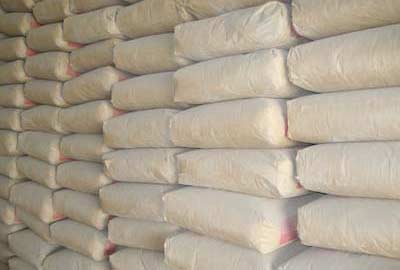
Cement
The House had in response to the rising cases of building collapse in Nigeria, set up an ad hoc committee on cement composition and pigmentation. The Committee, which was headed by Yakubu Dogara, recommended the use of 42.5mpa grade cement “because it is less susceptible to misapplication and most stakeholders will prefer it if given the chance to choose between 32.5mpa and 42.5mpa.”
The committee made 12 recommendations which were all adopted by the lower chamber of the National Assembly.
The legislators charged the governing council of the SON to ensure that all cement manufacturers in Nigeria retool and upgrade their production lines to start producing the 42.5mpa grade within a reasonable time from now.
It also recommended the creation of a cement fund from contributions of N10 per 50kg bag of cement produced in Nigeria and N20 only per 50kg of cement imported into Nigeria for the establishment of state-of-the-art laboratories in all the geo-political zones within the period of three years. When it comes on stream, the fund would be managed by a task force to be set up by SON, the Council for the Regulation of Engineering in Nigeria, COREN, the Council of Registered Builders of Nigeria, CORBON and the Nigerian Institute of Building NIOB.
Furthermore, the House recommended that any cement manufacturer or distributor implicated in the sale of expired cement should be maximally sanctioned to ensure that sanity prevails in the nation’s cement manufacturing and construction industry.
While the major cement manufacturers have already hailed the decision of House, the small players have cried foul. In separate statements issued by them, the three major manufacturers stated that long before the quality review by the SON, which pegged the 42.5mpa grade as the minimum standard for general purpose use, they were already producing that grade as their minimum quality.
Minimum quality
BUA which operates the oldest cement plant in Nigeria, the Cement Company of Northern Nigeria, CCNN, said it has been producing the higher grade of cement right from the outset, hence the company saw nothing wrong with the House’s decision.
“The BUA cement brand is different from others because it is of 42.5 and 52.5 texture grade. This is the highest quality texture which mixes and dries easily. Most companies import lower quality. Our prices are also competitive,” the company said.
Similarly, the Group Managing Director of Dangote Cement Plc, Devakumar Edwin, said the company has never produced a lower grade of cement and that the quality review by SON, which was also affirmed by the House of Representatives that investigated the disturbing menace of structural failures only confirmed its long held view that Nigerians deserved the best quality of cement.
But many stakeholders seem to have a different opinion.
COREN in a presentation by its President, Kashim Ali, an engineer, maintained that there is no scientific proof to insinuations that low grade of cement is responsible for the spate of collapsed buildings in Nigeria. COREN had observed that SON, which is the regulatory agency for setting standard for cement in Nigeria, did not have a competent laboratory for determining cement quality.
It also said that SON’s board as presently constituted lacked the technical competence to embark on such an activity”.
This view was shared by the Consumer Advocacy Foundation of Nigeria, CAFON. Its President, Sola Salako, asserted that since the commencement of cement production in Nigeria in 1952, the 32.5mpa grade has been the prevalent variant available and widely used in construction across the country.
CAFON argued that “overwhelming evidence abound that the 32.5mpa grade of cement has been the variant used for the construction of millions of buildings in the country, including sky scrapers and multi-storey buildings, all of which are still of good and enduring quality and standard today, 57 years later”.
President of the Nigerian Institute of Building, NIOB, Tunde Lasabi noted that experience throughout the world has shown very clearly that cement quality is not the source of building collapse.
Building collapse
Lasabi said the root cause is most of the time related to poor construction practices. He emphasised the need for training and re-training programmes for block makers and cement users in all parts of the country as is being done by some cement manufacturers.
The Nigerian Society of Engineers, NSE, also spoke in the same vein. Its President, Adewale Falade, contended that “cement as a material is not used directly in construction works but is normally mixed with other materials such as sand and granite to form mortars, sandcrete, saying that all three grades of cement approved by SON, and available in the market have been satisfactorily used for construction purpose in the country”.
Falade had surmised that “the production and marketing of Grade 32.5 already certified and approved by the Standards Organisation of Nigeria, SON for use in Nigeria should continue unabated.”
Vanguard Features, VF learnt that a pressure group has risen to champion the cause of the small manufacturers who may not be able to immediately meet the recommendations of the House of Representatives.
The group, Alliance Against Monopoly, in a statement jointly signed by its President, Chief Ike Omife, and the Secretary-General, Dr. John Ikegbunam, noted that the findings and conclusion of the House Committee Report were at variance with the submissions of most of the experts who testified on oath during the public session. It wondered how the Committee arrived at a conclusion that defied logic in a matter in which empirical facts were furnished by both experts and industry practitioners.
The organisation then wondered how a parliament which ordinarily should have the interest of the people at heart would endorse an obviously skewed report designed to entrench monopoly in the nation’s vibrant cement market.
An Abuja -based building contractor, Alhaji Idris Mohammed debunked claims that the quality of cement causes building collapse. Mohammed who said he has been in construction for over 30 years said experience has shown that it is the use of inferior materials and not adhering to the right measurement that cause buildings to collapse.
Disclaimer
Comments expressed here do not reflect the opinions of Vanguard newspapers or any employee thereof.