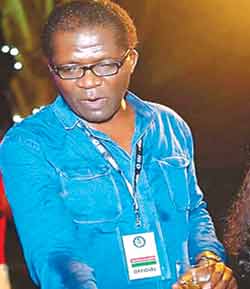
Keith-Shiri
By Benjamin Njoku
Ahead of flagging off of this year’s edition of the Africa International Film Festival (AFRIFF), which holds from November 9 through 16, Programmer of the festival, and international film curator,Keith Shiri has expressed the resolve of the organisers to use the festival as a platform to rewrite the history of film making on the continent.

Keith-Shiri
The Zimbabwean who is also a juror of the Africa Movie Academy Awards (AMAA) and advisor to the London Film Festival, has started work on delivering a memorable fourth edition in Calabar, Cross River State.
He has, amongst other activities, been touring festivals to spread the AFRIFF message and was at the recently concluded Cannes International Film Festival in France to do same.
Speaking on his recent experience in France, Shiri disclosed that it was smooth sailing. “I was there to do the work of AFRIFF. And one of the things I was impressed with, is how well Timbuktu, a film by Abderrahmane Sissako, did. Not only is this film one of the best from Africa in Cannes this year, it is the best film that received rave reviews. I am negotiating with the sales agent for AFRIFF possible screening. As a continent, I think we also need the support mechanism because this film can be claimed by any of the African countries as our own. This is a way to say, this is our brand and this is what we can do in our continent,” he said.
According to Shiri, the Cannes platform also afforded him the opportunity to see great films in all genres and network with international producers. “I remember talking to Ben Gibson, the director of the London Film School, to come to Nigeria. I made him understand our challenges. This is because one of the things I would like to suggest to AFRIFF is that, rather than just showcase films, it should find a way where we can bring people from the outside world and explore the opportunities that we can gain from them. Getting somebody like Gibson will give us an idea of how the British film policy operates.
“On the other hand, I am trying to see how Nigeria can begin to define its film policy such that it will create a platform where co-production treaties can happen. South Africa, for example, has got co-production treaties with the UK and Germany. And this can just serve as an incubator, where things grow.
It’s a place where we come to celebrate every year and people can begin to engage with Nigerian filmmakers. Also, content-wise, we invite filmmakers from all over the continent for competition and provide the panorama programme. That way, we can choose to have a film from Mexico or Brazil or Indonesia.
“In the same vein, African filmmakers are able to see what others are doing from the rest of the world. That’s why it is international. It is not a Nigerian film festival, but an African film festival. But, of course, the home brands have to benefit than the others, because people have the opportunity of seeing more filmmakers from Nigeria. Besides, it is also an opportunity for Nigerians to show the world what they have got,” he said.
Shiri admitted that like every human endeavour, the festival has its challenges but that organisers are undeterred. “AFRIFF has done exceedingly well in the last four years. All over the continent, there are possibilities. And I have always looked at Nigeria, for example, as a country to look up to.
This, for me, began back in the days when I read novels like ‘Things Fall Apart’ by Chinua Achebe and all the collections of a man like Wole Soyinka. They have always been a point of reference. Looking at the possibilities in Nigeria, I see the country as a power house. And with its huge population, it should be able to take a leading position.”
Disclaimer
Comments expressed here do not reflect the opinions of Vanguard newspapers or any employee thereof.