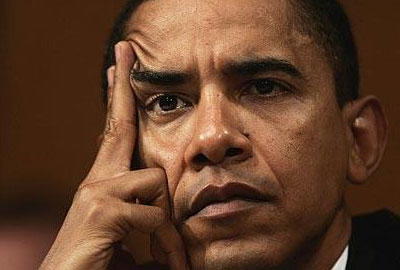
President Barack Obama of the United States
By Uche Onyebadi
YOU would think that former U.S. vice president Dick Cheney might be the last person to ever make a public statement about going to war again in Iraq, given the fact that he was the prime architect of the U.S. debacle in that country over what turned out to be some phantom weapons of mass destruction being built by late dictator, Saddam Hussein.
But, Cheney is not a man to stand akimbo and watch his “legacy” go into history’s incinerator of bad policies. With his equally war-mongering daughter, Liz, the former vice president wrote an article in the Wall Street Journal, where both Cheneys unabashedly criticized President Obama and asserted that “rarely has a U.S. president been so wrong about so much at the expense of so many” about Iraq. And this is a man who was so “right” about Iraq that the U.S. got involved in a most unproductive misadventure that resulted in 4,480 U.S. military casualties, $1.7 trillion and close to 500,000 Iraqi deaths. Even with such heavy losses, Cheney and his daughter are once again beating the drums of another war in Iraq and urging the U.S. to get involved once more.
In fairness to ultra-conservative Cheney, his war drums have attracted other people in the conservative wing of U.S. politics. No surprises here that the two most visible acolytes of U.S. engagement in wars abroad, Senators John McCain of Arizona and Lindsey Graham of South Carolina, have thrown in their weight in the calls for the U.S. to return to war in Iraq in some fashion. Both senators told the press that “We are deeply concerned that the President (Obama) continues to make political change in Iraq the prerequisite for greater U.S. military and other actions that could begin reversing the momentum of ISIS and improving the security situation in the country.” Of course this is their coded language for more military intervention in the current Iraqi crisis. At another forum, McCain was blunt in arguing that for a start, the U.S. should send in the war jets and bomb the advancing Iraqi dissidents into submission. While he ostensibly does not recommend U.S. boots on the ground for now, he would rather have U.S. presence in the air over Iraq, which is the normal prelude to outright war.
The current crisis was triggered by the rapid advance toward capturing the Iraq capital, Baghdad, by the coalition forces known as the Islamic State in Iraq and Syria (ISIS). Apparently, the government of Prime Minister Nuri al-Maliki has not and cannot find the means to halt the approach of the ISIS militia. Al-Maliki who, some three years, “patriotically” refused to make it possible for some U.S. troop to remain in Iraq and help in sustaining his government and building further capacity for the Iraqi security forces, is now crying for all to hear that the he and “Iraqi” people feel abandoned by the international community now that the militias are on the offensive.
Practically all observers of the dastardly events in Iraqi in the past years agree that al-Maliki singlehandedly invoked the present phase of instability in his country. Not only did he stubbornly drive the U.S. and allied forces out of Iraq, he deliberately populated his administration with clansmen and Shiite factions in the Iraq, and proceeded to adopt measures to eliminate the Sunni community. Now, the Sunnis are in league with ISIS in trying to drive al-Maliki out of power.
Nearly everyone agrees that for peace to return in Iraq, the first measure is for al-Maliki to step down and allow a more inclusive government to be set up.
Inclusivegovernment
Senator Dianne Feinstein of California who heads the U.S. Senate Intelligence Committee summed up this popular view when she told reporters that “I think that most of us that have followed this are really convinced that the Maliki government, candidly, has got to go if you want any reconciliation.”
President Obama has reiterated the same condition and in his speech on the current Iraqi crisis he promised to send up to 300 military advisers “to assess how we can best train, advise and support Iraqi security forces going forward” in their fight against ISIS forces. But, Obama was categorical about not sending U.S. troops in harm’s way once more in Iraqi, a pledge he made during his days of campaigning for the U.S. presidency. In his speech, Obama did not equivocate on this matter as he firmly said that “American forces will not be returning to combat in Iraq but we will help Iraqis as they take the fight to terrorists who threaten the Iraqi people, the region and American interests as well.”
The president’s stand against committing U.S. troops to another war in Iraq is what truly irks the likes of McCain, Graham and ultimately Cheney. They would rather see American troops and airstrikes against the ISIS sooner than later. To McCain and Graham, that would be a measure to assert U.S. “leadership” in global affairs. To Cheney, that would be something to support his much tarnished legacy as a man who sounded the war trumpet that left the U.S. bruised both in the loss of human beings and money.
The fact is that the U.S. is now war-fatigued. Polls after polls do not support any military intervention in any war anywhere in the world, let alone Iraq and Afghanistan. On this score, even the ordinary folks who do not support Obama agree with him that for now, at least, the U.S. is tired of fighting unproductive wars. Only the Cheneys and McCains of this world still thirst for the poisoned chalice which a majority of their compatriots do not want to drink from anymore.
Disclaimer
Comments expressed here do not reflect the opinions of Vanguard newspapers or any employee thereof.