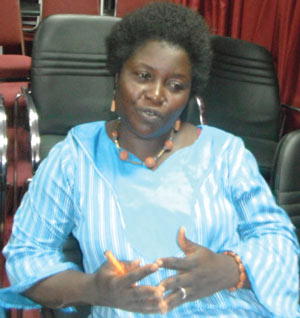
Mrs. Esther Dokyoung is the Founder of Helping Hands for Women and Youth, a non-governmental organisation working in collaboration with government agencies to promote art, sexuality education and human rights. In this chat with Vanguard Learning in Abuja, the Industrial Design graduate with a master’s degree specializing in Ceramics from the Ahmadu Bello University, Zaria, speaks on her research work in the area of clay therapy. Excerpts:
BY EBELE ORAKPO
The beginning:
ACCORDING to Mrs Dokyoung, an entrepreneur and researcher who has worked with several special schools: “I have been working in the area of clay therapy and eco-friendly production using waste materials – what you call junk art – combining it with clay since1997. I have been producing clay beads and I am passionate about it because we have abundance of clay in Nigeria. As a final year student, I saw a material on clay beads.
 Although we were not taught, I was interested so on my own, I started experimenting. I had to work with some girls that were into prostitution, to help them turn their lives around and I was looking for materials that I could use without spending a dime. I thought of clay and thought of making key holders, wall decorations and so on and then, I stumbled on the idea of making beads using clay. Clay beads have been century-long in use but it is just like it fizzled out over time.
In Nigeria, the Igbo Ukwu and Nok Art had clay beads on the sculptures but then, making them into jewellery, was more among the Red Indians, the Maya people, Chinese and Singaporeans but Nigerians did not really have a strong history of clay bead-making. So as a lover of beads, I asked myself, how can we have natural beads, not those ones manufactured in factories? That was how I got interested in developing and designing my own personal beads for the purpose of boosting tourism,” she said.
Clay therapy:
Dokyoung said that in the process of working with clay, she discovered the therapeutic property of clay.“The malleability of clay is so fantastic that with the touch of hands, clay gives you results that you will not get from plastacine; the touch in the hands is so nice. I know clay is dirty but there is an interesting part of clay that makes it superb as far as therapy is concerned. I am not so knowledgeable in medical science but the little psychology I know has shown that fine motor skills are actually strengthened as you keep working with clay.
Anything that will make you to twist, rub and squeeze the hands, will help the fine motor skills and also improve cognition. So for people who have accident, high blood pressure or diabetes and need to do a lot of exercise, clay is one material that you can just fetch and put in the hands and keep squeezing.
It’s so soft that when you squeeze it, it will not be like a ball. A ball has air within so that when you squeeze, the air goes in and then it bounces back up but in clay, the air particles are so little so when you squeeze, you still have a strong feel because it is compact and that is what helps a lot of people. I felt that if these things are working outside the country, why not in Nigeria? That was what actually motivated me to look at clay therapy as an area of interest.”
Mathematical Bin:
“I realised that clay being a material that is quite accessible and associated with children, could be useful also for counting so I designed what is called the Clay Mathematical Bin consisting of clay beads in a container so when the children want to do their arithmetic (addition and subtraction), they use them instead of using dirty can covers. In the process, they play with the beads because when you make the round ones, they roll. In the process of counting, the beads roll and the children play.”
Special needs children:
“The impact of play on education cannot be overemphasized as it helps the child to learn faster and slowly with stability so I felt that just designing the clay mathematical bin and keeping it all by itself, will not do. I asked myself: Who are the population that need this material most? I realised it is the special needs people; those who have difficulty in learning could benefit most from using the clay beads.
The clay beads should, however, not be small because sometimes they see them as biscuits as the colours are attractive especially when they have embossed designs, so we make bigger clay beads for them so that swallowing would be difficult.
I did a study with special needs children, children with mental retardation, autism, and cerebral palsy and I realised that even those that could not paint and could not even write a word, were able to do so. There was spontaneity in their work; instantly trying to put a string through the beads without me showing them anything. They just saw the beads and they felt they needed to string and put them on. It was something exciting to me.
“Secondly, they were able to count, even those that could not say 1, 2, 3; could turn the beads into the container as they saw other children doing. The other thing was that they turned the Mathematical Bin to a musical instrument, shaking the container, making some sounds etc. So fired clay beads could be useful in helping them to learn.”
Clay for play:
“Many caregivers want to teach their wards how to make clay beads but they lack the knowledge so I designed a manual – Clay for Play- with the same concept of promoting play while learning. I pray that before this year ends, the material will be published and made available to schools, hospitals and caregivers because I know there are many special needs people hiding in homes so it will help caregivers.
Disclaimer
Comments expressed here do not reflect the opinions of Vanguard newspapers or any employee thereof.