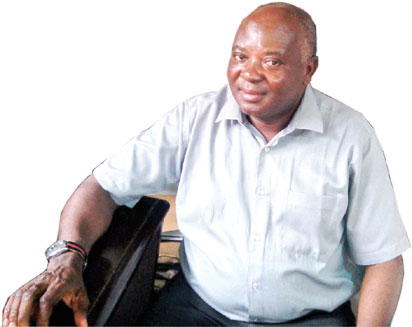
FEMI Owolabi is managing director/chief executive officer of Fembosco Engineering Ltd, a firm that specialises in electrical controls and technical products, with head offices in Lagos. After cutting his teeth at SCOA Nig Plc where he rose to become a department head, he left the transnational in 2003 and opened his own business, Fembosco.

In the interview below, Owolabi speaks of the electric power sector in Nigeria, averring that appropriate technology must drive the electric power distribution system for the nation to achieve uninterrupted power supply. In addition, he is of the opinion that the infrastructure of electric power distribution needs massive investment by the new owners. Excerpts:
By adeKunle Adekoya, General Editor
WHO are you?
I am Femi Owolabi, MD/CEO of Fembosco Engineering Ltd. I worked with SCOA Nig Plc from 1990 to 2003, rising to become head of department. I left in 2003 to start as Fembosco, using industry experience in electricity and power control systems.
It’s a great thing that power has been privatized in the country. If allowed to work, in the next five years, we should achieve at least 75 per cent of supply without interruption because that period is enough to stabilize the factors, install what is to be installed as well as change, and competition is vital to test abilities of the various companies. In our country presently, the power apparatus is aged and requires complete replacement.
Is that in the area of distribution or generation?
In both generation & distribution. For example, a transformer is one of the apparatus that is required to augment distribution. Most of these transformers are very old and at the consumption end, electricity does not get there. If you go to a particular unit today, the transformer is blown or bad. In addition, our power cables are also old and what’s more, ninety per cent of the installation apparatus are substandard, even from source.
From where they were sourced, some of them were specifically required to be manufactured below standard to save cost. For the new owners of the generation and distribution companies to achieve efficiency in distribution, these materials that are obsolete and substandard must be changed.
That will take time. This is because for these materials to be manufactured outside the country, it needs time. Time will also be needed for transportation from one point to the other, like from manufacturers to the ports in Nigeria, time to clear it from the ports and time to prepare site for the installation, also time to install.
So, we should not expect reliable, uninterrupted power too soon?
To the best of my knowledge, I don’t believe it can work that soon. The inputs we need for the power distribution system need time to be manufactured, especially because they have to be customized. Customized, because they have to be manufactured to our own voltage system and climate in Nigeria, so these things need time which I don’t think could be done in a year.
Are you saying the entire distribution system needs complete overhaul?
With what we have now, power companies generates power, then transmission takes place. These are high voltage and they are properly installed but when it comes to the downstream segment, the consumption level where we have all our overhead cables, you see that many of them have been joined together here and there, and are thus no longer in a condition to carry the required load.
Out there, there are transformers and feeder pillars and other machines that have been installed and in use for the past 15years to 20years, which are due for replacement. Even the defunct PHCN cannot get spare parts for them, and when they contact the manufactures of these equipment, they are told they are no longer in production. What we have on ground would not make us achieve our targets.
Nigerians have complained of being ripped off through exorbitant bills alleged to be inconsistent with power supplied. What is your own understanding with the metering system?
It’s either you set out to make money from the public or measure accordingly what you gave to people in terms of power supplied. When NEPA staff went round to read metres and bill accordingly, it was okay. But the way things are now, for me, we still don’t have a standard measurement for electricity consumption.
It was thought that pre-paid metres would solve that problem, when we would buy recharge cards, like what we do for our mobile phones.
If you have prepaid system, the power companies should test and calibrate the metres before giving them out to consumers, because you can as well do it in a way that sets the metres to rip people of their money. In the same manner, the pre-paid metres in use now can be bypassed. So, the prepaid metres we have on ground will not make the companies survive the business because when the companies come for inspection they see normal electricity connection, and when they leave, the bypass is re-effected and power theft continues.
So there should be a computerized system in their offices that they can detect a metre that is bypassed. With that, the investors can achieve their business objectives, so I suggest the present pre-paid metres be scrapped, and opt for computerized metres to stay in business.
What does your company, Fembosco Engineering do?
Fembosco Engineering Ltd is a company that deals in electrical control systems and technical products and we source our products from Europe where quality is enforced. Our major manufacturers include global industry giants like Legrand of France, ABB, Schneider Electric, and others.
Apart from product manufactured by these electrical giants, do you also take electrical contracting jobs?
We do installations, but as much as possible we work to satisfy our customers, we have contractors that come to buy products from us, so we educate them and sell products to them, except on products that are not known, in that case we need to do the installations ourselves to avoid malfunctions.
From experience in electricity distribution in Nigeria, a building may have electricity at “full current” and the next to it has “low current.” At what frequency do we distribute electricity domestically?
Each day what we think of is how do we rebuild consumption, because consumption is growing every day, Nigeria is growing so also consumption. There is now what we call energy saver. Take a 100 watts bulb for instance. New technology has reduced its energy consumption to 11watts and its brightness remains the same.
There now is LED technology where lighting consumes less electricity power. We must embrace LED technology in lighting our homes and offices to save money on energy.
Disclaimer
Comments expressed here do not reflect the opinions of Vanguard newspapers or any employee thereof.