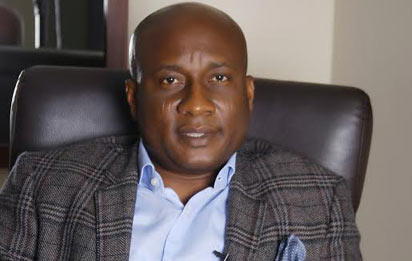
Allen Onyema
Chairman of the Foundation for Ethnic Harmony in Nigeria (FEHN) and a cadet pilot, Mr Allen Onyema, speaks on how to make Nigeria’s airspace safe among other issues.
What is your take on controversies trailing the proposed national carrier giving the Nigeria Airways experience?
What I think the government should bother itself with is providing the necessary infrastructure for the private sector to thrive in aviation. I do not support government running an airline. Airline has several avenues for leakages. Even private owners find it extremely difficult controlling corrupt practices within their system.
Government cannot and will never be able to run this business. The government has a sincere disposition towards setting up a national carrier but the truth is that corruption, in the coming years, will destroy the airline. If the privately owned airlines cannot effectively curb leakages in their system, government would be worse off.

*Mr Allen Onyema
Our airspace is becoming unsafe once again, as somebody interested in Aviation, what do you make of that?
You may be right and wrong that our airspace is becoming unsafe because of the not-too-good stories of the past. About a year ago, Dana Airline crashed, we had the helicopter crash in Bayelsa and now you have the Associated Airlines plane crashing, these may prompt anyone to say that the skies are not safe. However, it may not be totally correct to say that our space is unsafe.
It’s unfortunate and regrettable that these things happened. Some of these things could be avoided but that is not to say that they do not happen in other places. It’s just that when it happens in other places, the way they react and the things they put in place to forestall recurrence is not the way it happens over here. As far as I can say for now, the Nigerian skies are very safe despite the Dana and Associated plane crashes.
We also had the IRS that was guarded to land in Kaduna and a Cargo airline that made air return…
This country needs the media to understand aviation very well, that is, the dynamics of aviation and the dynamics of flying. If we all understand it, we would be spared a lot of the stories going round. Every country has air returns on daily basis. Air return is a precautionary measure, it’s not that there is going to be a disaster.
It is like when you are driving your car and one of your dashboard lights shows, you should stop and look at the car, to know what it is. It may be ordinary fuse which may not actually endanger the car. It could be something serious. So, when a pilot notices an adverse signal in the air after take-off, the only way he could stop is to turn back or land at an alternate airport.
The attitude of Nigerians and the press might endanger flight safety in this country. The way the media report aviation issues might endanger flight safety. When a pilot decides to take precautionary measures of going back to base, what you see in the newspapers the next morning is ‘ABC plane almost crashed! Danger averted! 98 people escape death!’
No, you don’t say it this way. In the developed nations with world class facilities, they do air returns regularly, you can have more than 20 air returns in a day. But in Nigeria, once it happens, the Minister must resign is what you hear. Time may come when these airlines, in order to keep afloat, will beg their pilots to see how they could manage it to the end and not have an air return. And it could spell disaster.
The Aviation Minister was quoted to have said that air crashes are inevitable. What do you make of that statement?
I’m not the mouth-piece of the minister and I wasn’t there to know how she put it. But I’m sure what she wanted to say was that there are times you can’t avoid these things not that every air crash is inevitable. There are certain things that are avoidable. Whether we like it or not, the present regime has tried for the aviation industry. We must accept that.
This present minister has given our airports a facelift. Despite all the things that were done in the past, this present minister and the government have gone a step further. It has never happened in this country; to give zero import duty to importers of aircraft and aircraft spare parts; now, you don’t pay a dime! And the government did these because they want to support flight safety. They said that the money operators would have used to pay heavily in taxes, they could channel to maintenance.
So government has done its best. And don’t forget, there is a regulatory body. Nigerians should understand that there are certain agencies that are autonomous. In fact, if it is found that government is over-bearing on the Nigerian Civil Aviation Authority (NCAA) in a manner that is regarded as a distraction globally, Nigeria can be sanctioned seriously.
People don’t understand this. The question is, who maintains the planes for these airlines? The solution to all these air crashes is maintenance. NCAA should be able to ask questions. Some of these things may also be human errors, 90 per cent of air crashes all over the world are due to human errors.
Is maintenance part of human error?
Both maintenance and pilots are human errors. Most times, the pilots are part of the human errors. There are procedures you must follow. If the pilot fails to follow procedures, there will be problem.
Talking about Nigeria, you said we are impatient, when a plane does air return consecutively within a short time, it boils down to poor maintenance…
I know what you are trying to say. I’m not saying that people don’t cut corners. It is obvious they do. But what I’m saying is that in all cases where people have air returns they should be encouraged to continue doing that if they notice anything. It is the pilot’s discretion to decide to continue the flight after seeing the signal on the dashboard. It’s not every red light that brings down the plane.
So, it depends on the pilot. Some will come back and I support any pilot who deems it fit to come back. So, the frequency of it might be as a result of poor maintenance. The civil aviation regulation stipulates that when there’s poor maintenance, such plane must be grounded. If a particular plane does that several times in a week, the plane must be grounded and proper look taken at it.
So, the most important thing NCAA should do is to ask every airline, every private operator, even the private jets, who maintains your plane? The NCAA should carry out periodic audit of every airline to determine the maintenance status of their fleet.
There are different kinds of maintenance system. We have the equivalent system, where the airline can employ aircraft maintenance engineers from different places. There is also the one that allows you to entrust your maintenance to an MRO – that is, a Maintenance, Repair and Overhaul Organization.
For example, the Equivalent System demands the airline operator to advertise and take engineers they feel are qualified for the kinds of plane they have. They are your own staff working for you, then, they will be undertaking your line maintenance.
In the other system, you contract a Maintenance Repair and Overhaul (MRO) organization. An MRO must have had the approval and capability to maintain the kind of fleet you have. You have some MROs that maintain only Boeing. So, if you have airbus, they can’t sign contract with you. Some may be maintaining Boeing, Airbus, Bombardier, etc and are approved by their own regulatory bodies. When they come here, the NCAA must assess and certify them to work in Nigeria before you sign a contract with them. The MRO works full time with the airline and ensures that every plane in operation is airworthy. Once contracted, you can never force them to sign off into service any plane that is not airworthy.
MRO is better because you don’t have the headache of bothering yourself about your staff. The MROs bring about quality because they have their name to protect and if anything goes wrong, the MRO will go in for it.
However, some of the MROs in Nigeria see Nigeria as a cash-cow while at the same time using the country as a training ground for their cadet engineers! Some of the so-called big and small MROs from Europe bring cadets into the country as qualified engineers while the airlines are stripped of their meager revenue to the last penny taking care of these half baked engineers. The government and the NCAA must make it compulsory that no MRO brings in engineers of less than certain period of post qualification and experience on the aircraft type. They must be made to develop local content too.
These MROs, though desirable, are draining the wallets of our airlines through expensive conditions of service and welfare for their staff Which none of them has ever enjoyed in their countries. They request that their engineers be put in 5 star Hotels on a full board basis throughout the year with a driver attached to each! They also work for six weeks and go off for six weeks. This means that they work for only six months In a year and go off for a year while the airline pays the full year’s wages!
Besides this, the airline provides them with six business class return tickets to their countries in a year!
This is one of the problems of the airlines. Airlines, most times, have no option than to sign these slavish contracts.
On what Nigeria should do to improve safety
To improve safety, the account balance sheets of the airlines must first be improved too. You can never talk about improving safety in aviation in isolation of the instrument with which to improve it – money! I do no think any pilot wants to die or seen an owner of an airline wishing that anything untoward happens to his airplanes. The issue of air safety is a collective one that demands the input and cooperation of every stakeholder – the airline, the staff, the MROs, the regulatory body – the NCAA, the government and the flying public.
The airlines and the government have a bigger role to play. While the airlines must ensure that they do not compromise safety in any way, the government must provide necessary infrastructures which are within its purview and under its control.
Every airline in this country with a fleet of over three aircraft must be given land at the airport of its hub for the building of a maintenance hangar! Any airline worth its name must have a maintenance hangar. For now, procuring lands at the airports, even when it is obvious that they are available and lying fallow for years, is almost an impossible task! Ownership of maintenance hangars by airlines is a prelude to the eradication of air incidents associated with lack of proper equipment maintenance.
With proper maintenance hangars, the airlines would gradually and steadily equip them in some years to come to be able to do even C- checks which are a big drain to the airlines’ fortunes and our national economy.
What Nigeria should do to improve safety is making sure that every airline has a structure for maintenance. An audited and inspected maintenance that must be able to meet international standards and requirement. If we do that, there won’t be any problem.
How about perceived old ages of airplanes in Nigeria?
It is highly laughable when Nigerians talk about aviation issues from a total position of absolute ignorance. The other day, someone at the National Assembly was proposing pegging the ages of airplanes to 12 or 15years! I was in the US when an American seasoned aviator drew my attention to the “absolute rubbish”. He said, no country in the world can afford to peg the ages of airplanes that ply their skies to even 20 years. “What you need in your country is maintenance and maintenance.”
Nigeria has one of the youngest air craft fleets in the world! Hardly you see any aircraft in Nigeria that is over 30 years. And that, by international standards, is very young. Go to America, the home of aviation itself, A DC-9 which is over 40 years is still flying. The major airlines of the world, Southwest, United Airlines, British Airways, Delta, and a host of others, have planes of 38 years, 39 years and 40 years that are still flying. So, the problem is lack of adequate maintenance.
On the armoured car saga
I do not subscribe to sensational journalism. I do not subscribe to the idea of trying and convicting one on the pages of newspapers. Stella has been arraigned, tried convicted and sentenced on the court of public opinion, an absurd process obviously energized by the press! This is absolutely unfair. I do not support corruption, I abhor it. But the manner of her trials is ungodly. You could see the hands of vested interests therein in the public trial. The tempo was unrivaled in the history of fighting and mouthing anti-corruption in the country.
Since her issue, we have been inundated by a bigger scandal of a state government elsewhere in the North having been fingered in a 10Billion Naira scam, to the extent that figures and beneficiaries of such funds are known. The press have not gone over the roof with this. I do not advocate that this happens but it is highly curious that in Oduah’s case, the fight was so dirty and nauseating.
Disclaimer
Comments expressed here do not reflect the opinions of Vanguard newspapers or any employee thereof.