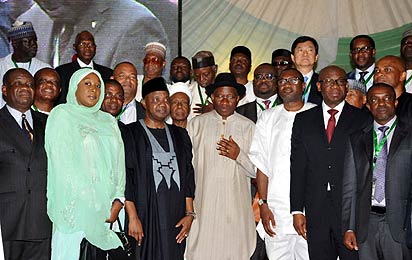
File: Jonathan, Sambo and new PHCN owners
The power sector has been stagnant for 30 years due to the absence of investment to meet surging demands. But there are indications that happy days are here at last. CHARLES KUMOLU reports.
DESPITE the fact that Mr. Debo Ademoyegun resides in a state that does not largely feel the heat of the failure of Nigeria’s power sector, his interest about the formal handover of the unbundled Power Holding Company of Nigeria, PHCN, to private organisations, would amaze anyone.
His reasons are simple. As one of the numerous taxi drivers of Yoruba descent in Bayelsa State, he told Vanguard Features recently in Yenagoa that power supply had never been in short supply in the state, even-though he sleeps only a few hours in his house due to the demands of his job. As far as the Osun State-born father of two is concerned, the formal handover of PHCN, which he claimed to have read in the newspapers earlier that day, was a sign of better days to come in Nigeria.
‘’This thing will help the whole country. We in Bayelsa don’t suffer the power problem like other parts of the country, but I am sure the whole nation will benefit from it. That was what they did with telephone (NITEL),’’ he said.
Ademoyegun’s claims on the relative stability of power supply in Bayelsa State, could also be supported by a 2010 report which stated that the state government had been able to ensure 17 hours of uninterrupted power supply per day from electricity generated from its gas turbine station. This encounter with Ademoyegun underscored the feeling of the populace across the country regarding the final privatisation of the sector.
Move might ensure stable electricity
Though, aggrieved PHCN workers had kicked against the hand over of share certificate and licenses to 15 new owners of PHCN assets, alleging that they had not been paid their terminal benefits, Vanguard Features,VF, investigations showed that apart from the angry workers , many Nigerians are optimistic that the move would guarantee stable electricity supply.
‘’If properly handled the move would be a good one, but you know how things are always inconclusive in Nigeria. I am in support of that because it would reduce the cost of production for manufacturers, who survive on diesel, and in places where things are normal the prices of manufactured goods will automatically go downwards,’’ Chief Donatus Anene, Chairman Donaplastics and Furniture, a Lagos based industry told VF.
The Chairman, Integrated Solutions, an Independent Power Company, Dr Yomie Asala, told VF that: ‘’What the government has done with PHCN, though belated, is what the nation needs now. “Although results will not come immediately because the new owners are not magicians, the fact is that Nigerians are in for an improved and reliable power generation and distribution. What is required for the success of this move is for everyone to play his role to enure its success because the consumer, regulator,DISCOS and GENCO’s have roles to play. Sure the nation will not be at this stage next year,’’ he assured.

President Jonathan , VP Sambo during the handing over of PHCN successors companies to investors in Abuja,.
Generation capacity of 20,000mw by 2018
Asala is not alone in his optimism about the development. The Bureau of Public Enterprises, BPE, is confident that the successful privatisation of the sector would increase the country’s electricity generation capacity to 20,000mw by 2018
The BPE boss, Mr. Benjamin Dikki, made the power generation projection when members of the House of Representatives Committee on Power paid an oversight visit to the Bureau recently in Abuja.
Represented by Kashim Ibrahim, who received the visiting committee members, Dikki said the target would be possible with private sector investment and managerial skills that would be injected into the sector by the buyers of the successor companies.
Private operators
Lending his voice, Chairman, Nigerian Electricity Regulatory Commission Dr. Bethel Amadi said: ‘’The reason private operators are coming to Nigeria is to improve power supply because Nigerian people have complained a lot about the sector. So private operators have invested a lot to improve the sector. I strongly believe that it is a fair bargain as far as Nigerians get better services at a fair price. People are yearning for adequate power supply, they want quality service with a fair pricing. They don’t want to be exploited by estimated billing.’’
Further checks on what to expect from this transition to private sector-driven power sector, showed that apart from stability in generation and supply, there would be an upsurge in revenue generation.
This increase in revenue is expected to come from the metering of many households and businesses which hitherto did not have meters. Industry experts opine that the revenue that would be generated from the sector, might surpass the one from the telecommunications industry.
‘’We are all living witnesses to the NITEL privatisation and today telephone is owned by every strata of the society. So, with commitment on the part of relevant stakeholders, the sector might even be next to oil and gas in terms of revenue generation. Nigeria is a big market and the coming of the private sector would bring back industries that had earlier closed down or relocated because of power failure. If you know what the alternative power sector market is worth, you will know that the nation is a big market,‘’ Cobhams Anefiok, an Engineer and Executive Director Linkline Energy told VF.
N620 billion to N1 trillion in 2016
Strengthening Anefiok’s position on the financial potentials of the country’s power sector, a 2012 report titled:”Transforming The Nigerian Power Sector – Thoughts On The Roadmap for Power Sector Reform” , observed that the “alternative power market is a large one, worth about $10 billion dollars per annum, if the power sector plan were to be successful, this market will disappear.
‘’If the North commits to generating 10,000 MW to 20,000 MW using Nuclear Energy, this will yield revenues of about $13 – $26 billion per annum, and net profits of about $11 – 22 billion per year,’’ the report further explained.
Similarly, NERC, reportedly said the country’s electricity market at the moment is doing N500 billion per annum, which translates to about N40 billion to N45 billion monthly. Hence, it predicted that the nation’s electricity market would grow from the current value of N620 billion to over N1 trillion in 2016.
Unresolved labour matters
However, some are scared that few unresolved labour issues might constitute a challenge to the new investors. But Anefiok does not consider that a threat. ‘’The Federal Government has already expressed its determination to complete payment to PHCN workers. So the fears should not arise,’’ he said
VF recalls that after months of planning, President Goodluck Jonathan, a few days ago, formally handed over the unbundled PHCN to private organisations that bought it. The President handed over the power companies amidst protest nationwide by PHCN workers over unresolved labour issues
Share certificates
The President who personally gave out the licenses and share certificates to the investors at the Aso Rock Villa told the new owners that liabilities of PHCN had been pooled together to be managed by Nigerian Electricity Liability Company, NELMCO.
His words: “Arrangements are also on-going to ensure that NELMCO is adequately funded, to assume liabilities associated with the privatisation of the PHCN successor companies, as well as other related liabilities. Various options are being explored for funding the TCN, so that it is able to implement projects that are key to stabilising and expanding the transmission grid.”
Five generating companies and 10 distribution companies received share certificates from President Jonathan who also promised that the physical hand over of the assets would be undertaken at the end of this month.
President Jonathan said the successful hand-over of the companies underscored the transparent manner the process was conducted as acknowledged by both local and foreign investors.
“Going forward, this administration is committed to providing all elements necessary for our private sector partners to succeed in providing Nigerians with uninterrupted power supply. To start with, the Nigeria Bulk Electricity Trading Company, NBET, the off-taker, has been provided with a capitalisation of over $750 million, positioning it to carry out its mandate without financial constraints,” he added.
Meanwhile, the Minister of Power, Prof. Chinedu Nebo has assured that the Federal Government would complete the payment of severance allowance of PHCN workers before the end of this month.
The Minister who has received accolades on his thorough and professional supervision of the privatisation programme, spoke at the thanksgiving service of Nsukka Anglican Diocese marking the end of its 2013 Synod in Nsukka.
“Government is working hard to ensure that all staff of PHCN are settled before the end of October. For now what government has given the companies that acquired PCNC are licenses and share certificates. The physical handover of PHCN will take place in some weeks to come,” he said.
The Minister said that the administration of President Goodluck Jonathan had invested much and was committed to ensuring that Nigerians enjoyed steady power supply.
“By God’s special grace, by the next six months, there will be double in the country’s generation capacity and by the end of 2014 the amount of megawatts generated will be fully transmitted. I must tell Nigerians that there are better days ahead as the country will witness great improvement in power the sector,” he said.
Disclaimer
Comments expressed here do not reflect the opinions of Vanguard newspapers or any employee thereof.