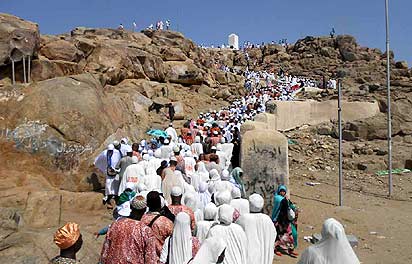
*Ogun Pilgrims at Mount Jabalithaor one of the holy sites in Makkah
By Harun Razaq
One of the most virtuous days in Islam is the first ten days of Dhul Hijjah (the 12th and last month of the Islamic calendar). The importance of these blessed days is based on the following:
(1) Allah swears an oath by these blessed days, which underlines their importance and the great benefits they contain. Allah says in Suratul Fajr: “By the dawn, by the ten nights”, (Q89:1-2). Ibn Abbas, Ibn al-Zubayr, Mujaahid and others of the earlier and later generations said that this refers to the first ten days of Dhu’l-Hijjah. Ibn Katheer said: “This is the correct opinion.” (Tafseer Ibn Katheer, 8/413)
(2) Ibn ‘Abbaas (RA) reported that the Prophet (SAW) said: “There are no days in which righteous deeds are more beloved to Allah than these ten days.” The people asked, “Not even jihaad for the sake of Allah?” He said, “Not even jihaad for the sake of Allah, except in the case of a man who went out to fight giving himself and his wealth up for the cause, and came back with nothing.” (Bukhaari, 2/457).
(3) These ten days occurred in the month of Dhul Hijjah, one of the four sacred months in Islam mention in Qur’an 9 verses 36.

*Ogun Pilgrims at Mount Jabalithaor one of the holy sites in Makkah
(4) These ten days include: the days of Hajj, the Day of ‘Arafaah, the greatest day of the entire year on which Allah perfected His Religion, Yawm al-Nahar (the Day of Sacrifice) etc.
DO’S OF THE DAYS: Among the good deeds that a Muslim is expected to do during these ten days are:
(1) Performing Hajj and Umrah in line with the commandment of Allah, Sunnah of Prophet Muhammad (SAW) and agreed by all Muslim.
(2) Fasting on some of these blessed days is established from the sunnah, more importantly, it is desirable to fast on the day of Arafah (with exception of Hujjaj). The prophet (SAW) said “fasting the day of Arafah expiates the sins of two years” (Muslim).
(3) Zikr (remembrance) of Allah, Ibn Abbas (RA) says concerning ayah “Remember Allah during the well known days” (Q2:203) that it refers to the first ten days of Dhul Hijjah (Bukhari). The prophet (SAW) is reported to have said …say tahlil (lailaha illa llahu), takbir (Allahu akbar) and tahmid (Alhamdu li llah) a lot (on these days).
Act of worship
And to say it loudly in the mosque, the home, the street and every place that is permitted to remember Allah and mention His name out loud, as an act of worship and as a proclamation of the greatness of Allah. Men should recite these phrases out loud, and women should recite them quietly.
Takbeer at this time is an aspect of the Sunnah that has been forgotten, so much so that one hardly ever hears Takbeer, except from a few people when going to eid ground. Where as this Takbeer should be pronounced from the first of Dhul Hijjah loudly, in order to revive the Sunnah and as a reminder to the negligent. There is sound evidence that Ibn ‘Umar and Abu Hurayrah (RA) used to go out in the marketplace during the first ten days of Dhu’l-Hijjah, reciting Takbeer, and the people would recite Takbeer when they heard them. (Fiqhu Sunnah 1/245) Shykh Salih Munajid said: “the idea behind reminding the people to recite Takbeer is that each one should recite it individually, not in unison, as there is no basis in Shari’ah for doing this”.
(3) Offering a high quality animal in sacrifice on the day of ‘eid. (4) Performing salat ‘id (‘eid -l -adha) with all the etiquettes attached to it.
(5) To occupy oneself with doing a lot of good deeds in general. For example to engage in act of worship such as salat, Qur’an, dhikr, du’a, sadaqah, ta’liim, honouring the parents, enjoining what is good, forbidding evil etc. at its appropriate time are highly encourage during these days.
DON’T’S OF THE DAYS: (1) It is forbidden for a person who wants to offer sacrifice to remove or cut his/her hair or nails from the first of these days till he/she offer his sacrifice on the day of ‘id. According to the Hadith that says: “When you see the new moon of Dhu’l-Hijjah, if any one of you wants to offer a sacrifice, then he should stop cutting his hair and nails until he has offered his sacrifice.” According to another report he said: “He should not remove (literally, touch) anything from his hair or skin.” (Muslim with four isnaads, 13/146)
(2) Also forbidden is using ram meant for sacrifice to fight another ram, playing and listening to music which is often associated with alcohol, committing zina, missing salat ‘id, and other salat under the guise of ‘id celebration. And all others act of sin.
Disclaimer
Comments expressed here do not reflect the opinions of Vanguard newspapers or any employee thereof.