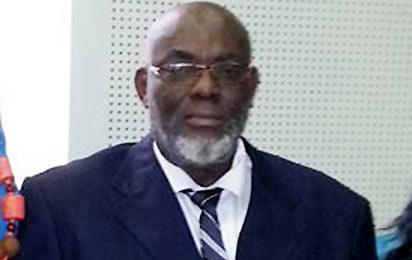
*Ebo
By EBELE ORAKPO
Mr. Nnamdi Ebo is a political scientist, public affairs analyst, author of Legal method and a scholar in legal literature and politics. Ebo recently launched a new book, There was a Time, a civil war memoir in Abuja. A book many felt he must have been inspired by Professor Chinua Achebe’s There was a Country which he said was just a coincidence because he had thought of the title eight years before Achebe came out with There was a Country in 2012. In this chat, Ebo speaks on what inspired him to write the book and many other issues. Excerpts:
Why did you feel the need to rekindle old painful memories:
“I was 11 years old in 1967. I was in Nigeria during the public proclamation. I was suddenly told I was no more a Nigerian boy but a Biafran boy. I did not understand it so I consulted two of my uncles who are now late. I said to one; ‘Uncle, they said we are now Biafrans? He said yes and walked away. Let me be honest, later I knew what it took to be a Biafran. Being a Biafran came with suffering, running from air raids, sleeping in bunkers.

*Ebo
I saw children emaciated, suffering from what later was called kwashiorkor and all the other experiences I had; domiciliation was a problem, you are domiciled in a village for a week, the next week, you are moving to another village. The country was shrinking badly and the shrinking came with so many hardships. I stopped going to school. So with all these, I knew something was not quite right.
Then, three and a half years later, there was a handshake in Lagos, there was breaking of kola nut and a hug; after that, they told us we are now Nigerians. Suddenly, I turned from a Biafran boy to a Nigerian boy; all these transformations were without my permission. So I knew I will tell the story someday, I did not know how but when I grew up, I decided to put it on paper and that is what we have today as There was a time.”
How could you have gained a good grasp of the civil war as an 11-year-old?
I had two uncles who were employed by strategic arms of the Biafran government. One was in broadcasting and there are two institutions without which the rebellion would have collapsed may be two weeks into the whole thing. The Broadcasting Corporation of Biafra was a strategic institution, the Uli Airport was another strategic institution because Biafra had been encircled, it was then an enclave so you found a situation where one was in broadcasting and each time he came home, he had stories to tell.
The other uncle was in Biafran Organisation of Freedom Fighters (BOFF) so with these two, I got to know quite a lot of things that happened and news were everywhere. The radio was there. So when I grew up, I got into the University of Nigeria, Nsukka, and started gathering my information to buttress what I experienced as a boy and that was how the reminisces came.
What do we need to do to avoid a reoccurrence of this type of war in future?
The truth is that some of the things that led to the war are still around. Things like corruption. That was what occurred in the 60s and one of the things that triggered the mayhem. There was corruption, tribalism, ethnicity, unhealthy regional rivalries which had been transformed to statesm, zonal rivalries; zones now struggle to use this candidate and that candidate and nobody is talking about merit. So these are the issues.
I don’t think a lot of Nigerians have learnt from the civil war. We pray that Nigerians will see reason so that it doesn’t repeat again because no country can survive two civil wars. I learnt a lot from that war. It was the only war that we had refugees that did not spill into neighbouring countries. It was a war that ended amicably. There was no armistice, so to say.
It was a war between brothers and the way Gen. Yakubu Gowon (Rtd) handled the surrender is something to be emulated. He did not give medals to the soldiers. Nigerians should try and learn from that war but there are a lot of people around now who do not remember the war. I think one of the reasons why people should read my book is to learn about the carnage, the suffering and all the accompaniments of a conflict. It is not the best.
Disclaimer
Comments expressed here do not reflect the opinions of Vanguard newspapers or any employee thereof.