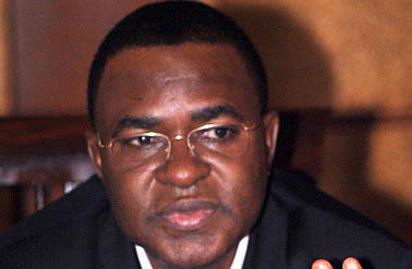
*Gov. Isa Yuguda
By Dele Sobowale
“The Forum of Commissioners of Finance from the 36 states led by the Chairman, Mr Timothy Odaah, had expressed anger over the unpaid arrears amounting to about N160bn($1bn)”. PUNCH 19, 2013.
Nigerians, for reasons difficult to understand, seem to be totally uninterested in the most important issues affecting their lives; one such is monthly revenue allocation to states. For the last one week, while the focus had been on politics, NGF, PDP etc, the Finance Commissioners of the 36 states had been in a tug of war with the Federal government; which owes them, collectively, about N160 billion.
Where true fiscal federalism exists, the problem should not have arisen at all. The states would have been collecting their own revenue; they would have been empowered by the constitution to take their own share s of the income generated and to send the balance to the centre. But, this is Nigeria; and, here, the Federal government collects the funds first and sends the states their shares – after keeping the whole lot for some time. Now, the Federal government is holding, for too long to N160 billion which should have been given to the states a long time ago.
There are two issues at stake in this dispute. Apart from the lack opf fioscal federalism, already mentioned above, there had been a steady decline in the crude oil revenue – which had constituted the major revenue earner for Nigeria since the 1970s.
Today, Nigeria is exporting, officially that is, only about 68% of the crude oil projected in the 2013 budget – which now in looking more like a mission impossible. Globally, most nations are experiencing weakening economic growth, especially China and the BRICS (Brazil, Russia, India, China and South Africa) – which had provided most of the global growth in the last twelve years. The developing nations which are growing faster than the advanced economies have not developed into consumers of Nigeria’s crude oil.
To add to our short-term woes, the United States, which even now, remains our biggest customer, has started exporting shale oil and increasing its domestic production of crude. Low demand from the US and other customers would ordinarily have resulted in a decline in crude oil revenue. Unfortunately, there are other problems.
Crude oil theft and vandalism have also contributed to lower revenue. The Federal government is faced with multiple problems with regard to vandalism. Pipe-line vandalism not only deprives the country of funds, it creates problems of environmental pollution which the nation must pay heavily to mitigate as well as security problems which claim funds and lives.
Altogether, the Federal government is in a tight corner which will call for the understanding and patience of the 36 states. The reason is not hard to discover; the Federal government itself is experiencing deep financial problems. As the Minister of State for Finance said, “We had shortages in revenue; so, the amount that we had statutorily reduced for the three tiers of government including the Federal Government”. What, Dr Yerima Ngama deliberately omitted is the fact that the revenue shortages will last for quite a while; may be, they will get worse.
What all these add up to is a long period of problems between the Federal and the states. Perhaps, no state government will receive anywhere near what was expected in January of this year. Unfortunately, few states have managed to mobilize the Internally Generated Revenue, IGR, to offset the short-fall from the Federal government.
Already, a number of states are already feeling the heat from their teachers who are demanding for the implementation of agreements reached with them at a time when few people could have foreseen the current shortfall in crude oil revenue. Teachers are not the only states employees who might be protesting unpaid salaries very soon. The unpaid arrears might soon affect other staff whose salaries might be delayed from now on.
Realising the seriousness of the problem, the Federal government had established a re-conciliation committee to resolve some of the issues involved. The committee, headed by Governor Isa Yuguda of Bauchi State, a former Managing Director of a bank, would ordinarily be expected to receive the support of the governors of other states. However, the recent break-up of the Nigeria Governors’ Forum could mean that Yuguda might fail to receive the co-operation from some of his colleagues which is vital for the reconciliation process to succeed.
Among the collateral damages which we can expect from the current situation is a halt to further allocation of funds to the Sovereign Wealth Fund, SWF, which involves saving some of the excess crude revenue against any future drastic drop in crude oil income.
While, the price of crude continues to exceed the benchmark of $75 per barrel, the aggregate revenue falls far short of the projections. Right now, Nigeria’s crude sells at over $102 per barrel; that is 33% over the benchmark. But, shipments are down more than 36%.
Left to the Minister of Finance, Dr Ngozi Okonjo-Iweala, the nation should still set aside some money to grow the SWF. At the moment, most governors are unlikely to support further investment in SWF; if not because the funds are needed to implement their own plans, but, perhaps, because some no longer regard Yuguda as a colleague.
The real question is: what can Nigerians expect from now on? The answer is not going to be pleasant, but, it is the truth. Unfortunately, it is the sort of truth which governments don’t like to tell. As the global economy slows down and as the US pumps more of its own oil, in addition to more oil production by other oil producers, the “shortages in revenue”, to which the Minister of State for Finance referred, will continue right through 2013.
The 2013 budget, over which the Executive branch and the National Assembly, NASS, are already trading blames, is already a failed budget. The NASS adamantly refuses to re-visit it and the Presidency says it cannot be implemented as it is. The truth is, whether revised or not, the sharp drop in crude exports, and the failure to develop other sources of revenue have combined to render the 2013 appropriation bill a dead letter.
Neither the Federal government, nor the 36 states nor the local governments will get what they expected from the Federation Account this year. For states which depend largely on Federal allocations, the time for belt-tightening has come.
The states’ commissioners of finance might angrily walk out of meetings with the Federal government. But, they will receive less money anyway.
BI-COURTNEY; COME BACK PLEASE; WE NEED YOU Nigerians, especially frequent users of the Lagos/Ibadan Expressway, can remember late last year when the Federal Minister of Works, told the nation that the Federal government had terminated the contract with Bi-Courtney and had “re-awarded” the contract to Julius Berger and RCC. Sure enough, within days, we saw crews of workers repairing the road. We were even told the entire road will be made motorable by Christmas. It was not to be.
First, there was no contract with Julius Berger. Only some portions of the road were repaired and now the death traps are back; it is now worse than when Bi-Courtney was in charge. Will the Minister of Works join us to beg Bi-Courtney to come back?
Disclaimer
Comments expressed here do not reflect the opinions of Vanguard newspapers or any employee thereof.