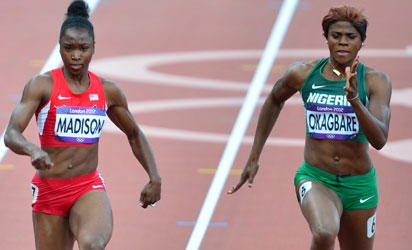
US’ Tianna Madison (L) and Nigeria’s Blessing Okagbare compete in the women’s 100m heats at the athletics event during the London 2012 Olympic Games on August 3, 2012 in London. AFP PHOTO
By LAJU ARENYEKA
Experts have attributed Nigeria’s poor performance in the London 2012 Olympics to the dearth of sports education in the country. It would be recalled that out of 214 nations that competed in various Olympic events, Nigeria was one of the 84 countries that did not receive any medal.
Hon. Daniel Ighali is a Nigerian-born wrestler who won the Olympic gold medal for Canada in 1998. When asked to comment on sports education in Nigeria, Ighali replied: “Is there really such a thing as sports education in Nigeria? If there is, I didn’t know about it.
“The age group set up is not here at all. In Canada for example, sports recruits are chosen from primary six at the age of 12. But training begins much younger than that, my son is six, and he has already started training. In sports like gymnastics, swimming and golf, techniques are taught from ages 2 or 3.”
According to Prof. Michael Mgbor of the Department of Human Kinetics & Health Education, University of Benin, “The reason why we have not done well in sports is because we have performed poorly in the school sports programme, and that is the very foundation of sports in any country. Sports are as important as academics and the ideal thing is that as students are going through the academic programme, they should also go through the programme of sports.”
Mr. Adeyemi Phillips, a past director of sports and physical development for the University of Lagos had this to say: “In many advanced countries, provision is made for athletes to carry on with athletics as well as with their academic programmes. Many of those students have access to scholarships on the platform of sports.

US’ Tianna Madison (L) and Nigeria’s Blessing Okagbare compete in the women’s 100m heats at the athletics event during the London 2012 Olympic Games on August 3, 2012 in London. AFP PHOTO
“But here, students have to choose between the two. I was a student in the United States and at the same time an athlete. During summer, I also had a job so money was not a problem. But it isn’t that way here, Nigerian athletes have always tried to put in extra effort but it just seems that this time, their efforts weren’t good enough.”
In a recent report, President Goodluck Jonathan was quoted to have said the following while commenting on the country’s poor performance in the London 2012 Olympics: “How can we possibly go to the Olympics and come back with nothing?,” he asked rhetorically.
“Four years ago, we did better. It is something that we have to address. Nigeria is a country of talented people. We must identify those talents all over Nigeria, and begin to train them for the next major sporting tournament. This idea of starting preparations at the last minute and achieving nothing must stop.
“We must get the private sector to invest in sports and governments at all levels must also do their bit. We are a country of gifted people. We must identify those areas in which this country can excel and work hard at them. We must win medals and bring glory to our nation.”
However, sports experts have argued that preparing children for a lifetime of training will achieve more success than simply preparing people for the “next major sporting tournament.” The 15-year-old Chinese gymnast who won the gold medal was taken away from her family at a young age, and underwent rigorous training away from family interference. It was after the Olympics that she was told that her grandmother had died, and that her mother had cancer.
Hon. Ighali, who led the country’s wrestling team to the last Olympics, said: “We don’t have such a system where talent is identified at a young age, such talented people are taught the basics, then move from the esquire level, to the cadet level, to the junior level and then advance from there. As it is in this country, if a child is talented in sports at a very young age, and his parents are not financially buoyant to train him, such talent will die. We should have a system here where students can continue in the area they are good at.”
It is, therefore, no wonder that many athletes have to seek training and citizenship in developed countries. Adeyemi opined that “the reason why Nigerians have done well in basket ball in the past is because many of our basketball players had scholarships from the United States, and spent time playing college basketball there.”
According to sports academician, Prof. Mgbor, “Sportsmen are supposed to be trained from a very young age; that is how it is in developing countries. It is quite ironic that a country that has over 160 million people and is also rich in material resources is lagging behind in such an area. Management is the problem. We cannot do well because we are not building people that will represent us in the future. We are only recycling the old.”
Mgbor continued, “I nearly shed tears every time I pass through the secondary school I finished from, there are no sports facilities. It is just a field that has been there since 1958. Except from a few of these elitist schools, many of these schools are a shadow of themselves in the area of sports.”
Disclaimer
Comments expressed here do not reflect the opinions of Vanguard newspapers or any employee thereof.