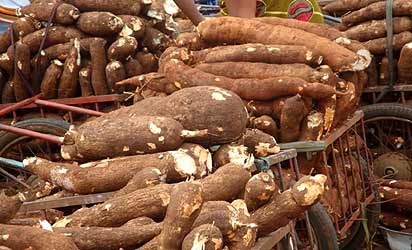
File photo: cassava tubers
By Dele Sobowale
“0810-0623558
On rubber. I am Dutch, but if I do not control myself, I will cry everyday over Nigeria’s paradise lost. Rgds Capt Addo Roosa.”
I want to extend my greatest gratitude to Captain Roosa for caring about Nigeria more than our leaders apparently do. I don’t cry over rubber because it represents several opportunities lost in this country. In my short span of life, I have been closely associated with at least four crops – two food and two cash crops – which if grown to the limit of our collective abilities could make our squabble over crude oil revenue disappear.
These are: rubber, cashew, rice and sorghum. But farmers engaged in growing cassava, yams and maize, close by the farms with which I was involved, have provided me with a glimpse of what an agricultural paradise Nigeria can be.
Perhaps, the first notion anyone really interested in agriculture, and that should include our presidents, governors, ministers (agriculture, water resources, works, transport, finance and power etc), the central bank governor and the research institutes is that farming is not a neat job; it is not a desk job and it is certainly not theoretical.
It is “dirty”, difficult, sometimes frustrating; but, in the end, thoroughly rewarding. The success of the nations responsible for the greatest output of food globally, rests in the fact that only a small percentage of people engage in it. Generally, they are people who really love the work and will do nothing else.
I left farming and rice milling in 1990 when I became head of an extended family at 46 with virtually all the family estates in Lagos. There was no way I could handle the God-given task from Sokoto. Otherwise, I was ready to spend years in the north to help achieve the goal of making Nigeria self-sufficient in rice production.
Then, I had no other idea. I just wanted to be a rice producer. The notion of everybody who has nothing to do should go into farming will not work. We might as well order everybody unemployed to go and become a musician or footballer. Only a few dedicated Nigerians can turn around our fortunes in agriculture. Our task is to find them.
Given that as background,a product like rubber calls for even more dedication because the farmer has to endure a long period between planting the first seeds and harvesting the first output of raw rubber. Meanwhile, a lot of things could go wrong along the way.
At this point, let me sketch for all of us the growth cycle of rubber and, in a third part of this series, the sort of interventions governments, banks, research institutes, farm extension workers etc, can provide will be discussed.
Rubber from seed to raw rubber: For the purpose of this part, we will assume a 100 hectare farm already cleared and ready to be cultivated. A virgin forest will require more time and planting time will depend on how fast the clearing can be done.
Ideally, 555 stands of rubber can grow on one hectare meaning 5,550 plants from the nursery. Meanwhile, 70,000 plants can be grown in one hectare of nursery. So, the 100 hectare farm will absorb 55,500 if they all germinate. But, there is a catch, fortunately, not a big obstacle.
Seeds must be gathered in September when the pods on mature trees are exploding. They are then planted on seed beds. Within 14 days, 20 per cent of what was planted will sprout vigorously. These will then be transplanted to the nursery where they will stay for 15 to 18 months. Here again, two snags are experienced and any error at this stage can result in the loss of the whole stock of nursery plants or low yield later on.
The plants from the nursery must be transferred to the farm in April-May, not later. Second, the plants cannot be transplanted without first procuring the number of “budding woods” required to speed them on their way. Michelin, at the moment, is the major supplier of budding woods and that extent is a limiting factor to the effort to increase the output of rubber in Nigeria.
Another supplier is at Akwete, Abia State; but Michelin remains the preferred supplier – for obvious reasons. But, as usual, this is not a total limitation, production of budding woods can be increased and, if not, they can be imported. About 80 per cent success is recorded from budding; so in order to get 55,500 trees on the farm, the farmer must start with at least 80,000 plants from the nursery.
For maximum yield, the farmer must also procure ethereal, a chemical also used to improve the yield of pineapples and citrus fruits. The substitute for ethereal is calcium carbide but that chemical can hurt the plant. Swiss Pharmaceuticals used to be a big supplier of ethereal but there is acute scarcity of it now; perhaps because expected increased cultivation of rubber had failed to occur.
There are one or two other minor obstacles to consider; but those need not delay us here. The most important thing at this stage is to observe that from the time seeds are gathered and planted and the time the plant starts yielding, a total of seven (7) years would elapse.
If there is one thing governments and the banks have been doing to discourage rubber cultivation the most, it is denying credit to cover the full cycle of the seed to plant of the rubber plantation. Credit is seldom available to the farmer, and when it is, the banks do not lend for more than five years – at most. Most often, the credit is for a shorter tenure and at interest rates of 25 per cent or more. No other rubber-producing country in the world punishes its rubber producer that way.
We still have a chance to get on the “rubber boat”; for many reasons which constitute our comparative advantages. First, Nigeria still has vast areas of land which have not been cultivated in the southern and middle belt regions. Second, we have abundant labor to do the work required for success. Third, we experience long and heavy rain during the season and rubber loves rain. What we seem to lack is the will, the plan and the determination to succeed and earn the huge bonanza rubber offers.
The third part of this series will focus on what we need to do to participate andperhaps eventually lead in rubber production worldwide.
Disclaimer
Comments expressed here do not reflect the opinions of Vanguard newspapers or any employee thereof.