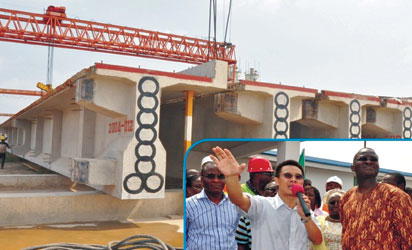
File Photo: On-going structure at the new rail line. INSET: Gov. Fashola being briefed by contractors at construction site
By Mike Ebonugwo
TRAFFIC congestion is one problem that has defied all the measures applied by successive administrations in Lagos. It was a problem that the Babatunde Fashola-led government also inherited and had at inception tackled by first addressing the prevailing transportation challenges in the state.
Long before the Fashola administration came into office, Lagosians were resignedly content with making the best out of the poor transportation options available, especially in terms of the rickety molue and danfo buses as well as the Okada and Keke(or Marwa) commercial vehicles operated by individuals who appeared in most cases to be on a suicide mission.
Model mega-city
The situation was hardly in line with the government’s envisaged and indeed much advertised vision of building a “New Lagos” and transforming the city into Africa’s model mega-city. The desire to change this unenviable situation gave birth to the Lagos Metropolitan Area Transport Authority, LAMATA, which in turn delivered the Bus Rapid Transit, BRT, Scheme, that today has provided Lagosians access to a decent, more comfortable bus transport system that guarantees faster travel time.
Buses operating under the auspices of the scheme are now familiar features on the Mile 12 to Lagos Island through the Ikorodu Road route. The presence of the scheme is also being felt in other parts of the metropolis with the result that passenger traffic on these buses is said to be presently in excess of 200,000 per working day.
The success of the scheme is believed to have been aided to a large extent by several road rehabilitation projects which have been executed and the on-going expansion of the 49.5km Lekki-Epe Expressway and the 60km Lagos-Badagry Expressway.
But the question remains: Is the success of the BRT enough to effectively address what has become the intractable problem of traffic congestion which has been a source of trauma to road users in Lagos. Many observers do not think so. And if recent indications are anything to go by, the state government is well aware that the battle to tame the traffic congestion monster is far from being over.
And this obviously explains why LAMATA is said to have developed a Rail Master Plan, complete with an extensive network of rail lines connecting most parts of the Lagos metropolis. Like the BRT Scheme, the urban rail system will, according to officials, be implemented through a Public Private Partnership scheme, PPP.
While conducting an on-the-spot assessment of the construction work done on the project from Orile to Mile 2 recently, an obviously impressed Governor Fashola said given the pace at which the contractors, China Civil Engineering Construction Corporation, CCECC, is moving with the work, the first seven kilometres of the Blue Line of the Light Rail Project will be delivered before the end 2012.

On-going structure at the new rail line. INSET: Gov. Fashola being briefed by contractors at construction site
He also assured that barring paucity of funds, the project would be delivered within the stipulated time, as 90 per cent of the structural work was already completed.
Significantly, the rehabilitation of the railway system includes track spot renewal of Lagos to Kano and Maiduguri to Port-Harcourt, supply of 25 new locomotive engines from Brazil South America to boost the existing motive power base of the corporation, upgrading of the signaling and telecommunication system from manual to semi automatic, as well as rehabilitation of carriage and wagon workshops, re-equipping the workshops, supply of service support (spare part consumables), strategic re-branding of the corporation, rehabilitation of stations and marshalling yards.
Rapid rail transit
It will be recalled that the idea of developing rapid rail transit in Lagos was mooted in the 1980s by the administration of Alhaji Lateef Jakande which conceived a metroline project for Lagos. Unfortunately the idea was aborted following the military overthrow of the Second Republic civilian administration and the enthronement of a military regime by General Muhammadu Buhari.
Since then, the dream of Lagos joining the league of mega-cities in the world with a rail-based mass transit, RBMT, system has remained in abeyance. That was until LAMATA came up with the framework for a rail mass transit system which would provide passenger rail services on the most heavily travelled corridors in Lagos.
Both the Red Line and the Blue Line which are the first to come on stream, will, according to officials, be developed on a PPP basis, with the Lagos State Government providing all rail and station infrastructure. On its own part, the concessionaire will procure and finance rolling stock, depot facilities as well as provide operations and maintenance over a 25-year period.
The Red Line rail system is being developed on North-South axis through some of the most densely populated areas in Lagos. Beginning on the island, the Red Line will run north to Agbado through a total of 13 stations. From the Marina to Iddo stations, the Red Line will share the alignment with the Blue Line.
The shared infrastructure in these portions will be constructed as part of the Red Line project. From Agbado to Iddo, the Red Line will utilize the existing NRC corridor. The Blue Line will run 27km from Okokomaiko to Marina, one of the most densely travelled corridors in Lagos.
Development of rail infrastructure
The rail infrastructure is being developed in conjunction with the Badagry Expressway project, a proposed toll road running from Lagos to Badagry. The Blue Line will run on an exclusive 15-metre right of way in the middle of the expressway.
In total there will be 13 stations, three that will be shared with the Red Line system. The stations will be located above the tracks, with large pedestrian walkways crossing the expressway. Large, concrete barriers will be placed between the rail lines and the expressway to ensure no external factors will disrupt service. The Blue Line system will require the construction of two bridges. The larger of the two, to be shared with the Red Line, will connect the mainland with the island. The second bridge will be across the river at Mile 2.
According to the Governor: “The Lagos Rail Mass Transit, LRMT, project will be the most multi-dimensional and most impactful efforts of the Lagos State Government at combating Lagos’ untamed traffic congestion, which has had adverse effect on the economy and the environment. On one of the sites, we have a total of 325 workers, 300 of them Nigerians and 25 Chinese.
“At the second site, where we have the terminus, you also saw another set of workers. Those people would, probably, have been idle, looking for desperate income, for which there is no work. But I am happy that we are able to put them to work and give them the opportunity to retain their dignity and use their own hands and their own skills to earn a living and feed their families.”
It is envisaged that by the time the first seven kilometres of the Blue Line would have been completed and the first five stations fully built, over 8,000 people would be employed in the course of the construction phase of the projects.
Disclaimer
Comments expressed here do not reflect the opinions of Vanguard newspapers or any employee thereof.