…How Obeka’s administration is repositioning the institution through academic expansion, infrastructure and innovation
By Peace Olanrewaju
There is a point in the life of every institution when plans and promises begin to take visible shape. For Wesley University Ondo, that point appears to be unfolding before the eyes of its students, staff, stakeholders and the wider community.
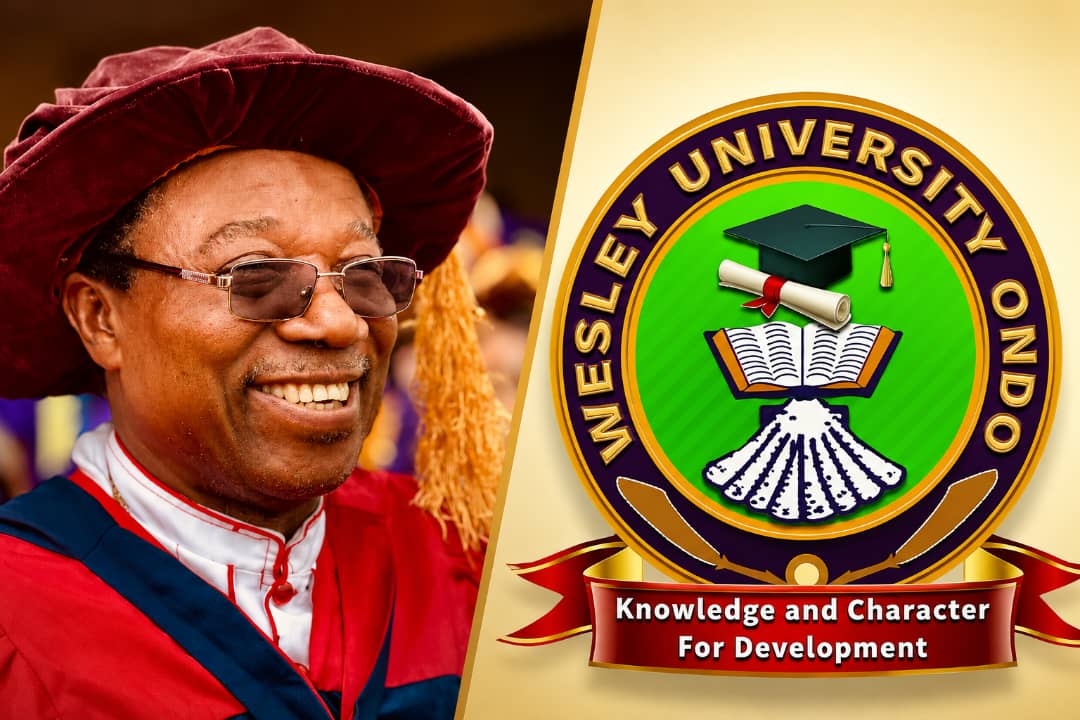
Since the assumption of office of the Vice-Chancellor, Rt. Revd. Prof. Samuel Sunday Obeka, JP, the University has embarked on a deliberate process of repositioning, with emphasis on academic expansion, infrastructure, innovation and strategic engagement.
The journey has not been without its challenges. Like many institutions, Wesley University has had to contend with financial and infrastructural demands as well as the need to attract more students and strengthen its operations. But rather than allowing these challenges to determine its future, the administration has pursued a gradual programme of institutional renewal.
One of the clearest signs of this change is in the area of academic development.
Wesley University is expanding its academic offerings to accommodate emerging areas of knowledge and the changing needs of the Nigerian economy. Its programmes now cut across health sciences, engineering, management, social sciences, computing, law and other professional disciplines.
The development in the health sciences is particularly significant. The University has programmes in Medicine and Surgery, Nursing Science, Medical Laboratory Science, Pharmacy, Optometry, Health Information Management, Radiography, Physiotherapy, Human Anatomy, Human Physiology, Community Health and Public Health, among others.
This expansion comes at a time when Nigeria continues to require more highly trained professionals in the healthcare sector. The University’s emphasis is therefore not simply on increasing the number of programmes available, but on creating opportunities for students to acquire professional knowledge and skills that can be applied to real societal needs.
The expansion also extends beyond the health sciences. Programmes such as Computer Science, Accounting, Business Administration, International Relations and Law are widening the academic choices available to prospective students.
Perhaps one of the most striking developments is the establishment of the Faculty of Engineering, scheduled to commence academic activities in September 2026.
The Faculty is expected to offer Aerospace Engineering, Biomedical Engineering, Chemical Engineering, Computer Engineering, Electrical and Electronics Engineering, Mechanical Engineering and Mechatronics Engineering.
The significance of this development goes beyond the addition of new courses to a university prospectus.
Aerospace Engineering points towards the expanding possibilities in aviation and space technology.
Biomedical Engineering brings engineering closer to healthcare. Computer Engineering, Electrical and Electronics Engineering, Mechanical Engineering, Chemical Engineering and Mechatronics Engineering all address areas that are increasingly important to Nigeria’s technological and industrial development.
For Wesley University, the expansion represents an attempt to prepare students for a future in which knowledge, technology and innovation will increasingly determine the competitiveness of individuals and nations.
Academic expansion, however, requires more than programmes and course titles. It requires facilities capable of supporting teaching, learning, practical training and research.
This is another area where the University has recorded developments. The administration has invested in classroom complexes, hostel facilities, laboratories and specialised academic buildings. The purpose-built Law Building and the University’s Anatomy Laboratory are among the facilities developed to support academic and professional training.
The transformation is also visible in the renovation of the Ecumenical Centre, which has been converted from a previously abandoned and deteriorated facility into a functional venue for major university ceremonies and gatherings.
Another important aspect of the University’s development is the growth of postgraduate education. The School of Postgraduate Studies offers opportunities leading to PGD, MBA, MPA, M.Sc., M.Phil. and Ph.D. degrees in various disciplines, further widening the University’s role in advanced learning and research.
But perhaps the most important question is what all these developments mean for the future.
A university is ultimately measured not by the number of buildings on its campus or the number of programmes on its list, but by the quality of people it produces.
For Wesley University, the ambition appears to be to produce graduates who combine academic knowledge with character, integrity and a sense of responsibility to society. That aspiration remains consistent with the identity of the University as a faith-based institution.
The transformation is therefore still a work in progress.
There are facilities and areas of development that still require attention. The University continues to need additional infrastructure, including a befitting Senate Building, expanded hostel facilities and further academic and research infrastructure.
That reality makes the present phase of Wesley University’s development more interesting. It is not a story of an institution claiming to have arrived. Rather, it is the story of an institution attempting to move deliberately in a new direction.
From the expansion of health sciences to the introduction of engineering programmes, from the strengthening of postgraduate education to the development of new facilities, the changes point to a University seeking to position itself for the demands of the future.
The real measure of this transformation will be seen in the students who are trained, the professionals who emerge, the innovations they create and the contribution they make to Nigeria and the wider world.
For Wesley University, the journey is continuing, but the direction is clear. With its expanding academic programmes, growing infrastructure and renewed focus on innovation and excellence, the University is steadily building a future that promises even greater opportunities for its students and a stronger contribution to society.
By: Peace Olanrewaju. Ag. PRO, Wesley University, Ondo.
Disclaimer
Comments expressed here do not reflect the opinions of Vanguard newspapers or any employee thereof.