By Osa Mbonu-Amadi
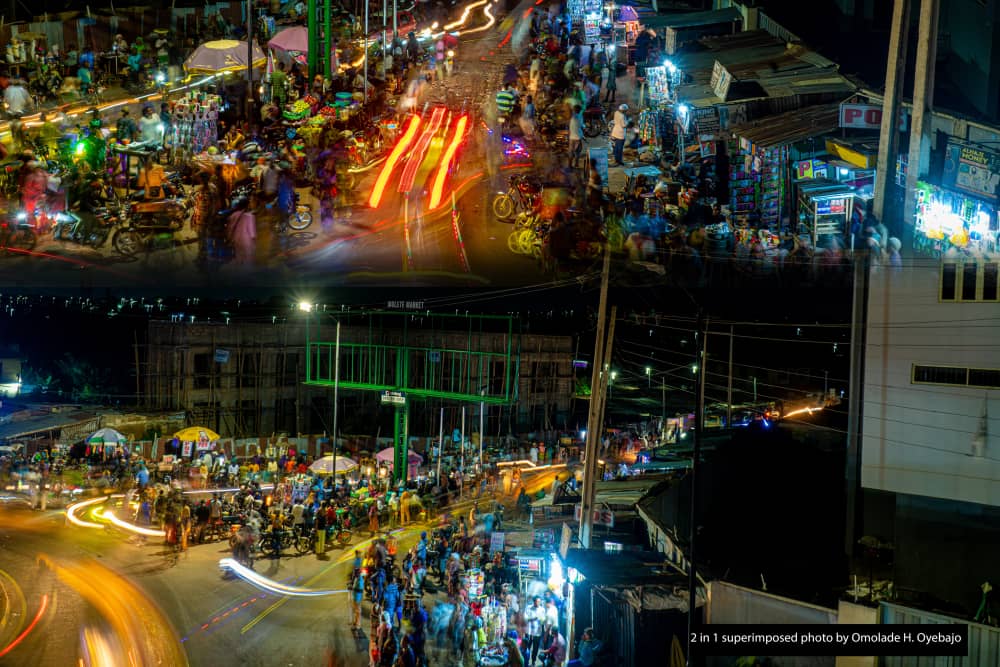
Nigerian visual artist, Omolade Hannah Oyebajo, in her work, Molete Light Trails, transforms a busy urban street into a captivating art photograph, using light as patterns for traffic, permanence, and transitions.
The series was part of a commissioned art project organised by Abulente Art and Cultural Centre, Osogbo, where Omolade, alongside other fine art photographers, explored the potentials of light in mirroring landscapes.
In this body of work, Omolade photographs the ever busy Ibadan suburb at eventide, using light trails as patterns to depict vehicular movements, commuters’ dispositions, and intersections. The resulting portrait unveils a city that is steadily on the move and never static.
In this series, Molete, a popular location in Ibadan, becomes alluring with a boisterous lifestyle, heavy traffic, and commercial activities, typically obtainable in most urban settings.
Narrating how she handled her assigned role, Omolade said, “I was more interested in exploring how to transform movement visually than in documenting Molete’s physical appearance. I investigated light as a subject matter, focusing on its effects on time, vehicular movement, and commuters’ postures.”
The artist applied what she describes as “long-exposure techniques” to capture passing vehicles and other phenomena on the frames. In doing so, she succeeded in using images to transform normal road networks into abstract compositions, reimagining the city with lines, colours and rhythm, and portraying adjoining streets as pathways of light, convergence points, and movement as forms of visual language.
Omolade’s cognate experience in art photography comes into play in the way she stylistically combines fine art, documentary, portrait, and filmmaking techniques in the visual storytelling process.
According to the artist, the photographs, drawn from light, transcend pictorial representations of vehicular traffic as they metaphorically represent “Molete in Ibadan” against the backdrop of “light trails” at eventide.
Omolade’s Molete Light Trail exemplifies a typical fine art photographic work that transforms a familiar setting into a dynamic image, highlighting memory, movement and creative abstraction, thereby triggering a visual story, embedded with messages on meditation, timing, and civilisation. Although they look similar, the pictures elaborating the storyline differ in terms of their thematic focus and emotional resonance.
The artwork is also embedded with a clear central idea which the artist transmits through a long exposure to things in motion.
To Omolade, the street is not a static subject because the passing vehicles animate it, leaving traces that could be creatively enacted on a frame to document constant movement.
Any viewer that interrogates the piece will observe that the innovative artist uses her camera to reorder reality, conceptualising a literal scene in the sphere of artistic imagery. However, her approach subjects the artwork to multifarious interpretations, implying that viewers are likely to arrive at differing and altered meanings.
Notably, a prominent feature of the collection is that the artist employs light trails to elicit both aesthetic and rhetoric effects, symbolically representing journeys and highlighting themes of the permanence of nature, transience of time, and inevitably of change.
In terms of visual language, the creative manipulates various images to create metaphorical meanings. For instance, she converts roads to lines, traffic to rhythm, and intersections to meeting places, thereby simultaneously prompting visual energy and structure that enrich the work as a coherent masterpiece.
What is more? The artist cues the viewer to interrogate the painting as an intersection between reality and imagination by repositioning Molete, a busy urban location on a frame, where the enchanting atmospheric images appear demystified and reduced to recollections of memory.
Omolade’s work focuses on life in a busy but unisolated community. By contrasting fixed landmarks and greenery, illuminated with streams of natural and artificial lights, the creative engages the viewer to uncover themes of permanence of nature and inevitably of change.
Prospective viewers can also extend the contrast to metaphorically represent transformative power of civilisation as it reveals how a traditional society is transformed into a modern city.
The never ending human and vehicular movements captured in the series suggest survival engagements of people in pursuit of ambition, commerce, and sundry activities that keep each person in their own lane. This feature is in tandem with the pattern of life in cities where everyone minds their own business, caring less for others. It also symbolically
represents a busy commercial town where people move and interact freely.
Capturing the essence and social pulse of the city with the series, the artist mirrors the interconnection between a visual environment and diverse social interactions.
Omolade’s Molete Light Trail aligns with the tradition of other works that unveil the intersection between cultural identity and civilisation in a contemporary society. Her work is largely etched in visual storytelling, recollected memory, and embodied experience.
With Molete Light Trails, the artist celebrates the beauty of a local, but evolving community. She employs technical tact and creativity to transform the rustic background through the artistic lens of her camera which she applies as a tool for capturing minute details that would ordinarily escape the natural eye.
The visual narrative portrays a nuanced package of the goings on in Molete, thereby cuing prospective viewers to observe every trail as a mark of time, each curve as a pointer to movement, and every streak as a reminder of a completed journey.
Even well-known spaces are transformed into very vibrant visual symbols where the creative uses light as brushstrokes, depicting the shape of endless motion. The work reveals that Omolade unwittingly reflects on the relationship between permanence and transience.
The enchanting piece also shows that Omolade’s commitment to education and professional advancement has earned her an admirable place among her contemporaries and requisite skills in diverse art subfields, including photojournalism, documentary, photography, and filmmaking.
Because documentation and interpretation are often interwoven in photography, Omolade effortlessly integrates these qualities in not only capturing a scene, but in engaging viewers to reimagine, and reinterpret it from new perspectives.
Using a distinct visual voice, the artist has also shown demonstrable experience across documentary, portrait, fine art photography, and filmmaking in exhibitions organised within and outside Nigeria.
Omolade has participated in group and solo art exhibitions held in Lagos, Osun, Berlin, Dubai, Gambia, Germany, Paris, Switzerland, and the UK. Her sterling work positions her as a well-exposed creative who combines skills and experience in image-making to document her observations through experimental compositions that resonate with diverse audiences across the globe.
Over the years, the artist has exhibited in the following galleries: Art X (2019), Rele (2019), Hourglass (2022), One Art (2022), Nimbus Art (2023), SOTO (2024), and Ovuomaororo (2024) in Lagos, Nigeria. She has also exhibited in Abulente, Osun State (2024).
From 2019 – 2020, the artist participated in workshops in Johannesburg, South Africa.
After participating in the 2021 “creating and sharing better images programme” organised by the Open University and Royal Photographic Society, UK, she, in 2022, attended another course on Expressive Drawing at the University of the Arts, London (UAL), UK.
Omolade evidently leverages her training in photojournalism, digital photography, and expressive drawing to create a balance between a visual narrative and dominant socio-cultural realities, leaving the viewer to reflect on the abstraction for applicable lessons.
In other words, the body of work is a product of not only artistic ingenuity, but technical discipline, experience, and attention to details employed in delineating lines, rhythm, and visual images through the compositions.
What makes Omolade’s Molete Light Trail more significant and socially relevant is that it transforms a typical urban setting to a spectacular sight for a viewing audience. Besides being visually captivating, the piece reflects conceptual coherence, capturing the artist’s vicarious experience along with that of the city dwellers. The artist conceptualises an everyday city life as a visual masterpiece that tells its own story.
Moreover, she takes the collection beyond photographic aesthetics by using abstract imagery to create emotive resonance. Masterfully, she uses the series to portray an ideal urban setting and a serene atmosphere, revealing that photography can be artistically deployed to control time, motion, and place.
Disclaimer
Comments expressed here do not reflect the opinions of Vanguard newspapers or any employee thereof.