By Ebunoluwa Sessou, Cynthia Alo and Precious Enaike
In a bid to accelerate the commercialisation of homegrown engineering solutions capable of addressing Nigeria’s development challenges, Enactus Nigeria, in partnership with the Nigerian Content Development and Monitoring Board (NCDMB), the Nigerian Society of Engineers (NSE), Renaissance Africa Energy Company, First Exploration and Petroleum Development Company (First E&P), and other stakeholders, has reaffirmed its commitment to nurturing young engineering talents and transforming innovative ideas into practical solutions for national development through the Nigerian Engineering Olympiad, NEO.
The Olympiad was conceived to bridge the gap between engineering education and industry by transforming students’ innovations into commercially viable businesses.
Speaking at the maiden edition of the competition, Country Director of Enactus Nigeria, Michael Ajayi, disclosed that 375 applications were received from universities across Nigeria, but only 12 institutions qualified for the grand finale.
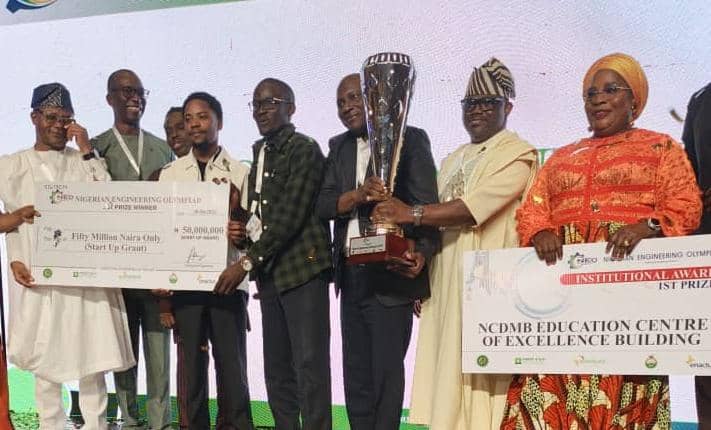
At the end of the competition, engineering students from Modibbo Adama University, Yola, Adamawa State, clinched the grand prize of N50 million and a fully furnished engineering building for their faculty with an innovation known as Ubuntu Sapphire—a community-powered rapid alert system that connects households through low-cost devices to instantly notify neighbours and emergency responders during crises.
The University of Ibadan emerged first runner-up, winning N30 million and engineering equipment worth N75 million for its faculty with Aurora Birth, a health-tech suite designed to reduce neonatal deaths resulting from birth asphyxia in low-resource settings.
The University of Jos secured third place with FarmAnchor, a solar-powered, AI-enabled device that helps smallholder farmers detect crop pests, diseases and soil deficiencies early through multispectral imaging and edge-based machine learning. The team received N20 million, alongside N50 million worth of engineering equipment for its faculty.
Ajayi said Enactus Nigeria supports forward-thinking organisations in co-creating and implementing projects that respond to real community needs through data-driven solutions, sustainability principles and entrepreneurial thinking.
“We have remained steadfast in our mission to empower young people to use entrepreneurial action to solve the world’s greatest challenges, starting with those in their immediate communities,” he said.
Delivering a keynote address on behalf of the Executive Vice Chairman and Chief Executive Officer of the National Agency for Science and Engineering Infrastructure, NASENI, Mr. Khalil Halilu, the Deputy Director of Engineering Infrastructure Department, Dr. Emmanuel Ajani said countries that dominate the global economy are not necessarily those endowed with abundant natural resources, but those that continuously innovate, commercialise research and build technology-driven industries.
He described engineering as the bridge between scientific knowledge and economic prosperity, noting that thriving manufacturing industries, efficient transportation systems, sustainable energy solutions, digital economies and modern agricultural systems are all products of engineering innovation.
Ajani lamented that although Nigerian universities produce numerous innovative research projects every year, many remain confined to laboratories and academic journals instead of becoming products that improve lives, create jobs and stimulate economic growth.
According to him, innovation is only complete when it creates value for society through commercialisation, stressing that moving from prototype to mass production remains one of the greatest challenges confronting innovators.
He announced that the top three winners of the Nigerian Engineering Olympiad would be admitted into the NASENI Innovation Hub, where they would receive mentorship, business development support, manufacturing opportunities, market access and commercialisation assistance.
Ajani added that NASENI’s innovation strategy is built around what he described as the “Three Cs” including Creation, Collaboration and Commercialisation stressing that Nigeria’s industrial transformation can only be achieved through stronger partnerships among government, academia and the private sector.
In his address, President of the Nigerian Society of Engineers, Engr. Ali Alimassuya Rabiu, FNSE, represented by former NSE President, Engr. Margaret Oguntala, FNSE, reiterated that the essence of NEO is to bridge the gap between classroom knowledge and industry practice by equipping young engineers with mentorship, exposure and entrepreneurial skills.
He commended the NCDMB, Renaissance Africa Energy Company and other partners for supporting the initiative, while also recognising lecturers, faculty mentors, judges and project coordinators for their contributions.
He challenged corporate organisations and industry stakeholders to provide sustained funding, incubation opportunities and commercial support for the innovations showcased at the Olympiad.
“This is the time to invest in our youth. Let us support these innovations beyond the competition through incubation, funding and commercialisation so they can become viable enterprises that contribute meaningfully to Nigeria’s economy,” he said.
The NSE reaffirmed its commitment to sustaining the Nigerian Engineering Olympiad as a permanent national platform for youth empowerment, engineering entrepreneurship and innovation development, urging young engineers to continue dreaming, building and innovating for the country’s future.
Also speaking, General Manager of First Exploration and Petroleum Development Company (First E&P), Mr. John Alamu, said the innovations displayed by the students have the potential to improve industrial productivity, create employment opportunities, tackle energy poverty and contribute significantly to Nigeria’s economic development.
Similarly, Vice President, Relations and Sustainable Development at Renaissance Africa Energy Company, Mr. Igo Weli, noted that some of the innovations showcased included drone technology for delivering products to remote communities and digital solutions capable of providing images and videos from inaccessible locations.
“We want to be the leading energy company in Africa, and to achieve that we need people, talent and game changers. What I have seen here today gives me confidence that Nigeria has the human capital to compete globally.
“Our challenge has never been a lack of talent but creating the right environment for innovation to thrive,” he said.
He urged participants who did not emerge winners not to be discouraged, noting that success often comes after setbacks.
Meanwhile, the Executive Secretary of NCDMB, Engr. Felix Omatsola Ogbe, FNSE, pledged the Board’s continued support for the development of Nigeria’s engineering talent through the Nigerian Engineering Olympiad.
“By sponsoring this competition, the Board is helping to build a skilled workforce that will drive Nigeria’s industrial growth for generations to come,” he said.
Disclaimer
Comments expressed here do not reflect the opinions of Vanguard newspapers or any employee thereof.