By Esther Onyegbula
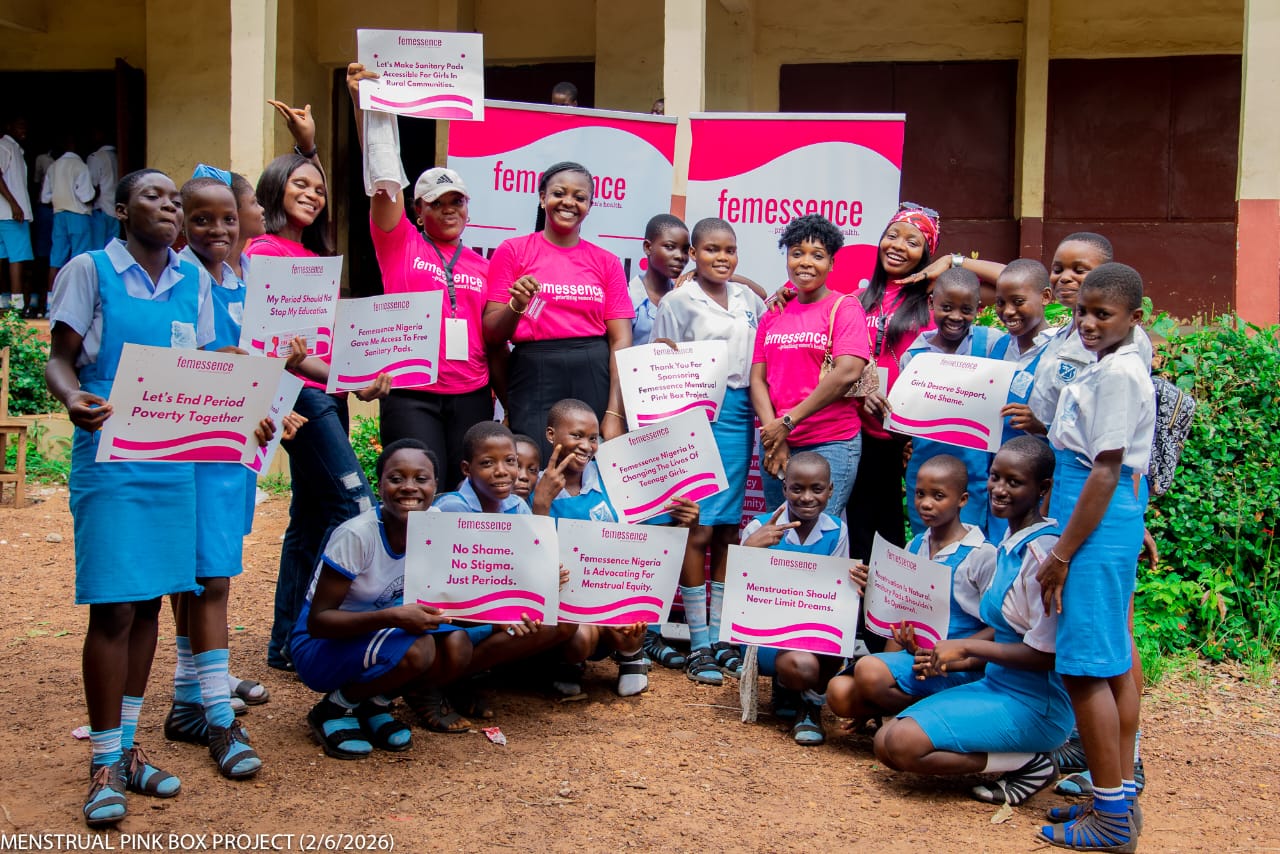
Femessence Nigeria has unveiled the Femessence Menstrual Pink Box Project, a sustainable menstrual health initiative designed to provide continuous access to sanitary products and menstrual education for schoolgirls in rural communities.
The project was unveiled at Community High Secondary School, Nsugbe, Anambra East Local Government Area of Anambra State, as part of efforts to address period poverty and promote dignity among adolescent girls.
Speaking on the inspiration behind the initiative, the Founder of Femessence Nigeria, Chioma Joy Ezechukwu, said the project was born out of her experience during her National Youth Service Corps (NYSC) in 2022, when she implemented a Community Development Service project on menstrual equity and hygiene at Asagba Secondary School, Asaba, Delta State, distributing over 150 sanitary pads to female students.
She said the experience exposed the limitations of one-off interventions and raised a critical question that eventually shaped the project.
“Over the years, many well-meaning organisations and individuals across Nigeria have supported girls by distributing sanitary pads during campaigns and awareness programmes. While this is commendable, I asked myself a fundamental question: what happens after the one-time pads finish?” she said.
Ezechukwu explained that this question led to the creation of a structured and sustainable intervention.
“This is what birthed the Femessence Menstrual Pink Box Project — a system designed to ensure that girls do not only receive sanitary pads once, but have continuous access to menstrual products and education throughout the school year,” she added.
She stressed that menstruation is a monthly biological process, noting that support systems must reflect that reality.
“Menstruation does not happen only on outreach days. It happens every month. Therefore, access to sanitary products and menstrual health education should also be continuous, not occasional,” she said.
The Femessence founder said Community High Secondary School, Nsugbe, was selected as the pilot school due to its rural setting and the readiness of the school management to support the initiative.
According to her, the school marks the beginning of a broader vision to establish sustainable menstrual support systems across rural schools in Nigeria.
Ezechukwu explained that the project goes beyond pad distribution, incorporating structured menstrual health education, monitoring, and a system designed to ensure accountability and continuity.
“At Femessence Nigeria, we are focused on improving the menstrual and hormonal health of women and girls through education, advocacy, solution-based products and community support,” she said.
She disclosed that each beneficiary is issued a “Pink Card” containing her details and a unique identification number, which serves as access to the Pink Box system within the school.
“The Pink Card ensures accountability and access. When a girl needs sanitary pads, she presents her card through the designated student representative, who then liaises with the teacher in charge to release the products,” she explained.
Ezechukwu added that Femessence representatives will conduct regular monitoring visits to schools for restocking, evaluation, and menstrual health education sessions.
“We don’t just supply products; we return to engage the girls, educate them, answer questions and gather feedback to continuously improve the programme,” she said.
She described period poverty as a widespread but underreported challenge affecting schoolgirls, particularly in rural communities.
Citing UNICEF data, she noted that 23 per cent of girls and young women in Nigeria missed school due to menstruation within a 12-month period, highlighting the scale of the problem.
“This means that one in every four girls has experienced disruption in her education because she lacks the resources to manage menstruation with dignity,” she said.
Ezechukwu added that stigma, lack of education and inadequate access to sanitary products continue to hinder the confidence and academic participation of many girls.
She said the Femessence Menstrual Pink Box Project aims to break these barriers by ensuring that menstruation does not become an obstacle to education or personal development.
“We are not just distributing sanitary pads. We are building a sustainable system that ensures dignity, access, education and support for girls in rural communities,” she said.
Disclaimer
Comments expressed here do not reflect the opinions of Vanguard newspapers or any employee thereof.