By Prisca Sam-Duru
For decades, the National Arts Theatre in Lagos stood as the undisputed space for West African creative expression. For a young Rosalyn Awelekanma Aninyei, childhood trips to the iconic theatre with her mother and siblings were formative. But even then, as a promising young music student watching the greats of Nigerian drama grace the stage, her mind was composing something outstanding. She wanted more instruments, more scale, and the drama to sing.
While she nursed her ambition in the creative industry, Rosalyn became a graduate of International Development with a Master’s in International Business, spent over a decade living in Vienna, and worked in high-stakes environments ranging from the Bank of Brasil to the Treasury of the International Atomic Energy Agency (IAEA).
Yet, the inviting power of the arts never declined. While in Europe, she immersed herself in the operatic culture of Vienna, eventually studying violin at the Vienna Conservatorium and orchestra management at the prestigious Juilliard School in New York.
In 2016, Rosalyn brought that wealth of global experience back home to Lagos, founding the Vesta Orchestra and Opera Foundation.
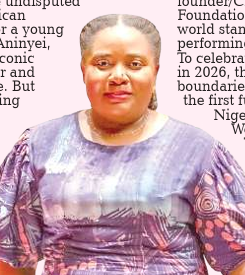
Fast forward to the present, Rosalyn Aninyei, founder/CEO of Vesta Orchestra and Opera Foundation, is a violinist looking to create a world standard stage for the many talented performing arts professionals in Nigeria.
To celebrate its landmark 10th anniversary in 2026, the foundation shattered creative boundaries by staging a historic milestone: the first full operatic adaptation of a Nigerian literary classic, Nobel Laureate Wole Soyinka’s satirical masterpiece, The Trials of Brother Jero.
Transforming Soyinka’s sharp-tongued, prose-heavy comedy about a fake beach prophet into a continuous European classical musical form might sound like a tall task, but to Aninyei, who took up the dual role of Director and Executive Producer, it felt completely natural.
“Opera as an art form is full of drama and humour,” Aninyei explains, reflecting on the premiere. “And Nigerians are equally full of drama and humour. This was an easy marriage. The singing and continuous music element in opera adds an intense emotional dimension, which just speaking may not convey.”
To execute this vision, Aninyei orchestrated a brilliant collaboration. She consulted legendary composer Dr. Seun Owoaje, who noted that the play first needed to be adapted into poetic verse. Then came songwriter Kehinde Oretimehin, who masterfully re-structured Soyinka’s text into a functional libretto (the text of an opera). From there, Dr. Owoaje composed a continuous, sweeping melody.
Pulling through the production did not come without its creative risks. “In opera, you do not get to hear everything being sung,” Aninyei admits. “We couldn’t take the entire book into the libretto, as the songs would have been too many. We had to carefully decide which scenes to summarize and which to perform in their entirety. A few critics noticed a missing line of dialogue here or there, but on the whole, the story was properly performed without any major loopholes.”
Despite opening night being an overwhelming success, resulting in an elated audience and non-stop laughter—the road to the stage was not entirely smooth, especially regarding funding.
“This was my first time directing, and I chose an opera,” she said. “Potential sponsors simply did not understand what I was talking about, seeing as the art form is not common to our environment. So, funding was a major issue.”
Beyond corporate scepticism, the structural realities of putting on a show of this magnitude in modern Lagos present real financial bottlenecks. Rosalyn notes that accessible, affordable performance spaces remain a critical missing link for independent producers. “I hope the government will join us as we try to provide more affordable performance houses. The current state of things puts premium spaces out of our reach financially.”
However, now that Vesta has proven the concept, Rosalyn is confident that returning to partners for the next production—and the inevitable domestic and international tours of Brother Jero will yield a different conversation.
What surprised Rosalyn the most wasn’t the reaction of traditional theatre patrons but a sudden wave of interest from Gen Z. Leading up to the premiere, her phone was ringing off the hook with calls from creative arts students across major institutions: LASU, UNILAG, OAU, and the University of Ibadan.
When she asked why they were so desperate to secure seats, their answers were identical: they were hungry for something different. They wanted to witness the dawn of a new recapitulation of Nigerian storytelling.
“It tells me people need us to approach ‘Nigeria’ anew,” Rosalyn says thoughtfully. “There is a massive hunger for African stories globally, and we must be the ones to tell them.”
As Vesta Orchestra looks toward the next decade, The Trials of Brother Jero stands as a proof of concept for a much broader movement to reinterpret African literary classics for contemporary audiences.
“I am filled with gratitude for the level of talent we have in Nigeria,” she concludes. “Around every street corner is a genius, and my work allows me to interact with many of them. We will be telling more of our stories as musicals and operas.”
Disclaimer
Comments expressed here do not reflect the opinions of Vanguard newspapers or any employee thereof.