
By Elizabeth Osayande & Ifunanya Ndigwe
James Hope University, JHU, has positioned itself uniquely in the Nigerian higher education space by operating strictly as a postgraduate-only institution. The University located at its Lekki, Lagos campus, focuses entirely on advanced learning and executive training. It has unveiled three flagship business programmes designed for a new era of learning shaped by artificial intelligence, digital transformation, and practical skills that offer students a clear return on investment, skills and employability.
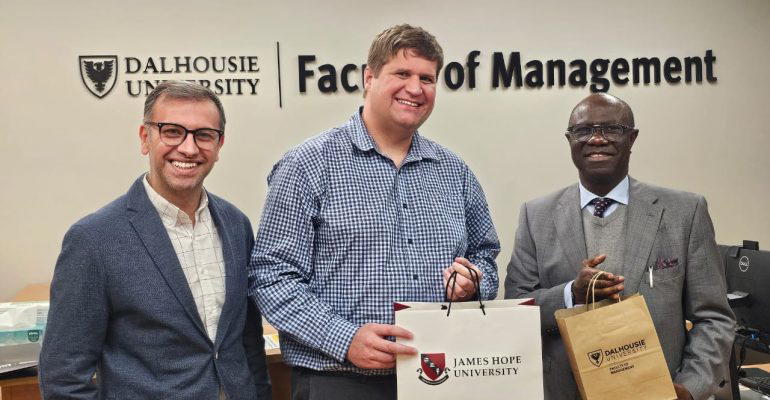
Speaking on the distinct structure of the institution, the President and Vice-Chancellor of James Hope University, Professor of Economics, Olu Akinkugbe, explained that the school currently does not offer undergraduate programmes, rather it dedicates its full resources to advanced learning.
“Without the demands of undergraduate programmes, we have the singular advantage of depth, immersing our students and faculty in innovative discourse, applied research, industry-driven curricula, and experiential learning,” Akinkugbe said.
The Vice-Chancellor further detailed the specific academic offerings, highlighting how the first course, named Innovation, Intrapreneurship, and Entrepreneurship, is built directly upon the real-world experience of the school’s founder, Jim Ovia, CFR.
Professor Akinkugbe said, “This programme is deeply rooted in the vision and lived example of our Founder, Mr Jim Ovia, a legendary banker, innovator, and entrepreneur, who founded Zenith Bank, one of Nigeria’s most respected and leading financial institutions. His journey from visionary ideas to institutional success embodies the very essence of innovation, leadership, and enterprise in Africa. This programme therefore teaches not abstract theory, but the practical, tested principles of creating value, fostering innovation within existing organisations through intrapreneurship, and building enduring ventures through entrepreneurship. While Nigerians see excellence in Zenith Bank, here at JHU, they see where that excellence is built.”
Addressing the technological change in financial systems, the institution introduced its Fintech and Analytics programme to close critical skill gaps across the continent.
“Nigeria is rapidly emerging as Africa’s largest and most dynamic fintech hub, with innovations in payments, lending, and blockchain transforming our economy,” Akinkugbe explained. “Our Fintech programme is strategically designed to produce graduates who not only understand financial systems but can harness big data, machine learning, and predictive analytics to drive inclusion, efficiency, and security in financial services. We are not stopping here. We are in advanced talks with the Fintech ecosystem in Nigeria, the University of Texas at Dallas, and two other universities in Canada and East Asia to set up cross-collaboratory technology solutions that will contribute to digital innovation on the continent. This will provide that all-important bridge to the missing middle—reportedly scarce middle-level skills in the fintech ecosystem. The proposed lab is not merely an infrastructure project. It is a skills-to-employment pipeline that will deliver measurable outcomes.”
The third flagship programme offered by the university focuses on Economic Development and Policy Analysis.
According to the Vice-Chancellor, the Economic Development and Policy Analysis programme “is designed to address Africa’s most pressing developmental challenges. It equips policymakers, economists, and development practitioners with rigorous analytical tools to design, evaluate, and implement transformative economic policies that will contribute to national growth and develop competitive positioning globally.”
To support these intensive academic streams, the university has established physical learning facilities and a specialized teaching team.
Professor Akinkugbe concluded that the university boasts “a state-of-the-art library, which the Librarian fondly refers to as not just a physical space filled with books and resources, but a hub of intellectual exploration and collaboration,” alongside an innovation hub, a research lab, and core integrated systems including an ILMS, LMS, and hybrid teaching facilities. Akinkugbe noted that the school also has high-achieving professors and lecturers who are a mix of core academic and industry practitioners. And all programmes are specifically designed for immersive and industry residency.
Disclaimer
Comments expressed here do not reflect the opinions of Vanguard newspapers or any employee thereof.