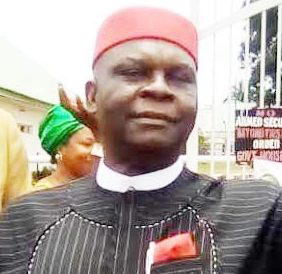
Ndubouke
By Jacob Ajom
A former national President of the Sports Writers’ Association of Nigeria, Fan Ndubuoke has highlighted the various obstacles the average sportswriter faces, on a daily basis, in the practice of his vocation. Delivering a paper at a workshop organised by the Imo state chapter of Sports Writers Association of Nigeria titled ‘The burden of finding a balance between patriotism and professionalism– the ethical question’, the former SWAN President said, ‘there is a thin line between those concepts, which in themselves are defined or dependent on environmental peculiarities.
Ndubuoke, a veteran in the trade posited that a sports journalist, like every journalist, for that matter is confronted with the burden of presenting ‘facts as they are, without fear or favour. Yet in doing so, he may step on dangerous toes. His commitment to truth may be interpreted as disloyalty. His insistence on accuracy may be labeled unpatriotic; and his refusal to compromise may cost him his job, his freedom, or even his life.’
Faced with this reality, today’s sports journalist must first examine and understand the three operative concepts of professionalism, patriotism, and ethics.
Traditionally, Ndubuoke noted, the elementary function of the media is to inform, educate and entertain. Today, however, in going about this three-pronged function, the danger or risk of stepping on toes or insistence on application of best practice could be misinterpreted by certain people or the state.
“This is the dilemma: Where should the sportswriter’s loyalty lie—his profession, the state, or the media owner?” He continued, “To answer this, it is useful to revisit the major philosophies of the mass media as outlined by Professor Andrew Moemeka in his Reporters’ Handbook: Authoritarian theory, Soviet Communist theory, Libertarian theory, Social Responsibility theory and the Development Media theory.”
He said, “each philosophy shapes the expectations placed on the journalist and determines the boundaries within which he must operate.”
Apart from these common structural hiccups, Ndubuoke submitted that the trajectory has been compounded by an additional encumbrance bedeviling the umbrella body of sports writers in the country. He termed it as “The growing shadow of corruption” and it’s impact on SWAN.
“Beyond these structural challenges lies a deeper, more corrosive threat—the pervasive corruption that has reshaped the values of our society and, by extension, the culture within SWAN.
One of the most damaging but often overlooked causes of declining creativity in sports journalism is the shift from professional excellence to political patronage. Many practitioners no longer pursue mastery of their craft. Instead, they position themselves for government favour, political connections, and “easy money.” This has produced a generation of sportswriters who are laid back, unmotivated, and unwilling to challenge themselves.
Because of the abandonment of the core responsibilities of sports writing business, and the erosion of ethical standard, the modern sports journalist has failed to apply critical thinking. This has resulted in flagrant disregard for laid down rules and rot in the system. He concluded that illegality in the administration of sports has become the new norm.
The consequences, he reckoned, are profound loss of investigative spirit, weakening of critical analysis, erosion of independence, decline in creativity and innovation and compromise of ethical standards
“Tragically, sections of the sporting press, including SWAN, have often enabled this decay. By celebrating administrators, ignoring illegality, and sometimes participating in the scramble for estacodes and brown envelopes,” adding that SWAN has inadvertently “helped sustain a system that produces no real value. If ethics is about accountability, then we must ask: Who is holding these institutions to account? Why should the National Sports Commission be poorly constituted, why should a one-man ran board be tolerated? Who is questioning the legality of their operations? Who is demanding transparency in how sports funds are used?”
Until we confront the institutional illegality and Ponzi style governance at the heart of Nigerian sports, our talk about professionalism, patriotism, and ethics will remain empty slogans. True patriotism demands that we insist on lawful, transparent, and accountable sports institutions — not merely applaud those who benefit from their dysfunction.”
When journalists become beholden to politicians, sports administrators, agents, or scouts, they lose the independence required to elevate the profession. Corruption has not only weakened our work ethic—it has eroded the very foundation upon which SWAN was built.
In conclusion, the former SWAN boss said, “the burden of balancing patriotism and professionalism is heavy, but it is not impossible. The sportswriter must remain steadfast, guided by truth, ethics, and a commitment to excellence. Only then can SWAN reclaim its rightful place as a guardian of Nigerian sports and a beacon of journalistic integrity.”
Disclaimer
Comments expressed here do not reflect the opinions of Vanguard newspapers or any employee thereof.