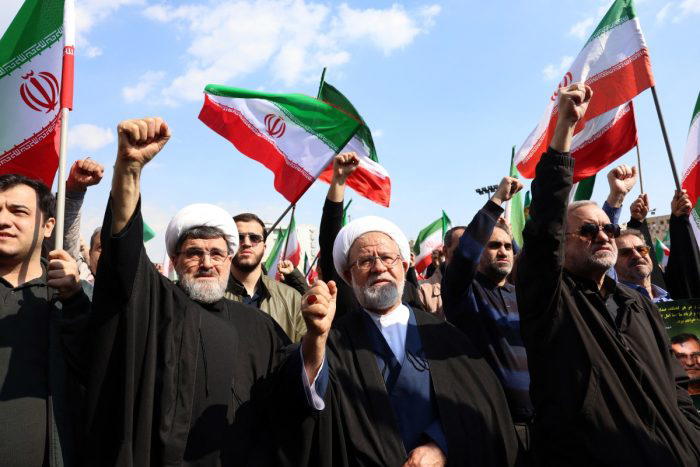
File: Iranians attend the funeral of Alireza Tangsiri, commander of the Iranian Revolutionary Guards’ navy alongside others killed in US-Israeli strikes on Iran at Enghelab Square in Tehran on April 1, 2026. Photo by AFP.
By Nkiruka Nnorom with agencies report
More countries, including Australia, France, United Kingdom and Iran allies – Russia and Turkey, yesterday, joined in calling for the inclusion of Lebanon in the two-week ceasefire deal agreed by the United States and Iran, even as Israel continued to pound Beirut amidst mounting condemnation of its attack on Lebanon.
US and Iran had Wednesday at the 11th hour of the deadline set by the US President, Donald Trump, for Iran to reopen the Strait of Hormuz, agreed to ceasefire and opted to explore diplomatic channel to end the 41 days war.
However, the peace deal seems to be derailing over disagreement on the details of the truce reached by both sides, especially as it relates to the inclusion of Lebanon’s Hezbolla in the ceasefire deal.
Lebanon was drawn into the war after Hezbollah launched rocket fire on Israel to avenge the death of Iran’s Supreme Leader, Ayatollah Ali Khamenei, who was killed at the onset of the war, prompting Israel to invade and stage air raids across Lebanon in a campaign that has killed more than 2,000 people, and displaced over 4,000.
This came as Tehran, yesterday, ruled out any restrictions on the country’s enrichment of uranium, saying the demand by the US and Israel will not come true.
The Iran also announced alternative routes for ships travelling through the Strait of Hormuz, citing the risk of sea mines in the main zone of the vital waterway.
“The claims and demands of our enemies to restrict Iran’s enrichment programme are merely wishes that will be buried,” Mohammad Eslami, head of Iran’s nuclear energy agency said.
The issue of uranium enrichment has been central to Western relations with Iran for more than two decades, with the US and its allies accusing Tehran of seeking atomic weapons, while Iran has always insisted its programme is for civilian purposes only.
US military to be deployed near Iran until real agreement reached
Meanwhile, Trump has said that US forces would be deployed near Iran and would remain stationed in the area until a real agreement was reached, even as Lebanon indicated interest to hold direct ceasefire talks with Israel.
“All U.S. ships, aircraft, and military personnel, with additional ammunition, weaponry, and anything else that is appropriate and necessary for the lethal prosecution and destruction of an already substantially degraded enemy, will remain in place in, and around Iran, until such time as the real agreement reached is fully complied with,” Trump wrote on his Truth Social platform.
While he said a deal failing was highly unlikely, he threatened to revert to “bigger, and better, and stronger” strikes if an agreement was not reached,” Trump added.
Calls for Lebanon’s inclusion, criticism of attacks mount
Leading the call, Pakistan, which condemned the attack, maintained that Lebanon is included in the ceasefire deal it helped broker between the US, Israel and Iran.
France’s President, Emmanuel Macron, condemned what he described as “indiscriminate” strikes by Israel on Lebanon, which he said posed a direct threat to the sustainability of the ceasefire and US and Iranian counterparts, Trump and Masoud Pezeshkian, to include Lebanon in the ceasefire reached with Iran.
UK’s Foreign Secretary, Yvette Cooper, and Defence Secretary, John Healey, said Israel’s attacks on Lebanon were deeply damaging and Britain wants to “see Lebanon included in the ceasefire”. They also maintained tha Strait of Hormuz must remain free of any tolls.
Turkey’s foreign ministry denounced the strikes “in the strongest terms” and accused Netanyahu’s government of undermining “international efforts aimed at establishing peace and stability.”
“We hope that the ceasefire will be fully implemented on the ground, including in Lebanon, and that the process will lead to lasting peace,” Foreign Minister, Hakan Fidan told a news conference alongside his Syrian counterpart in Ankara.
Russian Foreign Minister, Sergei Lavrov, hailed the ceasefire in a phone call with Iranian counterpart Abbas Araghchi, with the ministry saying in a read-out that “Moscow firmly believes that these agreements have a regional dimension and, in particular, apply to Lebanon.”
In a separate statement, the ministry’s spokeswoman Maria Zakharova condemned Israeli attacks on Lebanon, saying that “such aggressive actions threaten to derail the emerging negotiation process”.
Spain’s Prime Minister, Pedro Sánchez, said Israeli Prime Minister, Benjamin Netanyahu’s “contempt for life and international law is intolerable.” He also called for Lebanon to be included in the ceasefire.
The United Arab Emirates reaffirmed its solidarity with the Lebanese government and support of “Lebanon’s unity, sovereignty, and territorial integrity.” The country also expressed concern over “continued escalation” and the repercussions for “regional security and stability.”
Italy’s Foreign Minister, Antonio Tajani, said he called Lebanon’s President Joseph Aoun to express solidarity for the “unjustified and unacceptable attacks.” Tajani said he summoned the Israeli ambassador, adding: “We want to avoid there being a second Gaza.”
Criticism has also poured in from the United Nations and NGOs with the United Nations Secretary General, António Guterres, unequivocally condemnming the strikes and called for an end to the hostilities, which he said “pose a grave risk to the ceasefire,” in a statement from a spokesperson Wednesday.
The International Committee of the Red Cross said it was “outraged” by the death and destruction in densely populated areas across Lebanon.
Disclaimer
Comments expressed here do not reflect the opinions of Vanguard newspapers or any employee thereof.