Reports of Nigerians achieving remarkable success overseas have become increasingly common, with professionals and scholars earning recognition in fields ranging from technology and medicine to engineering and the arts.
While these achievements often inspire national pride, they also renew debate about the limited opportunities and structural challenges facing many talented individuals within Nigeria.
Observers frequently cite chronic underfunding of research, aging infrastructure, and disruptions in academic calendars as factors that have weakened the capacity of local institutions once regarded among Africa’s finest. As a result, many Nigerian scholars pursue advanced training and research abroad, where funding, facilities, and stable systems enable them to thrive.
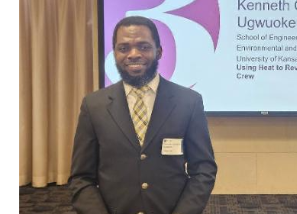
The trend was highlighted again recently when Kenneth Chinekwu Ugwuoke, a Nigerian graduate scholar in Environmental and Water Resources Engineering at the University of Kansas, won first place in the university’s prestigious Three Minute Thesis (3MT) Competition.
The 3MT competition, first developed in 2008 at the University of Queensland, challenges master’s and doctoral students to present years of research in just three minutes using a single slide, while communicating effectively to a non specialist audience. The format has since spread to hundreds of universities across more than 60 countries and is widely regarded as a leading platform for showcasing graduate research and communication skills.
Ugwuoke’s presentation, which focused on sustainable water management and environmental remediation, impressed judges and fellow researchers, earning him a cash prize and selection to represent the University of Kansas at the Midwest regional 3MT competition next year.
His research addresses the growing problem of perchlorate contamination, a chemical commonly associated with rocket fuel and explosives that can infiltrate soil and groundwater. Long term exposure has been linked to disruptions of thyroid function and other health risks.
Rather than relying on costly and disruptive traditional cleanup methods, Ugwuoke’s work explores biological approaches to remediation. By identifying heat stable enzymes produced by microorganisms capable of breaking down perchlorate, his research points toward cleaner, more sustainable ways of restoring contaminated environments. Scientists say such techniques could significantly reduce the financial and environmental costs of large scale soil and water treatment.
For Nigeria, where environmental challenges such as oil spills, industrial waste, and groundwater pollution remain pressing concerns, the relevance of such research is clear. Analysts note that innovations of this nature could have direct applications domestically, if supported by sustained investment in scientific research and infrastructure.
Ugwuoke’s achievement has been widely celebrated among Nigerians online, adding to a growing list of success stories involving Nigerian scholars in leading global institutions. Yet it has also revived a familiar and difficult question: why do many of the country’s most promising researchers find recognition and resources only after leaving home?
Education experts argue that while Nigeria continues to produce highly capable graduates, systemic constraints including limited research funding, low academic wages, and institutional instability have made it difficult for universities to compete globally.
As international universities increasingly benefit from Nigerian talent, the contrast remains stark. Achievements like Ugwuoke’s demonstrate the global competitiveness of Nigerian scholars, but they also underscore the urgent need for reforms that could allow similar excellence to flourish within Nigeria’s own borders.
Disclaimer
Comments expressed here do not reflect the opinions of Vanguard newspapers or any employee thereof.