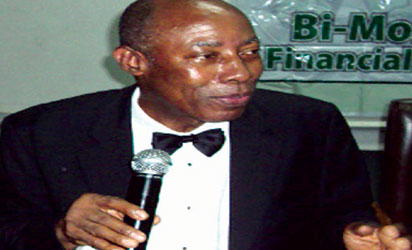
Mazi Okechukwu Unegbu
By Babajide Komolafe
Mazi Okechukwu Unegbu is the Managing Director/Chief Executive, Maxifund Investment and Securities Limited and President of Chartered Institute of Bankers of Nigeria (CIBN) from 2002 to 2004. In his over 30 years career in banking and finance he has worked in prominent financial institutions including First Bank, defunct African Merchant Bank, Progress Bank (rose to become Chairman/Chief Executive), Broad Bank and Citizens Bank (as Chief Executive in 2005).
As the guest speaker at the Zenith Bank sponsored Bi-monthly Discourse of Finance Correspondents Association of Nigeria (FICAN) held last week, he barred his mind on recent development in the nation’s financial sector especially the planned removal of the autonomy of the central Bank of Nigeria (CBN) by the National Assembly, the recent probe of the near collapse of the nation’s capital market by the House of Representatives and the demutualization of the Nigeria Stock Exchange. Excerpts:
Considering the fact that the capital market collapsed in 2008, What is your take on the timing of the probe of the near collapse of the capital market by the House of Representatives? Is the timing right and is it properly focused on the necessary issues?
I do not agree with you that the timing of the probe was wrong. If you realize at some time most of us were saying let the government intervene in the market not by giving money but by reviewing the structure. For instance, the Securities and Exchange Commission (SEC) is set up by law, the structure in that place is not correct. There was lack of proper co-ordination between the capital market regulator and the place that provide the platform.
The Nigerian Stock Exchange is what we call a self regulatory organization providing the platform that enables market to be conducted and the license is regulated by the SEC. And we were calling for proper restructuring of the SEC the way it was and we can see that coming out very vital during the probe. So, I think some of the issues raised were also apt, even if everything was not such. It was only spoiled through what I may call inexperience of the legislators that is to some decree and the impunity role of the SEC.
The regulators made a mistake of going to issues and then raise them when the issues have not being genuinely touched. If the regulators have taken time, let us go. You don’t do things with a preconceived idea to find somebody guilty. That is why the problem arose and that was what happened that almost diverted attention from the real issues. Some of the issues that came up that were not suppose to be there. I mean that is my advice to that and I tell you also that that is why I am calling for a re-thought in financial regulation. There should be a rethought. Financial regulation should not be base on impunity but be based on facts.
On the ongoing debate about the quest of the National Assemble remove the autonomy of CBN, you said the problem is that the we have a weak CBN but a strong CBN Governor and that what is needed is to strengthen the CBN. But what measures can be put in place to ensure that whoever becomes the CBN Governor does not use the CBN to pursue what might be perceived in some quarters as religious or political interest?
Then the CBN autonomy, I think I have even answered that during my presentation. I said that all we need to do is to set up strong institutions. Let the institutions be strong. Let it be, if you go there tomorrow what you see on ground will determine how you are going to do the job. You see that in the US Federal Reserve the man there now is still following what was there before.

Mazi Okechukwu Unegbu
But in our own system I was talking about I think I talk financial friction, I have talked about the US- UK model; I have talked about the euro zone model. I said we don’t know what model we are following here and this model we need to look at what the situation is because as far as we are concerned conservatism is the essence of regulation both for the capital market and the banking sector or money market.
So it is important that whoever is at the Head of that institution should first of all sit down, study the institution before you start talking.. That is why most of the managing directors of banks that I know, those that were there when the banks were in trouble, and the moment they got there they started talking , we are going to raise it to a high level. That is all balderdash, because you don’t know where you are.
Before you start making that comment you must first of all know your environment, get the environment working fine, take appropriate note; get to know the people that are working with you before you start commenting. I remember when I was appointed the managing director of Citizens Bank and one of you complained that I was not talking, saying it is unlike you. I told him what you want me to say.
I have just spent one month. I don’t even know where I am. I told him to come back after nine months because by then I would have known the system and I would be talking from the experience of what I have done rather than getting there and after one month start talking. That is the problem that we have. So for anybody, conservatism is a very important aspect of our business.
Let me tell you why autonomy is very important. In times of crises, let me give you the example, I remember I was in banking when the CBN reports to the ministry of finance and to the presidency. I was then given a mandate in First Bank then to set up FBN Merchant Banker. Myself and four other people and that was when Atedo Peterside was also going for his own bank as a merchant bank then and each time we go, the ministry of finance was here in Ikoyi and the other arms have moved to Abuja.
It was a very terrible thing because in the ministry of finance, to move files; it could take you three months. To get license that time was like going through hell and coming back. So the files will never moved and you want to know, at that time bribery is not the way it is known now because you cannot come back to tell the your MD, they say I should bring money. You dare not say it. At that time things were still good but it took time. So that is a strong reason, so when they removed the CBN from the stranglehold of the ministry of finance, we all applauded it.
Then it was now going through the presidency and all that. There was a time when they had the instrument autonomy and then they also have the policy autonomy. Initially they granted them the instrument autonomy which made it easy for them to relate quickly with the banks and deal with them fast. Before that time you have to go through ministry of finance before you can close the bank. So, do want us to continue with that?
I have told you why the autonomy issue is coming. It is because there is one strong individual holding forth in a very weak and disorderly structured institution. So why not let us ask that the institution should restructure itself to take care of the imbalances in its structure, the lack of foresight in the regulation. If they can do that, then whoever goes there, things will keep going.
I tell you, let me give you example, in First Bank that is why the bank is still growing. I don’t know what it is now but at that time if you like come from the air with all those razz mantas or grammar or you do it like this, you do it like that, there is a system that has been set in place, that this bottom-up approach to situations and once the middle say it agrees with the bottom, that this thing is not right to do, no managing director can change it. That is the system, a strong institution.
You see before Even CBN talked about tenure limit for bank chief executives, there was already a tenure limit in First Bank. You can’t spend more than two terms, three years or so and once you scale through that you are up and another person is being groomed to take over. That has being the system and it is working for them perfectly. For me we should not disturb the autonomy of the central bank as that will be dragging us back to the 80s.
You said there is need for more Exchanges before the Nigeria Stock Exchange is demutualised. An you elaborate on this?
I did say that the danger of demutualising is converting a mutual institution to a one now owned by private businesses. Now, it is not parallel exchange, even if they call it parallel, let them come, let them compete among themselves. Competition is the fuel of business so that they can have services.
When it came up the former stock exchange authority kicked against it and some of us were called names for supporting it. Because I remember I became a member of the Abuja Stock Exchange, I am still a member of the Abuja Commodity Exchange, I still belong. The reason is this; it is dangerous to have one monopoly, that monopoly would hold all the power. Take it or leave it.
Secondly if you now think that if we demutualize that particular monopoly without other competing organizations, we are going to face a problem. And I did say that supposing something happens to that privately owned business like some banks failed, in your korokoro eyes many banks failed in this country.
Supposing those banks that fell and there is no NDIC to pay you N100,000 or N200,000 as insure deposit and there is no other bank that you can go to what will happen? The system will ground to a halt. So that is why we are calling for more exchanges, so that if we demutualise the current Nigeria Stock Exchange and something goes wrong with, there is an alternative.
Now assuming you have the share of First Bank and they demutualised the Nigeria Stock Exchange and because of the greed of capitalism and because of the greed of directors, because of the greed of staffers, and because of so many externalities that affect that business, and because we have to compete with other exchanges outside Nigeria and something happens to it and you have First Bank certificate or shares to sell and there is no platform and there is no other platform for you to do that. If there be is a struggle, are you not going to have financial difficulty even when you have something that can bring you money.
And secondly if those things happen, people wanting to raise money cannot raise money because the Exchange has failed. So you face problem of illiquidity and also you face problem of not being able to raise a development capital from the market. But if there is an alternative you don’t need to depend on that because you can take your share to another exchange, maybe in Ibadan or somewhere to raise money with your share.
So that is what am saying if you want to demutualize I am not against it, I know you people are not against it but we are saying there is a danger if you should demutualise and there is no other alternative competing exchanges, we would have problem should there be collapse of that particular exchange.
Disclaimer
Comments expressed here do not reflect the opinions of Vanguard newspapers or any employee thereof.