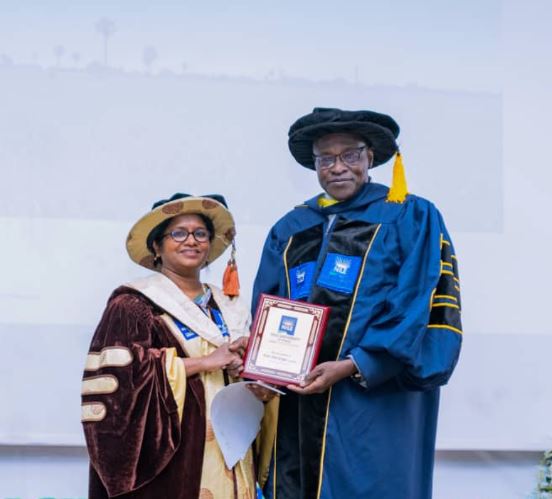
Varsity Will Shape Global Conversations on AI, VC Declares
By Joseph Erunke, Abuja
A Professor of Artificial Intelligence and Quantum Computing and Deputy Vice-Chancellor (Administration) at Nile University of Nigeria, Prof. Prema Kirubakaran, has dismissed concerns that artificial intelligence (AI) will replace humans, saying instead that the technology will enhance human capacity, innovation and productivity.
She made the remarks during the university’s 6th Inaugural Lecture, which focused on the future of AI in research and global development.
Delivering the lecture titled “Navigating the Future of AI in Research: Innovations, Ethics, and Global Impact,” Prof. Kirubakaran said the world is gradually moving beyond conventional artificial intelligence toward what she described as “Organoid Intelligence.”
“Technology does not replace humans; it improves us. Just as we moved from button phones to smartphones, we are evolving into a more intelligent and skilled society. The key is upskilling. Those who fail to adapt are left behind, not because of technology, but because of resistance to learning,” she said.
According to her, by 2030 artificial intelligence is expected to evolve into systems powered by artificial brains developed through collaboration among biologists, engineers and computing scientists, with significant benefits for healthcare and productivity.
“Organoid Intelligence will not function in isolation. It will be driven by collective human expertise. Doctors, engineers and computing scientists will work together to reduce mortality rates, improve diagnostics and enhance quality of life,” she explained.
Earlier, in his welcome remarks, the Vice-Chancellor of Nile University of Nigeria, Prof. Dilli Dogo, FNAMed, described artificial intelligence as one of the defining challenges of the modern era, stressing that universities must lead in shaping how the technology is applied in research, policy and society.
He noted that AI has already simplified many aspects of research by saving time and improving efficiency, while also raising important questions about humanity’s future.
“Will AI define who we are as human beings, or will we continue to define AI? These are questions that will continue to challenge our minds,” he said.
In an interview after the lecture, Prof. Dogo disclosed that Nile University has made AI literacy compulsory for all students and staff, describing it as essential for relevance in the 21st century.
“If you are an academic today and you are not AI-literate, then you are digitally illiterate, whether you are a professor or a graduate assistant,” he said.
“AI has reduced what used to take weeks or months in research to a matter of hours. But the question is whether we are trained enough to use it responsibly.”
Dismissing fears that AI would encourage laziness or eliminate jobs, the Vice-Chancellor said the technology lacks creativity and emotions and remains dependent on human input.
“AI will not think for our future. It will only help us do things better and faster. If humans stop enriching the system, AI itself becomes empty,” he said.
He explained that Nile University prioritises inaugural lectures as part of its academic culture to ensure that research outcomes are shared beyond academia and made accessible to policymakers, industry leaders and the general public.
According to him, the institution was founded with a vision of becoming a global centre of learning, teaching and research, noting that its inaugural lecture series continues to address topical national and global issues.
“When academics research, publish and innovate, there is a responsibility to share those findings not only with fellow scholars, but also with policymakers, industry leaders and the wider society,” he added.
Prof. Dogo noted that the lecture series has attracted growing national and international attention.
“After some of our previous inaugural lectures, I received calls from universities across the country and even requests for online streaming from people who could not attend physically. That tells us we are on the right path,” he said.
Also speaking, the Pro-Chancellor of Nile University, Mr. John Vermaaten, expressed optimism about the future of artificial intelligence, particularly in healthcare, business automation and drug research.
“These technologies tend to be additive. They create more opportunities, make people more productive and open new frontiers for research,” he said.
“I am very hopeful, and I believe Nile University can be a leader in AI research in Nigeria and globally.”
He acknowledged that while AI remains transformative and full of uncertainties, the university’s academic and management team is well positioned to promote responsible innovation.
The event attracted academics, industry stakeholders and students, further reinforcing Nile University’s growing role as a platform for shaping national and global conversations on artificial intelligence and its impact on society.
Disclaimer
Comments expressed here do not reflect the opinions of Vanguard newspapers or any employee thereof.