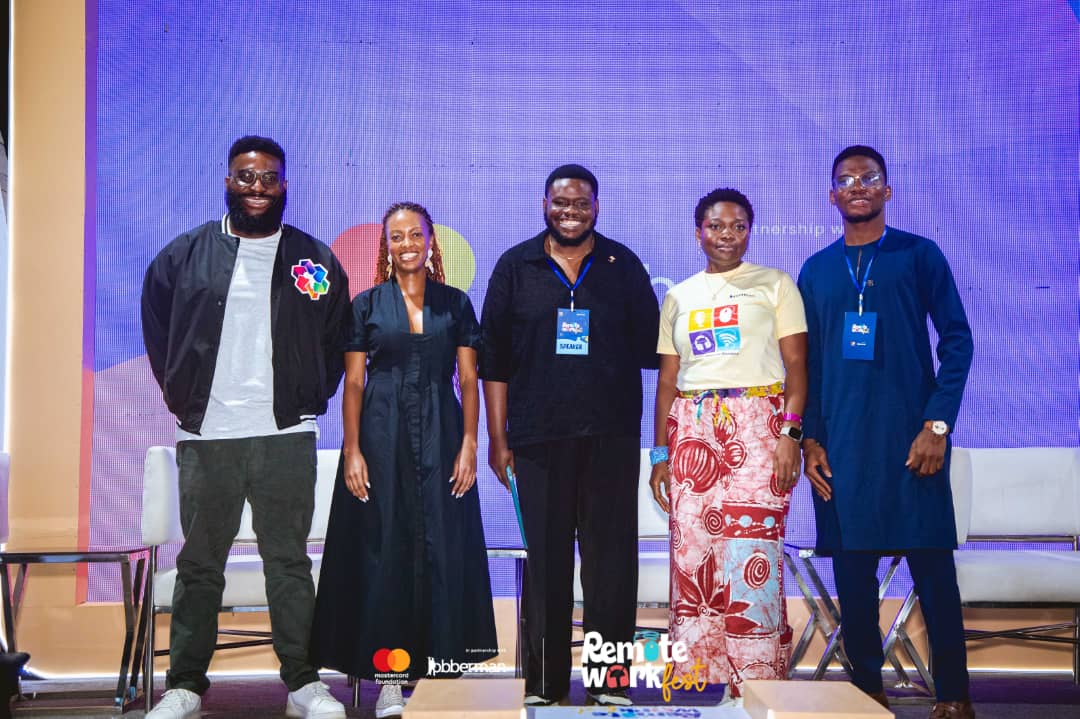
L-R: Gabriel Akan Umoden, Chief Marketing Officer, The African Talent Company; Penina Kimani, Head of Strategy, The African Talent Company; Cecil Jones, Head of Product, Itana; Samantha Ifezulike, Head of Operations, Jobberman Nigeria; Olamide Adeyeye, Country Head of Programmes, Jobberman Nigeria, at the Jobberman Remote Work Fest held in Lagos recently.
By Yemisi Suleiman
The Landmark Centre Victoria Island, Lagos, came alive recently, with possibility as about a thousand young Nigerians gathered for the maiden edition of the Jobberman Remote Work Fest 2025. With the theme “Work Beyond Borders: Building Africa’s Global Remote Workforce,” the festival set out to challenge long-held narratives about Africa’s place in the global economy, and replace them with a future driven by talent, skills, and opportunity without borders.
Organised by Jobberman Nigeria and The African Talent Company, in partnership with the Mastercard Foundation, the event convened industry leaders, policymakers and ambitious young professionals around a shared idea: Africa’s greatest export is no longer raw materials, but people. Through panel discussions, fireside chats and networking sessions, conversations focused on how African talent is already shaping the future of work, and how remote work is redefining how the continent learns, works and earns.
At the heart of the discussions was a compelling data point: 62% of international companies are already hiring from Africa. With Nigeria projected to become the world’s third most populous country by 2050 and nearly 80% of its population currently under the age of 44, speakers highlighted the urgency, and advantage, of positioning African youth as a solution to global workforce shortages, particularly in ageing economies.
In his opening remarks, Gabriel Akan Gab-Umoden, Chief Marketing Officer of The African Talent Company, captured the spirit of the day. “Talent has no borders, and opportunities shouldn’t either. The world is hiring, and Africa is ready,” he said. Expanding on this vision, he added, “We are moving from exporting raw materials as a continent to exporting talent. That is the one thing Africa has in limitless supply.
Today is a celebration of how African talent is shaping the future of work from wherever we are.”
Gab-Umoden emphasised that the festival was designed to spark new thinking and practical action. “It exists to inspire young professionals to imagine careers that are flexible, fluid, and borderless. It exists to connect remote-ready talent with employers who see Africa as a strategic source of global talent. It exists to equip you with practical skills, tools, and playbooks to genuinely be remote-ready and job-ready,” he noted.
The keynote session, “Work Beyond Borders: Building Africa’s Global Remote Workforce,” delivered by Iyinoluwa Aboyeji, Founding Partner of Future Africa, and represented by Cecil Jones, Head of Product at Itana, challenged romantic notions of remote work. Jones addressed the misconception that remote work is easy or effortless, stressing instead the discipline it demands.
“Remote work is not an easier way to work; it is probably the most disciplined way you can work. To survive the volatility of the global market, you must treat yourself as a service exporting to the world. You are a business,” he said.
Adding further context, Olamide Adeyeye, Country Head of Programmes at Jobberman Nigeria, presented a data spotlight that underscored both the risks and opportunities ahead. While artificial intelligence is expected to displace 92 million jobs globally by 2030, it is also projected to create 117 million new roles, a net gain that African youth can seize if adequately prepared. “The world does not just want to hire what you know; they want to hire how you work,” Adeyeye explained.
“Employers rank communication and self-management as top priorities. It is no longer just about technical skills, but about the ‘soft skills’ that enable talent to slot easily into any company globally without friction.”
He further outlined that the “Work Beyond Borders” initiative, supported by the Mastercard Foundation, is anchored on three pillars: creating flexible career pathways, integrating African talent into global teams, and ensuring young people are truly “remote-ready” through digital literacy and cultural fluency training.
For attendees, the impact was personal as well as professional. “This session was truly eye-opening,” said Kola Oluremilekun, reflecting on Gabriel Gab-Umoden’s presentation. He shared that it inspired him to overcome his shyness and speak more confidently about his abilities. “I have learnt that I no longer need to hold back—people need to know what I can do,” he said.
The experience reshaped his view of global opportunities, reinforcing the value of connection and collaboration. Motivated by the fest, Kola is now focused on building digital marketing skills and leveraging remote work as a pathway to personal growth and improved well-being.
The festival also featured a high-level panel moderated by Toun Tunde-Anjous, Founder and CEO of The People Practice, with contributions from Uwem Ekanem, Country and Regional Director at Nexford; Chinaza Nduka-Dike, VP of People Operations at Moniepoint; Ashley Immanuel, COO at Semicolon; and Usman Maaruf of the National Talent Export Programme (NATEP), Federal Ministry of Industry, Trade and Investment. Together, they explored what it will take, across policy, education and industry, to sustainably build Africa’s global remote workforce.
By the end of the day, the message was clear: Africa is no longer waiting to be included in the future of work. It is actively shaping it, one skilled, confident, and globally connected professional at a time.
Disclaimer
Comments expressed here do not reflect the opinions of Vanguard newspapers or any employee thereof.