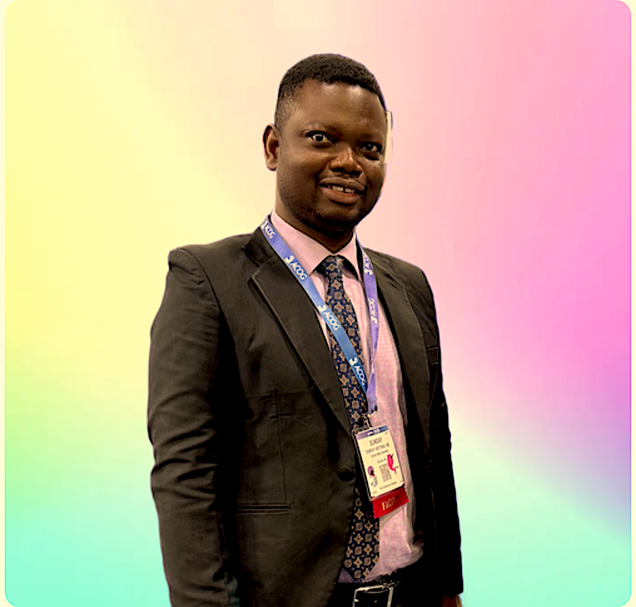
In a world where a woman still dies from pregnancy or childbirth roughly every two minutes, Nigeria carries one of the heaviest burdens.
For Dr Sunday A. Adetunji, those numbers were never abstract.
He lost two siblings to sickle cell crises and a young cousin to childbirth complications.
That private grief drove him to establish a maternity hospital in Lagos, and then to cross continents to study biostatistics, epidemiology, and artificial intelligence in the United States.
Today, he moves between the operating room, the data lab, and global maternal health debates, trying to shift the odds for mothers and babies worldwide.
What follows is an edited conversation about how personal loss became a hospital, how that hospital led to AI-driven research, and why he believes preventable maternal deaths should become statistically rare in our lifetime.
Q1: You describe maternal mortality as something you felt long before you studied it. What did that look like growing up?
I grew up in Nigeria in a house where medicine was never just “science.” It was the difference between watching someone you love walk through the door or never seeing them again.
As a child, I lost two siblings to sickle cell crises—sudden, severe attacks caused by sickle cell disease, an inherited blood disorder. Later, a young cousin bled to death during childbirth. Those were not hospital statistics for me. They were empty chairs at family meals, birthdays that never happened.
Long before I ever learned the phrase “maternal mortality ratio” (the rate at which women die from pregnancy or childbirth per 100,000 births), I understood a hard truth: in many places, survival depends less on biology than on whether the health system catches you in time.
Q2: How does that personal grief connect to the global numbers we hear from WHO and the UN?
Unfortunately, my family’s story is part of a much larger pattern. In recent years, about 260,000 women have died annually from causes related to pregnancy and childbirth—that is roughly one woman every two minutes. More than 90 percent of those deaths happen in low- and lower-middle-income countries, even though most are preventable with timely care.
Nigeria is one of the epicenters. Recent estimates suggest that Nigeria alone accounts for more than a quarter of all maternal deaths worldwide, with tens of thousands of women dying from pregnancy-related causes each year. When you grow up watching that unfold in real time—not just as a researcher, but as a family member—you cannot treat those numbers as distant.
For me, the statistics simply put language and scale on something I already knew in my bones.
Q3: You did not just enter the system—you built part of it. Why did you decide to found a hospital?
I trained in medicine at Obafemi Awolowo University and went on to specialize in obstetrics and gynecology, which focuses on pregnancy, childbirth, and women’s reproductive health. In the labour wards, I kept seeing the same story repeat: women arriving too late, babies dying inside facilities designed to protect them, families pushed into poverty or permanent grief by complications that were, at least in principle, preventable.
I realised I didn’t only want to practice inside existing structures; I wanted to build one that reflected the standard of care I felt women deserved. That led me to found Alifort Hospital in Ikorodu, Lagos—a multispecialist centre built on a very simple idea: no woman should die giving life because of where she was born or how much she can pay.
Q4: What does that look like on the ground in terms of impact?
Over the years, Alifort has grown from a modest neighbourhood clinic into a trusted maternity and emergency-care hub. We provide emergency obstetric and newborn care for high-risk pregnancies, perform surgeries and critical care in an area where specialist access has often been limited, and run outreach so we can find high-risk women before disaster strikes.
Local church leaders describe our team as long-term medical partners for their congregations. For nearly a decade, I’ve led repeated health seminars on hypertension, diabetes, heart disease, maternal complications, cancer warning signs, and mental health, combined with on-site screening clinics for blood pressure, blood sugar, and other basic tests.
Through that mix of outreach and subsidised care, thousands of church members and ministers have been reached, and many have discovered serious conditions early enough to change their life trajectory.
A registered orphanage in Ikorodu calls us their consistent medical partner. Since 2020, we’ve supported school needs, and ensured that children with no parents to speak for them receive dignified, high-quality care irrespective of their ability to pay. Their executive director has described our work as giving the children not just treatment, but a sense of security about their future.
Behind those community descriptions are deeply personal stories: women with histories of repeated pregnancy loss who now have healthy children; extremely high-risk pregnancies—like severe oligohydramnios (dangerously low amniotic fluid) or very early rupture of membranes—where the baby not only survives, but goes on to meet all developmental milestones.
Those are the days when I feel that the vow I made as a child is being honoured in some small way.
Q5: Yet you left that hands-on environment to pursue biostatistics and epidemiology in Oregon. Why?
The hospital work was, and still is, essential. But I kept asking myself a larger question: how do you make sure the lessons of one hospital protect women across a whole state, a whole country, maybe even across continents?
That question carried me to the College of Health at Oregon State University in the United States. I completed a Master of Public Health in Biostatistics—essentially, advanced analysis of health data—and I am now a PhD candidate in Epidemiology, which studies who gets sick, why, and how to prevent it, with a focus on maternal and reproductive health.
My work now sits at the intersection of clinical obstetrics, statistics, and artificial intelligence.
Rather than chasing one disease at a time, I focus on the critical decision points where the health system either saves a life or fails it—and on how to convert those fragile moments into data that can redesign the system itself.

Q6: One of your flagship projects looks at pre-eclampsia. Why that condition, and what are you doing differently?
Pre-eclampsia is a dangerous pregnancy complication that causes high blood pressure and organ damage. It can lead to seizures, stroke, or death for both mother and baby if it’s missed. Globally, it affects an estimated 2 to 8 percent of pregnancies and is responsible for tens of thousands of maternal deaths and about half a million fetal or newborn deaths each year.
We recently published a study in Ultrasound in Obstetrics & Gynecology, which is one of the world’s leading journals in maternal–fetal imaging. The paper is titled “Multimodal AI-augmented radiomics and spectral Doppler ultrasound for early prediction of pre-eclampsia.”
What we did was combine radiomics—mathematical patterns extracted from ultrasound images—with spectral Doppler signals, which give a detailed picture of blood flow between mother, placenta, and baby, and then feed these into AI-driven risk models. These are computer systems that learn from large datasets to identify which women are at highest risk before they show severe clinical symptoms.
The goal is straightforward to say but extremely hard to achieve: see pre-eclampsia earlier, before blood pressure explodes, before organs begin to fail, before the situation becomes a race to save two lives in an emergency theatre.
Q7: How do you see AI, ultrasound, and your hospital experience fitting together in the future?
For me, they are not separate worlds. The hospital shows me, every day, where the system fails. The data and AI work give me tools to redesign those failure points.
If AI-guided ultrasound can reliably flag high-risk pregnancies weeks earlier, clinicians in both high-income and low-resource settings can intensify monitoring, adjust medications, and plan deliveries instead of reacting to crises. That is how you turn a chaotic 2 a.m. emergency into a planned, safer birth.
Ultimately, my agenda is simple: identify the exact moments when a life can be lost or saved, turn those moments into data, and then use that data to make preventable maternal and newborn deaths statistically rare. We talk a lot about the Sustainable Development Goal of reducing maternal mortality, but behind that are very concrete, technical decisions about who gets screened, when, and with what tools.
Q8: When you look back—from the empty chairs in your childhood home to now—how do you make sense of the journey?
I still think in faces, not in p-values or impact factors. I see my siblings, my cousin, the patients whose stories did not end the way we hoped—and the ones who now send photos of toddlers starting school.
What began as private grief in a Nigerian household has become a global project in my mind: to ensure that survival in childbirth is no longer determined by postcode or ability to pay, but by a health system that is ready in time.
If, by building a hospital, by analysing data, by designing AI tools, I can help move the world even a little closer to that reality, then those losses—while they will never be justified—are at least answered.
Disclaimer
Comments expressed here do not reflect the opinions of Vanguard newspapers or any employee thereof.