By Gift ChapiOdekina
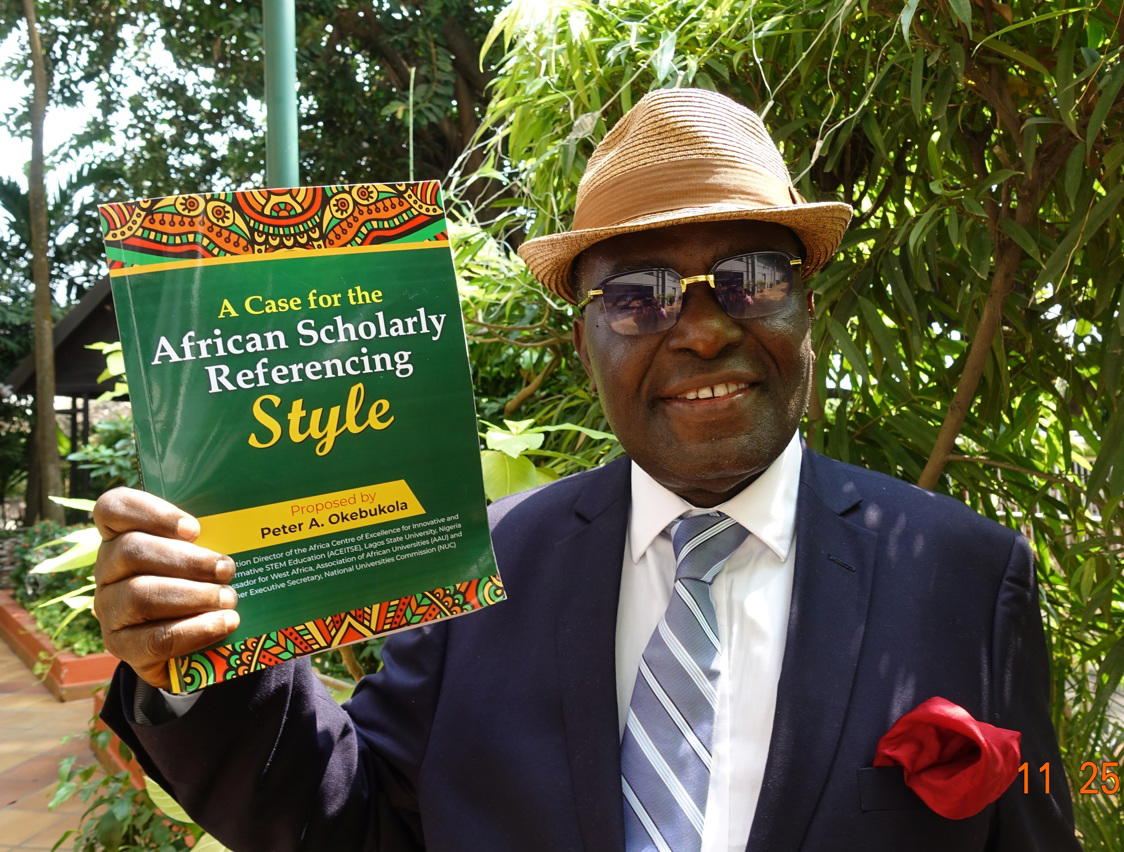
Nigeria’s former NUC Executive Secretary Professor Emeritus Peter Okebukola, has unveiled the African Scholarly Referencing Style (ASRS) the first referencing system ever conceived, developed and owned by Africa ushering in what stakeholders describe as a historic shift in global academic practice.
The initiative, which has received overwhelming endorsement from scholars and institutions across continents, is being hailed as a bold step toward Africa’s intellectual independence and a national victory for Nigeria’s leadership in higher education reform.
Speaking to journalists in Abuja, Okebukola said the ASRS marks the end of an era in which African scholarship depended exclusively on Western knowledge frameworks.
“ASRS responds to a longstanding gap in global academic practice. Although Africa has produced centuries of scholarship and hosts thousands of universities, none of the twenty-nine internationally recognised referencing styles currently in use originates from the continent,” he said.
“Systems such as APA, MLA, Chicago, Vancouver, Harvard and IEEE were created outside Africa and reflect Western epistemological traditions. ASRS offers Africa an unprecedented opportunity to assert its scholarly identity and intellectual sovereignty.”
The Secretary-General of the Association of African Universities (AAU), Professor Olushola Oyewole, described the development as a turning point in Africa’s fight against epistemic marginalisation.
“Professor Okebukola’s initiative rightly responds to longstanding concerns around epistemic colonialism, the marginalisation of African epistemologies, and the under-recognition of African scholarly traditions in global citation frameworks,” Oyewole said.
He added that ASRS is “a groundbreaking and highly visionary contribution to Africa’s intellectual sovereignty.”
The AAU has already expressed willingness to host the development and deployment of ASRS, while senior UNESCO officials and leading members of African academies have commended the project as timely and transformative.
More than 500 top African and international academics, including former vice-chancellors, professors of global repute, and senior researchers, have endorsed the system, describing it as the most important scholarly innovation to emerge from the continent in decades.
ASRS is designed to be 95 percent aligned with existing global referencing patterns to allow easy adoption, while the remaining 5 percent introduces African-centred innovations. These include structured frameworks for citing:
oral literature and custodians of indigenous knowledge
multilingual African sources
community authorship and folklore
institutional documents and locally published materials
Okebukola explained that ASRS will come in ten specialised variants, inspired by major global styles such as APA, MLA, Chicago, Harvard, Vancouver, Turabian, IEEE, AMA, ACS and Bluebook—but with subtle African perspectives woven into each.
Unveiling the implementation blueprint, Okebukola said the ASRS project is “ambitious and pan-African in scope.”
According to him, the ten-year plan includes:
creation of a style manual, training tools and citation software
pilot deployment in select universities and journals
continent-wide adoption by institutions and university presses
eventual recognition by global indexing platforms such as Scopus and Web of Science
“This phased implementation ensures that ASRS is not only widely adopted but sustained across generations of scholars,” he said.
Beyond citation formats, Okebukola emphasised that ASRS is a continental declaration of intellectual confidence.
“ASRS is much more than a new citation format. It is a statement of Africa’s intellectual independence… The days when Africa will be a push-over in scholarship by other regions of the world are numbered.”
He also disclosed that he is developing additional Africa-inspired research designs and statistical models to be released in 2026, complementing the ASRS and advancing Africa’s leadership in knowledge production.
Okebukola’s leadership in championing ASRS reinforces Nigeria’s central role in shaping Africa’s higher education future. As a former Executive Secretary of the National Universities Commission, UNESCO Kalinga Prize laureate and West African Ambassador of the AAU, his credibility has been instrumental in rallying continental support.
Education analysts say the initiative places Nigeria “at the centre of a global academic revolution,” and could position the nation as a reference point for scholarly innovation, intellectual ownership and academic standardisation across Africa.
With ASRS set to become the continent’s first unified scholarly citation framework, Africa—and Nigeria in particular—appears poised to redefine how knowledge is produced, validated and recognised on the world stage.
Disclaimer
Comments expressed here do not reflect the opinions of Vanguard newspapers or any employee thereof.