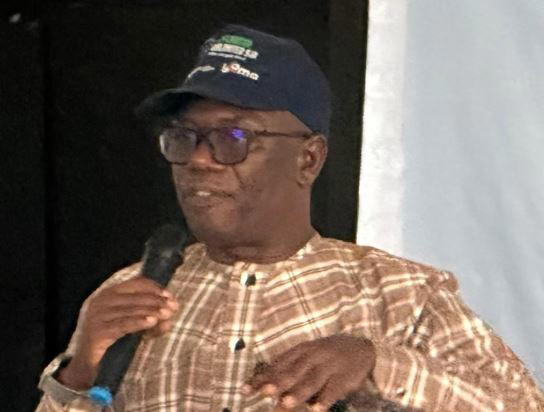
… As traditional leadership drives change in Araromi-Aperin
… Adopt clear urban sanitation strategies, UNICEF to States
By Chioma Obinna & Rotimi Ojomoyela
Once a proud seat of ancient civilization, Oyo State now faces a modern sanitation dilemma. Despite being one of Nigeria’s most urbanised states with nearly half its population living in cities, the state is grappling with a deepening urban sanitation crisis that threatens public health, environmental safety, and economic productivity.
A recent assessment by development partners paints a grim picture. The state produces an estimated 1,875 metric tons of human waste daily, but only 3 percent is safely captured, emptied, and disposed of.
Another 43 percent is not contained at all, much of it ending up in open spaces and drainage channels. Even more worrying, only 2 percent of this waste reaches approved disposal sites.
Experts say this failure exposes both a health risk and a lost opportunity.
According to WASH experts, if properly managed, Oyo could unlock a ₦75 billion sanitation economy, powered by a mix of public investment, private partnerships, and community participation.
According to a 2021 WASH NORM data presented during a two-day media dialogue on urban sanitation, Oyo ranks 33rd on Nigeria’s Open Defecation-Free, ODF, chart, with only eight of its 351 wards certified ODF. Implementation of the state’s ODF roadmap remains limited to just three local government areas.
In his presentation titled “Urban Sanitation Crisis: Current Situation in Nigeria,” UNICEF WASH specialist, Mr. Monday Johnson highlighted that rapid urbanisation, weak institutional coordination, and outdated policies have left many Nigerian states without a clear strategy for managing waste in expanding cities.
“Over 1.5 million households in Oyo still require safely managed sanitation services,” he said, warning that “urban expansion is far outpacing the capacity of existing WASH systems.”
Also speaking, UNICEF Communications Officer, Blessing Ejiofor, reiterated that access to safe water, adequate sanitation, and good hygiene is a fundamental human right — particularly for women and children. She urged journalists to use their platforms to advocate for stronger policy action and accountability in the WASH sector.
Progress in communities
Meanwhile, some communities in Oyo are showing that progress is possible. The Olori of Araromi-Aperin in Ona-Ara Local Government Area, Olori Rebecca Obisesan, narrated how firm traditional leadership and community mobilisation helped end open defecation in her community — a milestone achieved in 2021.
“Before the campaign, we were doing short-put in the bush,” she recounted. “Many houses did not have toilets. It was only the palace that had about 22 toilets.”
She credited the transformation to the intervention of the Oyo State Ministry of Health and the leadership of her husband, Oba Mudashiru Musa Obisesan, the Alararo of Araromi-Aperin.
“Kabiyesi ordered that every house must have a toilet. That was how things changed,” she said. “The whole community used to smell because people were dumping faeces everywhere.”
According to her, access to water is not a challenge in the community, as residents rely on three functional boreholes in addition to those in the palace. However, she pointed out that public sanitation remains a gap.
“There is no toilet in the market. They use the mosque toilet,” she said, urging the government to build public toilets in trading centres.
UNICEF officials at the dialogue expressed concern that most Nigerian states still lack an urban sanitation policy or regulatory framework.
This governance gap, they warned, leaves cities vulnerable to disease outbreaks, flooding, and environmental pollution.
“The challenge is not just infrastructure—it’s governance,” one UNICEF representative noted. “Without clear policies, coordination, and funding, urban sanitation will remain Nigeria’s silent crisis.”
Experts say achieving sustainable sanitation in Oyo and across Nigeria requires a Citywide Inclusive Sanitation (CWIS) approach that covers the full sanitation chain—from containment and safe disposal to reuse and recycling. It also calls for dedicated urban sanitation units, capacity building for local actors, and structured private sector engagement.
As Nigeria races toward the Sustainable Development Goal 6 target of universal access to water and sanitation by 2030, stakeholders say the Oyo experience offers both a warning and a lesson: that leadership, policy clarity, and community participation remain the strongest tools in turning waste into wellness.
Disclaimer
Comments expressed here do not reflect the opinions of Vanguard newspapers or any employee thereof.