By Johnbosco Agbakwuru
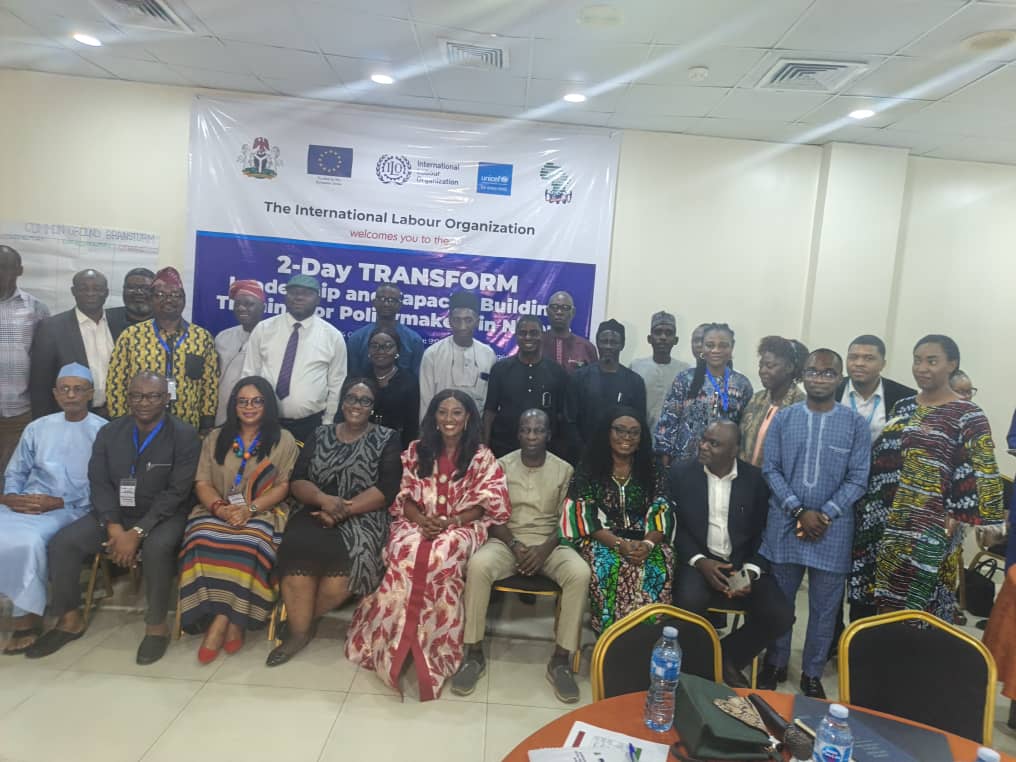
ABUJA — THE International Labour Organization, ILO, in partnership with the United Nations Children’s Fund, UNICEF, in Abuja on Thursday, organized a transformative social protection capacity workshop funded by the European Union for policy makers.
The project, valued at millions of euros, targets strengthening social protection systems in four Nigerian states: Sokoto, Abia, Benue, and Oyo.
Speaking at the capacity building workshop for policy makers, the ILO Country Director for Nigeria, Dr Vanessa Phala, said the project aims to expand access to social protection, particularly for vulnerable populations and those affected by economic shocks.
According to her: “It aims to extend social safety nets to vulnerable populations, reduce poverty, and build resilience by equipping policymakers with the skills and data to design and implement effective social protection policies.
“At the heart of the initiative is the training of policymakers responsible for developing, implementing, and monitoring social protection programs through the ILO’s innovative
“This program focuses on building critical thinking and leadership capacities to improve policy design and the efficiency of social protection systems. The collaboration includes the Federal Ministry of Labor and Employment, which oversees the welfare of workers in both formal and informal sectors in Nigeria.
“This project is expected to deliver lasting improvements in social protection architecture, enabling states to accurately identify beneficiaries and allocate resources transparently.
“By providing ladders that vulnerable people can climb during difficult times and building bridges to opportunities, the initiative emphasizes dignity rather than privilege. The lessons learned from the four states are anticipated to inspire and be replicated across Nigeria, ensuring no one is left behind in the country’s social development.”
Phala said: “As an international labour organisation, we are honoured and pleased to partner with our sister agency, UNICEF, to implement this very important and laudable project that supports sustainable social protection systems in Nigeria,” she said.
She explained that the SUSI project aligns with Nigeria’s national development priorities, the ILO Decent Work Country Programme, and the UN Sustainable Development Cooperation Framework.
“The project responds to the decent work agenda, where social protection remains a core component of national development, and also fits into the government’s Renewed Hope agenda,” she added.
Also speaking, Mrs Franca Adukweh, Director, Social Protection Security and Cooperation Development at the Federal Ministry of Labour and Employment, said the training was vital to building the technical capacity needed to strengthen and maintain Nigeria’s social protection systems.
“This lecture is not just another workshop; it is a vital step towards building the technical capacity and shared understanding required to strengthen and maintain national social protection systems,” she said.
Adukweh described social protection as one of the most effective tools for reducing poverty, promoting social inclusion and ensuring that no one is left behind in the nation’s development agenda.
“As policymakers, we are at the heart of this transformation. Our role goes beyond policy formulation; we are the bridge between ideas and implementation,” she said.
She commended the ILO, UNICEF and other partners for their commitment to strengthening institutional capacities and promoting knowledge sharing, urging participants to approach the training “with an open mind, a spirit of collaboration and a shared determination to make social protection a new reality for all Nigerians.”
In her remarks, Ms Zarema Yerzhanova, UNICEF Social Policy Manager, said the training was an important platform to unite policymakers and experts committed to strengthening inclusive social protection systems.
“It is a great honour to deliver these remarks on behalf of UNICEF. This important training brings together dedicated public servants, development practitioners and technical experts united by the common goal to strengthen social protection that leaves no one behind,” she said.
Yerzhanova noted that although Nigeria had immense potential, millions of citizensespecially children still faced poverty, deprivation and vulnerability to shocks ranging from climate change and conflicts to health emergencies and rising costs of living.
“In this context, social protection is a smart and essential investment in people. When it is well designed and collectively financed, it improves productivity, enhances human capital and builds resilience,” she said.
She commended the European Union for its financial support and reaffirmed UNICEF’s commitment to working with the Nigerian government and partners to build systems that are more inclusive, child-sensitive and sustainable.
Disclaimer
Comments expressed here do not reflect the opinions of Vanguard newspapers or any employee thereof.