By Chioma Obinna
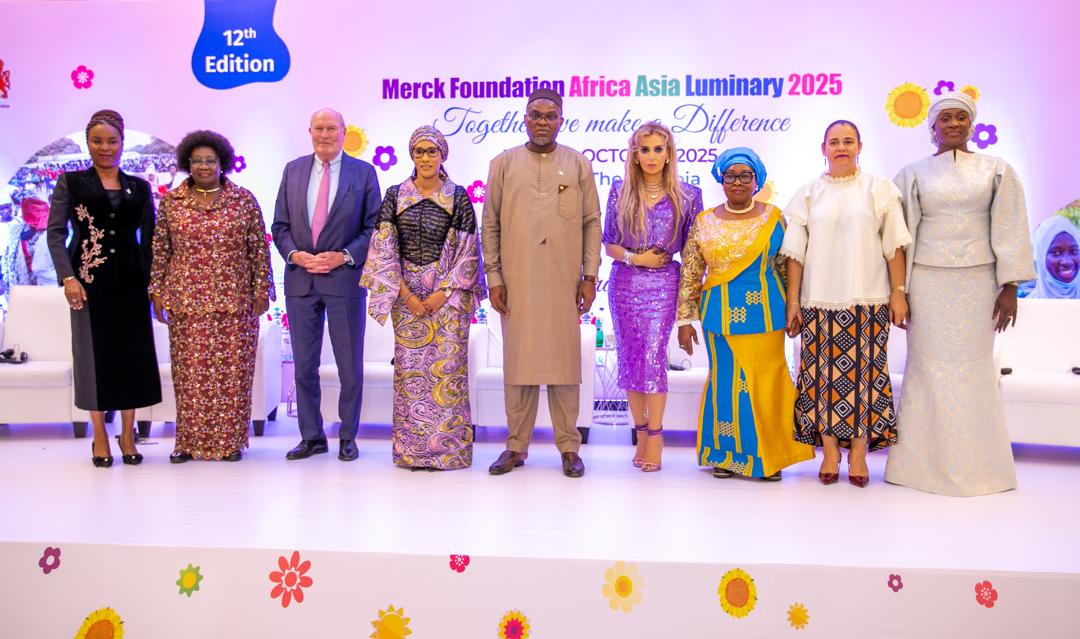
From tackling Africa’s critical shortage of medical specialists to breaking the stigma of infertility and championing girls’ education, the 12th Merck Foundation Africa Asia Luminary opened in The Gambia on Monday with a call for sustainable healthcare transformation across the continent.
At the conference, held for the first time in Banjul, was a shared mission: to build local medical capacity, empower women, and ensure that no African is denied care for lack of trained professionals.
In her welcome address, the CEO of the Merck Foundation, Senator Dr. Rasha Kelej, revealed that through partnerships with over 30 African First Ladies, the Foundation has awarded more than 2,400 scholarships to doctors and healthcare providers from 52 countries since 2012 creating the first oncologists, diabetologists, and fertility specialists in several nations.
“Before our intervention, some countries like Burundi, Liberia, Sierra Leone and The Gambia had no specialists in key fields such as oncology, fertility or ICU care. Patients either had to travel abroad or had no access to treatment at all. Today, we are changing that story,” Dr. Rasha Kelej told delegates, her voice drawing a standing ovation.
For The Gambia, the partnership’s impact has been nothing short of transformational.
According to Dr. Kelej, 94 Gambian healthcare professionals have benefitted from Merck Foundation scholarships — a remarkable number for a small country, strengthening local capacity in oncology, respiratory care, pediatrics, and reproductive medicine.
The three-day Luminary, co-chaired by Mrs. Fatoumatta Bah Barrow, First Lady of The Gambia, brought together First Ladies from across Africa, government ministers, healthcare experts, policy makers and media professionals including the First Lady of Nigeria, Mrs Oluremi Tinubu
Delivering his keynote, the Chairman of the Merck Foundation Board of Trustees, Prof. Dr. Frank Stangenberg-Haverkamp, underscored the urgency of building human capacity in healthcare across Africa.
“Africa carries 24 percent of the world’s disease burden but has only 2.9 healthcare workers per 1,000 people,” he noted.
“Our scholarships aim to bridge this gap. Many of our alumni are now the first specialists in their countries — we are literally making history together.”
He announced that the Foundation’s training programs now span 44 critical specialties from oncology, endocrinology and cardiovascular medicine to clinical psychiatry and neonatal care.
Haverkamp said the Foundation’s long-term goal is not only to train individuals but also to transform entire healthcare systems by building sustainable local expertise that reduces medical tourism and saves lives.
In her address, First Lady Fatoumatta Bah Barrow praised the Foundation’s collaboration with her office, describing it as “a lifeline for the country’s public healthcare sector.”“About a hundred Gambian doctors have been trained through Merck Foundation programmes — this is building a stronger medical workforce for the future,” she said.
“Together, we are empowering professionals, uplifting women and giving the next generation of Africans a healthier, more hopeful future.”
The Luminary also spotlighted the Foundation’s social impact initiatives, including its flagship campaign “Merck Foundation More Than a Mother” — which seeks to break infertility stigma, end gender-based violence and promote reproductive health awareness across Africa.
Complementing that is the “Educating Linda” program, which provides scholarships for underprivileged yet high-performing girls to complete their secondary education. Each year, 40 girls per country are supported through the initiative.
“Educated girls grow into empowered women who drive social and economic development,” said Prof. Haverkamp. “Health and education must go hand-in-hand.”
Throughout the event, speakers emphasized that Africa’s health challenges require collaboration, not competition — and that women leaders play a central role in driving change.
“As First Ladies, we are not just symbolic figures. We are mothers, caregivers and advocates who must ensure that no one is left behind.”
Disclaimer
Comments expressed here do not reflect the opinions of Vanguard newspapers or any employee thereof.