By Obas Esiedesa, Abuja
Fourteen years after Nigeria enacted the Freedom of Information (FOI) Act, challenges of implementation remain visible across ministries, states, and local government councils. Despite the law’s promise of transparency, bureaucratic inertia, poor record-keeping, and limited grassroots awareness continue to frustrate citizens seeking access to public records.
But the initiative by the Centre for Transparency Advocacy (CTA), with support from the European Union through the Rule of Law and Anti-Corruption (RoLAC) Programme and International IDEA, is beginning to change the landscape.
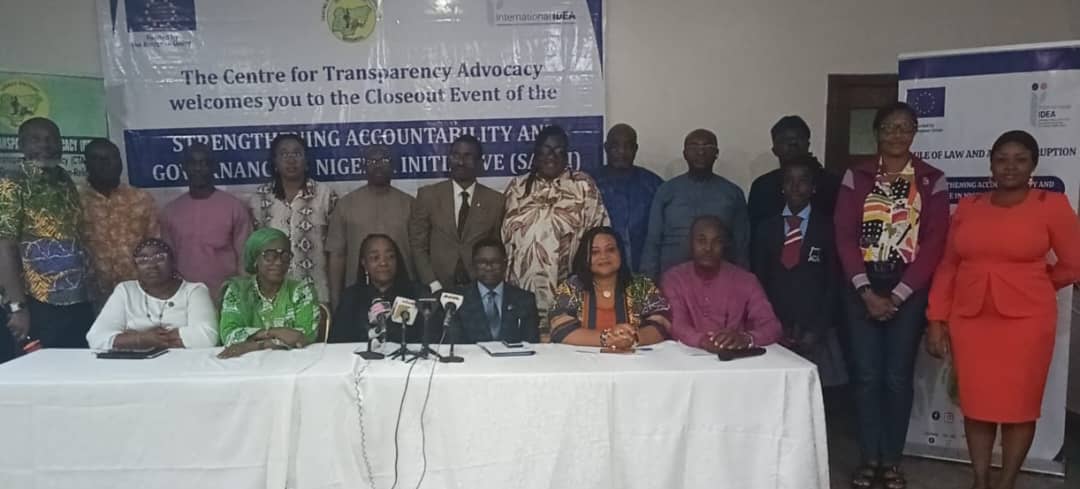
Launched in October 2024, the Strengthening Accountability and Governance in Nigeria Initiative (SAGNI) is a one-year project focused on the Federal Capital Territory (FCT), Anambra, and Edo States. Its goal is simple but ambitious: to make the FOI Act not just a piece of legislation but a working tool for accountability, accessible to citizens, civil society, journalists, and professional bodies.
According to CTA’s Executive Director, Faith Nwadishi, “Access to information is the bedrock of accountability and good governance. What we are doing with SAGNI is showing Nigerians that the FOI Act is not abstract—it is theirs to use.”
The project’s design targets both the demand side (citizens, CSOs, media, professional groups) and the supply side (government institutions). By building awareness, training stakeholders, and creating institutional structures, SAGNI aimed to bridge the gap between the rights guaranteed under the FOI Act and the reality of its usage.
At its halfway mark, SAGNI recorded measurable progress. According to its midterm evaluation, awareness of the FOI Act among targeted stakeholders has now reached 100 percent, while knowledge of national and state-level FOI provisions has doubled since the baseline survey in 2024.
Despite this awareness, actual usage remains limited: only 20 percent of surveyed stakeholders have ever filed an FOI request. Still, the existence of FOI desks in some ministries and the introduction of legal directives suggest a shift toward institutional compliance.
Two key legal breakthroughs have strengthened the enabling environment. In April 2025, the Supreme Court ruled that the FOI Act applies to all tiers of government, ending years of ambiguity that had allowed states and local councils to avoid compliance. Also in April, the Head of Service of the Federation issued a directive requiring federal ministries, departments, and agencies (MDAs) to process FOI requests through their legal units, enhancing accountability and standardizing responses.
Both developments give SAGNI and its partners stronger legal backing to demand compliance across federal and state levels.
The project’s midterm evaluation combined a quantitative survey of 35 stakeholders with in-depth interviews of 15 government officials, CSO leaders, legal experts, and media practitioners. The findings provide insight into progress and persistent gaps.
While awareness has increased significantly among surveyed stakeholders, 80 percent have never filed a request. Only 13.6 percent reported filing more than three requests. When asked about institutional readiness, 37.1 percent rated FOI uptake at national and sub-national levels as “very good,” but 31.4 percent described it as “poor.” Perception of state-level laws remains mixed, with 60 percent believing their state has an FOI law while 31.4 percent say none exists, highlighting continued uncertainty. Demographically, 40 percent of respondents occupy top-management roles, 54.3 percent are aged between 46 and 60, and nearly half (48.6 percent) are female. A majority (57.1 percent) represent non-profits. In terms of location, 34.3 percent were drawn from the FCT, 45.7 percent from Anambra, and 20 percent from Edo.
SAGNI’s achievements are not only legal but also programmatic. Through targeted interventions, the project created platforms for dialogue, training, and innovation.
Speaking on the impact of the project at a close out session in Abuja, Nwadishsi noted that “from roundtables that sparked conversations to capacity-building workshops that empowered stakeholders, to advocacy visits that elicited commitments, to radio jingles and programmes in both pidgin, Igbo and English languages, SAGNI has left footprints of progress. We have seen successes in raising awareness, improving requests for information, and nudging institutions toward greater openness. But we have also learned that the path to accountability is continuous, it demands persistence, collaboration, and courage.
“To move FOI awareness beyond professional circles, CTA rolled out a multilingual media campaign: broadcast jingles in Pidgin, Igbo, and English; produced a Theatre for Development documentary linking FOI to anti-corruption outcomes; and aired radio series “Transparency Talk: Sanitise Nigeria, Say No to Corruption through the FOIA.” The programme ran across the three focal states and is estimated to have reached a cumulative audience of roughly six million listeners. Social media extensions reinforced key messages and directed audiences to CTA materials and contacts for FOI support.
“To keep FOI visible at all levels, CTA produced and distributed 500 simplified FOI handbooks with infographics, along with branded notebooks and pens to reinforce recall at trainings and events. Social media messaging extended campaign reach, providing bite-sized guidance on “how to ask,” timelines, and escalation options when agencies fail to respond”.
It also held synchronized regional roundtables in Abuja, Awka, and Benin City brought together over 150 participants to discuss “FOI: 14 Years After.” Six intensive capacity-building workshops trained 45 participants on FOI request procedures and introduced Theatre for Development as an advocacy tool. More than 20 bi-weekly radio shows reached an estimated six million listeners, spreading awareness far beyond formal stakeholders. Three innovation hackathons allowed stakeholders to design prototype tools for FOI request tracking and data visualization. In addition, stakeholder town halls fostered dialogue between government, civil society, and the media on how to strengthen FOI uptake at national and state levels.
These interventions have helped normalize conversations around the FOI Act, moving it from the realm of legal specialists into public discourse.
Despite these gains, SAGNI’s evaluation highlights persistent obstacles. Bureaucratic resistance, poor record-keeping, and limited rural awareness remain major challenges. Many government agencies still rely on paper-based filing systems with little indexing, making it difficult to retrieve requested information.
Political will is also uneven. While some agencies are enthusiastic, others remain resistant, often treating FOI requests as nuisances. In rural areas, awareness of the Act remains low, and citizens are less likely to pursue requests due to lack of resources or knowledge.
As one local government official put it: “FOI only gains traction if governors see it as a governance priority.”
The evaluation found significant differences between states. Anambra, for instance, recorded the highest level of participation in SAGNI activities, thanks in part to the state’s own investments in digital tools and community engagement. By contrast, Edo’s lower survey representation underscores the risk of under-reporting progress where participation is thinner.
Still, peer learning groups have been established in all three focus states, providing forums for experience-sharing and joint problem-solving.
While awareness has improved, turning that awareness into practical, sustained usage of the FOI Act requires deeper reforms. The report recommends enhancing rural and legal capacity by expanding training through “train-the-trainer” modules with grassroots CSOs, the National Orientation Agency, and the Nigerian Bar Association. It also calls for eliminating cost barriers by removing administrative fees and enforcing the seven-day statutory response deadline.
Incentives for compliance are also necessary, such as publishing quarterly FOI League Tables ranking government agencies and introducing Service Delivery Awards for top performers. Scaling digital solutions, such as integrating CTA’s FOI tracking applications into government portals and launching a public FOI performance dashboard, is another priority. Sustaining multi-stakeholder engagement through quarterly town halls, strengthening legal support through pro bono FOI clinics, and securing dedicated budget lines for FOI implementation are all vital steps forward.
The FOI Act is not just about access to records; it is about building trust between citizens and government. By demanding disclosure, citizens can hold institutions accountable for budgets, procurement, and policy decisions. For journalists and civil society, it is a tool to investigate corruption and push for reforms. For the average Nigerian, it is a way to know how public resources are being used.
CTA’s SAGNI project demonstrates that change is possible when awareness meets advocacy and institutional reform. The Supreme Court’s ruling, the Head of Service directive, and CTA’s grassroots engagements are together creating a more enabling environment for transparency.
CTA’s interventions have proven effective in mobilizing both citizens and institutions. Yet challenges—bureaucratic inertia, uneven political will, and rural exclusion—must still be overcome. As the project enters its final phase, its focus will be on deepening reforms, strengthening legal and institutional capacity, and ensuring that FOI rights translate into real accountability.
Ultimately, the success of SAGNI is not only about statistics or legal victories. It is about changing Nigeria’s governance culture—ensuring that transparency and accountability are no longer optional but essential features of democracy. With sustained advocacy and commitment, the FOI Act can fulfill its promise, empowering citizens and strengthening Nigeria’s democratic future.
Nwadishi concluded: “The Freedom of Information Act 2011 (FOIA) is a powerful instrument in our arsenal against corruption. By leveraging FOIA, we can promote transparency, and hold leaders accountable”.
Disclaimer
Comments expressed here do not reflect the opinions of Vanguard newspapers or any employee thereof.