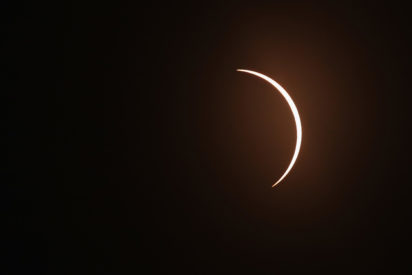
CARBONDALE, IL – AUGUST 21: The moon eclipses the sun above the campus of Southern Illinois University on August 21, 2017 in Carbondale, Illinois. Although much of it was covered by a cloud, with approximately 2 minutes 40 seconds of totality the area in Southern Illinois experienced the longest duration of totality during the eclipse. Millions of people are expected to watch as the eclipse cuts a path of totality 70 miles wide across the United States from Oregon to South Carolina on August 21. Scott Olson/Getty Images/AFP
Residents of Nigeria and several other West African countries will witness a rare celestial spectacle on Sunday, September 7, as a total lunar eclipse lights up the night sky from 8:00 PM West Africa Time.
The eclipse, expected to last around 83 minutes, will turn the Moon into a striking reddish hue, offering a breathtaking sight for stargazers across the region.
According to the National Television Authority (NTA), scientists confirmed that the event will be visible across most of Africa.
“Countries including Nigeria, Ghana, Cameroon, Gabon, Equatorial Guinea, Benin, Togo, Niger, Chad, and São Tomé and Príncipe will experience the eclipse, though the westernmost areas may miss parts of the early penumbral or partial phases due to the Moon rising closer to or during totality,” the network reported on Sunday.
While some western locations may miss the earliest stages, most of Nigeria will enjoy the full display, with experts assuring the public that it is both safe and awe-inspiring to watch with the naked eye.
A total lunar eclipse occurs when the Sun, Earth, and Moon align, causing Earth’s shadow to cover the Moon.
The National Aeronautics and Space Administration (NASA) notes that eclipses can be total, partial, or penumbral. The agency predicted that Sunday’s total eclipse will be visible across Europe, Africa, Asia, and Australia.
The Moon’s reddish glow, often called a “blood moon,” is the result of sunlight bending through Earth’s atmosphere.
Unlike solar eclipses, which require protective eyewear, this lunar eclipse poses no risk to human eyes.
Disclaimer
Comments expressed here do not reflect the opinions of Vanguard newspapers or any employee thereof.