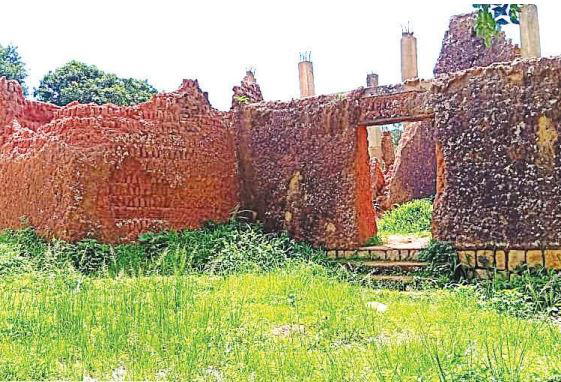
A part of the Zaria Friday Mosque in MOTNA
By Marie-Therese Nanlong, JOS
Once regarded as one of the cultural heartbeats of Plateau State, the Museum of Traditional Nigerian Architecture, MOTNA, located in Jos, now stands precariously. Forlorned and almost left to thrive on its own, the entity, which tells history of a people and society, is now threatened and may disappear with the story of hope and survival if not urgently attended to as a heritage of pride and adulation.
The story of MOTNA, a landmark that was the cynosure of all eyes and fun-seekers, is now thrown into the fissures of neglect and facing the risk of being thrown into the abyss that it might never recover from for a long time to come. MOTNA was once a sought-after base that made headlines and attracted attention from far and wide. But that allure is no more while the motivation to visit the place and relax and learn, has since vamoosed like a shadow. The wind has left the sail. In its former place of pride and beauty, desolation and squalor seem to have taken over, leaving the place with a sense of abandonment and obscurity in the process.
Some structures are in a state of despair, while others have since collapsed and are now forgotten. They are just no more and like the dead, their memories have since been cut off and forgotten by the living but thrown into history. Right now, apart from the the Ilorin Mosque and the Tiv, Goemai, Gbagi, Pategi, Idoma, Tarok, Berom, and Mbula compounds, that are still standing, four key structures in the northern section of the museum complex have crumbled. These include the Kano City Wall, the Katsina Emir’s Palace, the Zaria Friday Mosque, and the Gobirau Minaret. Their collapse is not just due to time but also to deeper structural, environmental and administrative challenges.
According to Mr. Kamndu Bitrus, the Curator of MOTNA, the main issue lies in the construction style of the buildings in the northern part of the museum. “Those structures were made of mud, designed as flat-roofed or domed traditional buildings replicated from Northern Nigeria, especially Kano, Kaduna, and Katsina,” he explained. “But the rain patterns here in Jos are different, more intense and more frequent, causing faster deterioration. Without constant maintenance, these structures cannot survive,” Bitrus said in an interview.
Recall that in 2006, the Federal Government, under President Olusegun Obasanjo, disengaged no fewer than 200 staff and traditional builders responsible for the yearly maintenance of the structures.
As a result of the removal of the key staff, the maintenance of the structures is said to have deteriorated rapidly, thus giving room for the current decay that now defines the once beautiful arena. The Jos Museum, which hosts MOTNA, was once a major tourist destination. Citizens like Gregory Atang remembers it as “a hub of learning, tourism, and cultural pride, where architecture students, historians, tourists, and even families used to frequent the site to better understand Nigeria’s diverse heritage.” Bitrus added: “You cannot talk about the future if you don’t know your past. This museum gives people a link to their roots. It empowers the local economy too, because visitors book hotels, buy crafts, and create a cycle of cultural tourism that brings revenue and boosts the economy”.
In 2021, due to increasing pressure and the need to preserve Nigeria’s traditional architectural heritage, authorities decided to separate MOTNA from the main National Museum in Jos. MOTNA was given autonomy and a mandate to grow. Bitrus gives reasons why things went rapidly down the drain and what has been done to keep the place going despite mounting challenges they face daily. He said: “When I came in, the place was dense. Trees and overgrowth gave cover to criminals. We had to engage communities, clear the environment, and bring everyone on board to restore this space. We also brought in vigilantes to tackle insecurity and give people a sense of safety.”
The transformation has not been easy, but efforts are bearing fruit. The craft village around MOTNA is being revived, and some new structures have been built. People now come more freely, and the area is regaining life. A recently signed Memorandum of Understanding allows a private individual to redevelop parts of the northern section into a film village with plans to return it to the museum after restoration. “This partnership is giving us hope. According to the designs we have seen, it will be a beautiful place,” Bitrus maintained.
Despite progress, challenges remain. The lack of perimeter fencing and encroachment on museum land are growing concerns. However, the curator has approached the Plateau State Commissioner for Lands, Survey, and Town Planning, Mr. Peter Gai, seeking intervention. He also speaks of a vision where MOTNA becomes a “living museum”, a place where people not only visit but live, keeping it alive. While some of the buildings have collapsed, the spirit of MOTNA remains upbeat because the museum is not just a relic but a reminder of identity, unity, and the power of community to preserve history.
Disclaimer
Comments expressed here do not reflect the opinions of Vanguard newspapers or any employee thereof.