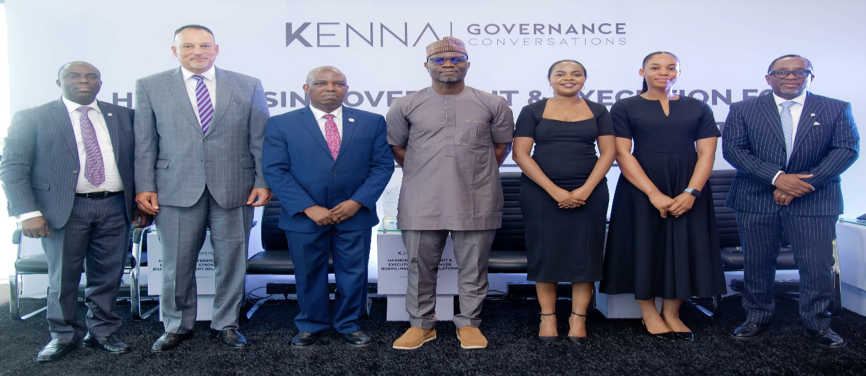
CORPORATE GOVERNANCE (L-R): Adekunle Omidiora, Practice Director, KENNA; Dr. Tunde Coker, CEO, Open Access Data Centres; Titus Osawe, Coordinating Director, Financial Reporting Council of Nigeria; Dr. Emomotimi Agama, Director-General, Securities & Exchange Commission; Nimma Jo-Madugu, Partner; Abasiemediong Etuk, and Prof. Fabian Ajogwu, SAN, all of Kenna at the 2025 Executive Session in Lagos.
In a demonstration of its commitment to thought leadership, Nigerian commercial law firm Kenna hosted an executive session in Lagos.
The high-level forum convened business leaders across diverse sectors, regulators, andcorporate governance professionals to deliberate on forward-looking strategies for strengthening board-management alignment, with the aim of enhancing organisational resilience in today’s fast-evolving business landscape.
In his keynote address, the Director-General of the Securities and Exchange Commission (SEC), Dr. Emomotimi Agama, stressed the need for well-run companies, as their actions have a direct impact on the economy and the country at large. He maintained that effective corporate governance practices are essential to the well-being of organisations, while noting that the quest to create harmony between the board and management of organisations should not lead to the blurring of lines between the roles and responsibilities of the parties.
He went further by stating that effective and transparent communication between the board and management is the first step to creating a collaborative organisation. According to Dr. Agama, “As regulators, we often see reports and complaints where boards and management struggle and fight over matters they should not; often driven by personal interest rather than the company’s interest. We must ask ourselves exactly what we intend to achieve; otherwise, why would we be sleeping on the same bed?
Trust and respect are essential, and only within a culture of genuine trust and respect can effective decision-making and collaboration flourish. When we dare to be board or management, we must have alignment that speaks to a shared purpose. That alignment is forged through open and transparent communication, ensuring both sides understand and pursue the same objectives,” he remarked.
Senior Partner at Kenna and Nigeria’s first Professor of Corporate Governance, Prof. Fabian Ajogwu, SAN, in his address “Strategic Governance: Harmonising Oversight and Execution for Sustainable Growth,” enunciated the board’s key responsibilities, which he identified as: appointing and evaluating the Chief Executive Officer; setting the company’s strategic direction; continuously monitoring and periodically reviewing that direction to ensure its ongoing relevance; and establishing the company’s risk management framework as contained in Principle 1 of the National Code of Corporate Governance 2018.
The Learned Professor cited instances of how governance failures and lack of transparency led to the erosion of share value, as seen in the Volkswagen emissions scandal; and the outright collapse of institutions, and board indictments as witnessed in the case of the Federal Republic of Nigeria vs Lord Udensi (the Alpha Merchant Bank case)
Professor Ajogwu, nevertheless, gave recommendations on how companies can clearly delineate the roles of the board and management for effective governance. According to him,“To achieve effective governance, a company must first clearly delineate the roles of its board and management. This begins with role metrics, which serve to demarcate guidance from instruction; an often very difficult line to draw”. He added, “Anchoring these metrics in a comprehensive board charter and nurturing a strong board culture will give everyone clarity of purpose. A capable company secretariat then acts as guardian of these boundaries, confidently directing queries to the appropriate party. Furthermore, establishing clear escalation protocols ensures that issues requiring heightened attention are addressed swiftly. And, to truly validate your system, you must test it through scenarios that simulate real-life challenges.”
In an interactive session, the Coordinating Director at the Financial Reporting Council of Nigeria (FRC), Mr. Titus Osawe, gave a detailed analysis of how regulators at the FRC set the tone for board-management dynamics without directly interfering in the activities of companies. According to Mr. Osawe, “Our mandate at the FRC is to make certain that there are right standards and guidelines out there; codes that serve as a compass for both boards and management. We recognise that communication and openness flow more naturally when operators have clear benchmarks to follow.
Mr. Osawe added: “Rather than intercede in corporate affairs, we issue codes and guidelines that articulate the boundaries of board oversight and executive execution. When the need arises, we develop industry-specific provisions so that each sector’s unique risks and opportunities are addressed. This approach ensures we do not stifle innovation or day-to-day decision-making yet still maintain a framework for accountability.”
On his part, the CEO of Open Access Data Centres, Dr. Ayotunde Coker, touched on lessons for managing difficult decisions between board and management, while offering insights to board members on staying relevant. For Dr. Coker, “Managing tough decisions demands that the board and management operate in complementary roles; the board provides vision, drawing on contextual expertise, while management drives execution. A true coaching relationship between the chairman and the CEO transforms potential conflict into collaborative problem-solving. Management must continuously supply the board with real-time updates, so directors can grasp fast-moving developments in technology and regulation. Conversely, board members must educate themselves relentlessly, keeping pace with industry shifts to ask the right questions. When both sides commit to that exchange of insight and guidance, even the hardest decisions become opportunities for sustainable growth.”
Partner and member of the firm’s Corporate Governance & Regulatory Compliance unit, Ms. Nimma Jo-Madugu, shared insights on the telltale signs of either board overreach or management misstep. According to Ms. Jo-Madugu, “In every organisation, the telltale signs of board overreach or management misstep are the same typical things you see in any dynamic: people are not able to be honest about what they are seeing, and the world begins to view management not as executors but as power-hungry actors overstepping their independence. At some point, evidence of that failure will surface in the form of missed targets, stalled projects, or an exodus of talent. The cure lies in structuring a fluid line of conversation between the board and management; one where feedback flows freely and questions are welcomed, not feared.”
The session was moderated by Abasiemediong Etuk, Co-Coordinator of the firm’s Corporate Governance and Regulatory Compliance practice unit. The session had an audience comprising executives spanning several organisations, including MTN Nigeria, Atlantic Refinery, Guinness Nigeria, Lagos Free Zone, Zenith Bank, Seplat Energy, Stanbic IBTC Bank, Optimus Bank, Afrinvest, Total Marketing, PAC Capital, among others.
The first edition of the Executive Session had Corporate Governance experts, Prof Mervyn King SC and Prof Fabian Ajogwu SAN in conversations, while the second coincided with the release of the book “Sustainability and COP28: What it Means for Boards.”
Disclaimer
Comments expressed here do not reflect the opinions of Vanguard newspapers or any employee thereof.