…as she redefines role of artist as active agent for societal reflection and transformation
By Rowland Yohanna Goyit
In contemporary art, it is not uncommon for creative practice to intertwine personal history with broader socio-political dialogues. Among artists deftly navigating this intricate space is Nigerian-born painter, Chidimma Urunwa Ikegwuonu, professionally known as Urunwa art, Currently working from Manchester, Chidimma’s recent oeuvre embodies a compelling confluence of personal testimony, cultural reclamation and social activism, positioning her prominently within contemporary global art conversations.
Educated in Fine Art from the University of Benin, Nigeria at the undergraduate level and MA at the University of Salford, Manchester, Chidimma adeptly blends traditional painting methodologies. Her approach is multidisciplinary, heavily emphasizing social transformation and community dialogue through visual storytelling. Her art practice, described by the artist as an intersection between the “physical and metaphysical, personal and collective,” notably centres on issues of identity, displacement and resilience.
Her recent series “Ode to Becoming” encapsulates the potency of her thematic engagement. Through titles such as “Her Silence Bloomed into Witness (Omenelū)” and “The Smoke That Wore Her Name: Ebēlē,” Chidimma painted deeply resonant narratives, embodying both historical silence and contemporary vocal reclamation. Her visual lexicon typically features fragmented, veiled female forms adorned with botanical alibis like banana leaves, vines and flowers. These features symbolize a dual existence resonating with the fragility of vulnerability and the regenerative potential inherent in the feminine form. Thus, her canvases become refined cartographies charting the feminine experience where each stroke and layer are deliberately placed to invoke a visceral engagement with trauma, renewal and survival.
For instance, “unCERTAINTY” (2025), executed in muted ochres and greys, portrays ambiguity both in form and concept. The central figure appears transient, almost ghost-like, partially dissolving into the canvas, reflecting life’s inherent unpredictability. Her technical approach, employing translucent oil glazes layered over preliminary washes, amplifies thematic resonance through meticulous craftsmanship. The resultant effect is a richly textured narrative that mirrors psychological uncertainty and transfiguration.
Likewise, “Onyemaechi” meaning “who knows tomorrow,” explores the dynamic tension between hope and uncertainty. The lone figure, set against a twilight backdrop, bears fragmented limbs and a botanical crown. Chidimma metaphorically addresses the precarity and resilience intrinsic to contemporary women’s lives, particularly within diasporic contexts. The deliberate juxtaposition of warmth and coolness, solidity and fragmentation, reveals the subtle complexities of navigating displaced identities, a recurrent feature in her work.
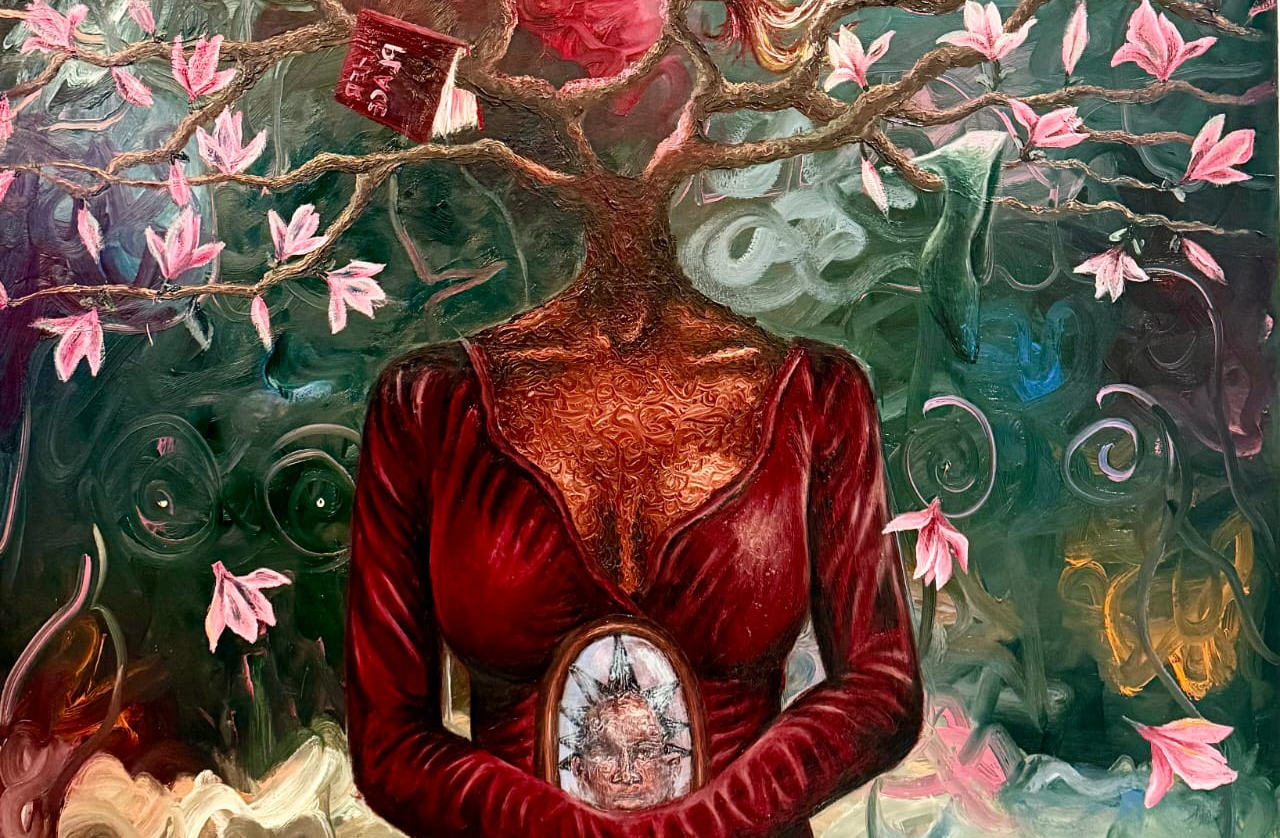
Chidimma Urunwa’s Her Silence Bloomed into Witness (Omenelū) is a compelling meditation on the quiet power that lies within constrained voices, particularly those shaped by cultural expectations. The painting’s striking image of a faceless figure whose head blooms into delicate branches and flowers challenges conventional portraiture and identity. The absence of a face, replaced by organic growth, evokes a complex dialogue between visibility and erasure—where silence, often imposed or expected, is transformed into a site of resilience and subtle resistance. The title’s invocation of “Omenelū,” meaning to not follow the norm, reinforces the painting’s challenge to accepted codes of conduct, especially those historically imposed on women within traditional cultural frameworks.
In this work, the artist carefully negotiates the tension between repression and expression. The floral motifs that seemingly grow from the figure’s lips and head act as metaphors for muted voices blossoming into testimonies that cannot be ignored, even if unspoken. The figure’s composed yet inscrutable posture suggests a controlled defiance, a refusal to conform silently to the roles dictated by inherited social orders. The intricately patterned skin, reminiscent of ritual markings or cultural inscriptions, underscores how identity and subjugation intertwine how personal histories and societal expectations leave visible marks on the body and spirit. Urunwa’s subtle visual language invites the viewer to consider how silence has been wielded both as a tool of control and a seedbed for transformation.
Chidimma Urunwa deliberately uses the Igbo language to title her artworks as a meaningful act of cultural reclamation and identity affirmation. Rooted in her personal heritage as an Igbo woman, the language goes beyond symbolism to become an essential part of her artistic practice, allowing her to convey experiences, memories, and spiritual reflections deeply connected to her cultural background.
Titles like Onyemaechi (“who knows tomorrow”), Omenelū (“witness”), Atuegwū (“bold she becomes”), and Ebēlē carry layered meanings that resist direct translation, invoking rich cultural nuances and collective histories integral to Igbo cosmology, traditions, and social realities. By centering indigenous language, Urunwa grounds her work in specific cultural and historical contexts, ensuring that her art is not simply aesthetic but also deeply anchored in identity and narrative authenticity.
Furthermore, these titles function to affirm cultural pride and resist cultural erasure, particularly within diasporic contexts. They become sites of resilience and counter-narratives against the marginalization and oversimplification of African identities within global spaces. In this way, Chidimma’s Igbo titling can also be seen as an act of advocacy, a commitment to preserving, promoting and honouring Igbo linguistic heritage amidst globalization’s homogenizing forces.
This integration of Igbo language aligns with contemporary postcolonial and feminist discourses, underlining how language can be a powerful tool for identity affirmation, decolonization and healing. Her titles, thus, invite global viewers into a richer, more profound engagement, encouraging them to delve into deeper cultural dialogues and challenging them to approach her work from a perspective of intercultural empathy and awareness.
Chidimma’s painterly practice has garnered critical acclaim through exhibitions at esteemed venues such as Thought Pyramid Art Gallery, Orisun Art Gallery in Nigeria, and the Salford Museum in the UK affirming her growing prominence within international contemporary painting. Her work’s distinctive visual language, marked by layered symbolism, tonal depth, and technical finesse, continues to position her as a leading voice in socially conscious figurative painting. While her themes often engage with broader social realities, it is through the painted surface her masterful command of composition, texture, and gesture that she asserts the transformative power of visual art. Her canvases not only evoke personal and collective narratives but also affirm painting as a vital, responsive medium in contemporary discourse.
It is obvious to see influences such as Frida Kahlo, Ming Ying, Njideka Akunyili Crosby and Tracey Emin distinctly apparent in Chidimma’s emotionally charged visual language, her painterly distortions and autobiographical intimacy. However, she is gradually evolving beyond these influences, carving her own distinctive idiom of spiritual expressionism, an artistic territory imbued with earthy tonality and symbolic depth that invites profound viewer introspection.
Conclusively, Chidimma Urunwa exemplifies an artist whose practice significantly contributes to contemporary dialogues on feminism, identity politics, migration and socio environmental concerns. Her work, grounded in meticulous painting techniques and a distinct visual language, positions her among leading contemporary artists whose narratives command sustained global attention. Through her compelling visual and social interventions, Chidimma not only reclaims suppressed voices but redefines the role of the artist as an active agent for societal reflection and transformation.
Disclaimer
Comments expressed here do not reflect the opinions of Vanguard newspapers or any employee thereof.