By Favour Ulebor
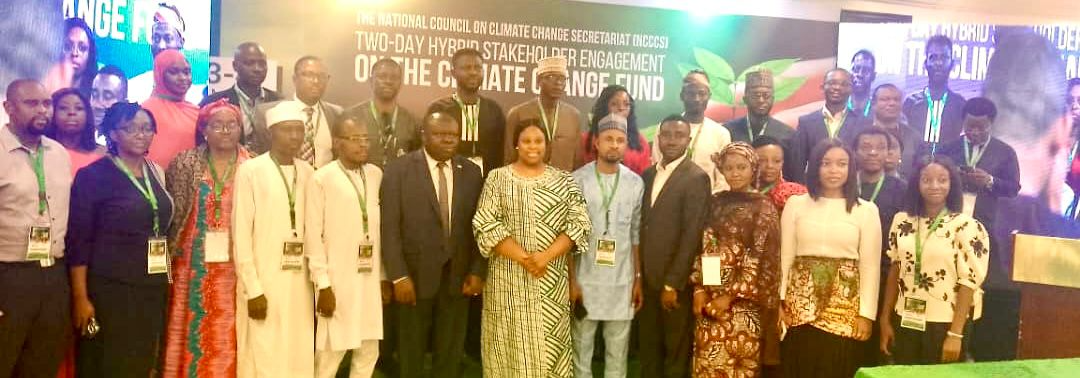
ABUJA—The National Council on Climate Change (NCCC) has convened a two-day hybrid stakeholder engagement to chart a clear roadmap for the operationalisation of Nigeria’s Climate Change Fund.
The event, which held on the 3rd – 4th of March, in Abuja, aimed at structuring the fund in a way that attracts global climate financing and supports the country’s net-zero ambitions.
Speaking at the event, the Director-General of NCCC and Special Presidential Envoy on Climate Change, Nkiruka Maduekwe, stressed the urgency of establishing the fund, which remains inactive despite being mandated by the 2021 Climate Change Act.
Maduekwe highlighted that the fund would position Nigeria to attract financing from international sources such as the Green Climate Fund (GCF), Global Environment Facility (GEF), and Adaptation Fund, among others.
She emphasized the need for a structured approach to prevent greenwashing while ensuring Nigeria meets its 2070 net-zero target.
She said, “the Climate Change Fund, professionalising the Climate Change Fund is very importantbecause that’s to provide you very clearly where we are going to get integration finance and adaptation finance from the country.
“And so for us as the Secretariat, this is a long time coming. The Secretariat was established by the 2021 Climate Change Act and the Council was inaugurated in 2022.
“But from 2022 to date, one of the key things is operationalising the Climate Change Fund and that hasn’t happened yet. And so for us, it is important, it is urgent that the Climate Change Fund is operationalised.
“But how do you operationalise something with nothing? And so this stakeholder engagement is very key to taking the feedback, co-creating the pathway for the Climate Change Fund and understanding that this is the path that Nigeria wants to take with regards to the architecture of the fund, the different windows, with satellite innovation, adaptation, operations.
“With this fund, we are looking forward to getting finance from GCF, GES, Adaptation Fund, the loss and damage.
“Two documents are coming out of this stakeholder engagement, which is happening today, the 3rd of March and the 4th of March. The first one is the climate architecture for the Climate Change Fund. The second one is a draft climate finance taxonomy.” She added.
Speaking during a panel session, the Infrastructure Finance Lead at the UK Nigeria Infrastructure Advisory Facility (UKNIAF), Abdul Oladapo, outlined strategies for developing climate change funds.
He stressed the importance of differentiating between climate finance and development finance, urging Nigeria and other Global South nations to adopt a development-first approach in accessing climate funds.
In his remarks, the High Commissioner of Rwanda to Nigeria, Ambassador Christophe Bazivamu, shared Rwanda’s climate finance and environmental conservation strategies, urging African nations to take the lead in solving climate challenges rather than seeing themselves as victims.
Bazivamu detailed Rwanda’s successes, including the creation of the Rwanda Green Fund, which has financed over $200 million in energy and ecosystem restoration projects.
He also highlighted the country’s green bond initiative, carbon market framework, and sustainable mobility projects, including a nationwide shift to electric motorcycles.
Calling for stronger Nigeria-Rwanda collaboration, Bazivamu emphasized that climate finance must be accessible beyond large-scale projects.
He said“The climate crisis is a continental and global emergency, and Africa, despite contributing the least to global emissions, suffers the most.
“We must embrace a multi-stakeholder approach, where governments, businesses, and communities work together to turn policies into action.
“Finance alone is not enough. It must drive sustainable projects that uplift communities, create jobs, and protect the environment,” he stated.
As Nigeria moves to operationalise its Climate Change Fund, experts and stakeholders at the engagement underscored the importance of implementing a finance strategy that aligns with national climate goals while securing international funding opportunities.
Disclaimer
Comments expressed here do not reflect the opinions of Vanguard newspapers or any employee thereof.