By Joseph Erunke, Abuja
A total of 3,084 Women Injecting Drugs, WIDs
Were successfully linked to the National Needle and Syringe Programme, NSP between 2022 and 2024.
Similarly, 663 women were linked to cervical cancer screening within the period through the Society for Family Health Reducing the Incidence of HIV and Hepatitis among Women Who Inject Drugs, SFH RIHHWID Project.
The project which equally reached 7,540 WIDs, provided HIV testing services to 5,412 just as it screened 3,878 for Hepatitis C and linked 61 women to HIV treatment, respectively.
Implemented by the Society for Family Health with funding from ViiV Healthcare Positive Action, the project aimed at addressing challenges in three pilot states of Abia, Gombe and Oyo.
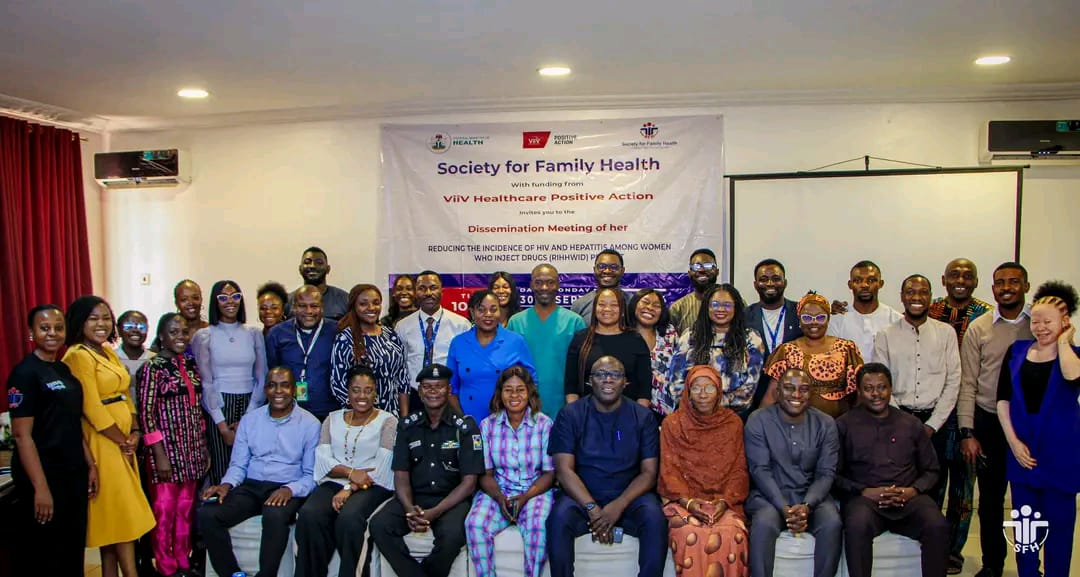
The project held its End of Project Dissemination Meeting in Abuja, recently, bringing together key stakeholders from government agencies, the Nigeria Police, World Health Organization,WHO, among others.
Presenting the group’s report at the event,the Programme Coordinator, Peace Ikani, highlighted the need for continuous collaboration from stakeholders towards the sustenance of harm reduction efforts.
Ikani, who said that Women Injecting Drugs were estimated to make up 20 per cent of all drug users in the world, said the number may be underrated due largely to criminalisation, gender inequality, and social stigma.
Noting that women injecting drugs were confronting stigma in two folds, from being both drug users and women,she explained that the development can result to what she referred to as “compounded adverse effects.”
Ikani,who noted that women injecting drugs were also facing issues,some of which she mentioned as ‘police intimidation, sexual assault’ among others, recalled that Instances have been “documented where women felt compelled to offer sexual favours to evade police scrutiny and as a result, WIDs are frequently discouraged from reporting acts of violence to law enforcement..”
According to her,“This can deter them from engaging in harm reduction programmes due to the fear of exposure, harassment, or arrest,”
Speaking at the event also,the Head of Positive Action,Viiv Healthcare, Jenny Cozins, expressed happiness that the project had brought the issue of WIDs to the fore, thus giving room to stakeholders to recognise their specific needs and take positve steps to solve them.
She said,”We have also highlighted where cultural and social norms often stigmatise and marginalise WIDs.The project has reached communities that have provided them with confidential services and has empowered women to seek help and have access to essential care. Additionally, the project has also connected people to prevention services, which is really important in the fight against HIV.”
On his part,Chief Superintendent of Police, Solomon Tanko,who spoke for the
Police Action Committee on AIDS,PACA, explained that most police raids involving women injecting drugs were not deliberate.
To avoid the development,he asked that stakeholders avail all necessary contacts to the police.
Also speaking,The Team Lead, Communicable and Non-Communicable Diseases Cluster, World Health Organisation,WHO, commended the Federal Government for steps taken so far in adopting WHO recommendations to guide the achievement of 2030 goals.
She said:“We have seen the government work tirelessly to ensure that the last component, the harm reduction bids, is also introduced into the country,.”
She urged the SFH to publish the findings so that Nigeria and the world could benefit from them and assist in setting up policies and guidelines that would help them benefit from the programmes.
Earlier,in her opening remarks, the Society for Family Health Deputy Managing Director, Pharm Kene Eruchalu, while reeling the summary of the RIHHWID project, reiterated the important assignment carried out in the last two years with a view to reducing new HIV and Hepatitis C infections among WIDs in the project states.
Eruchalu expressed gratitude to the stakeholders over their various invaluable contributions to achieving the project’d goal.
The National Needle and Syringe Programme,NSP is a nationally guided intervention specifically for people who inject
drugs on harm reduction.
Recall that following the 2016 United Nation’s commitment, it became imperative
for Nigeria, as a country to consider and implement interventions that are wholistic in content towards controlling the spread and transmission of HIV (as well as other STIs) among Persons Who Inject Drugs,PWID.
Implementation was executed by the Society for Family Health and funded by ViiV Healthcare Positive Action, with the aim to reduce morbidity and mortality due to HIV/AIDS and Hepatitis C among Women Who Inject Drugs,WIDs.
Disclaimer
Comments expressed here do not reflect the opinions of Vanguard newspapers or any employee thereof.