By Gabriel Ewepu
ABUJA- WITH commitment demonstrated by the private sector to upscale agricultural activities in Nigeria, 12, 000 farmers in the oil palm value chain are targeted to benefit from the launch of a Netherlands funded programme, Solidaridad and IDH, phase two of the National Initiative for Sustainable and Climate Smart Oil Palm Smallholders, NISCOPS.
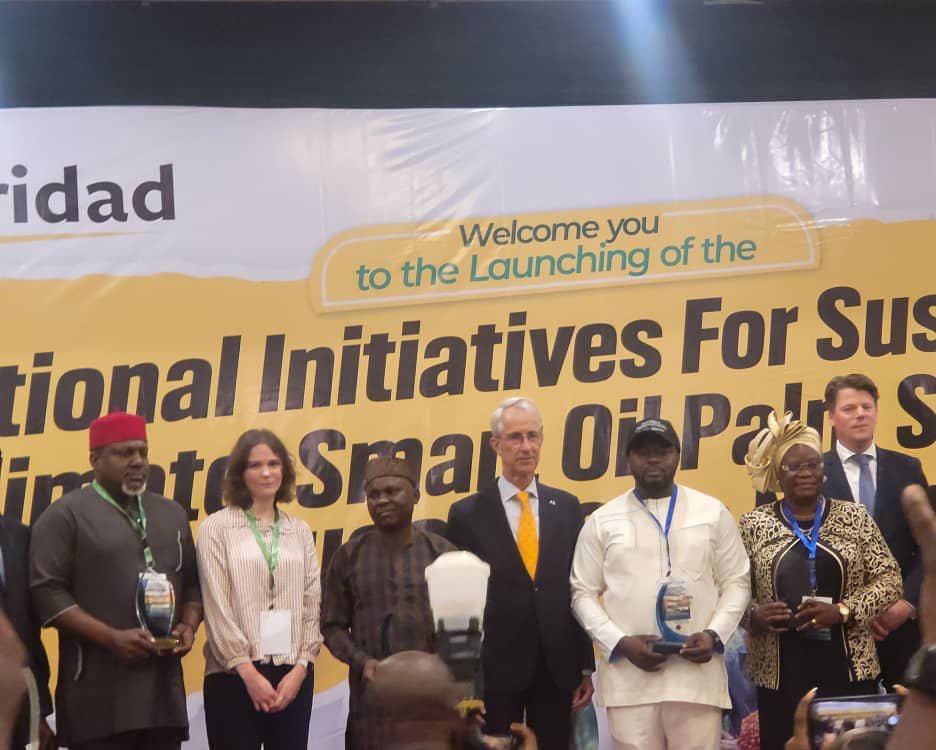
Speaking on the side-lines of the unveiling of the initiative, the Ambassador of the Kingdom of the Netherlands to Nigeria, H.E, Wouter Plomp, said the essence of the NISCOPS, is basically to improve the production of oil palm in the country, which Plomp also pointed out that palm oil is vital for Nigeria’s economy including Nigeria’s forests.
He also explained that unveiling of the second phase depicts Netherlands’ passion to ensure sustainable and a more environment-friendly activities, therefore will establish a social and bright future of Nigeria’s palm oil production.
He said: “You know very well that palm oil is vital for Nigeria’s economy; so is the future of Nigeria’s precious forests and so is equitability in the division of the gains of the palm oil sector.
“So, what we aim to achieve by this project is to have a more sustainable future and a more equitable future for the palm oil production in Nigeria.”
The Chairman Executive Board of IDH, Daan Wensing, said IDH has been deep into empowerment of the private sector across the world in terms of meeting the Sustainable Development Goal in the area of innovation power and investments.
Wensing further stated that IDH had partnered with Solidaridad, the government, public private partnership, farmers and civil societies.
In a remark, the Programme Manager, Solidaridad, Kene Onukwube, explained that the second phase of NISCOPS is a consolidation of the first phase’s achievement.
“We have been able to up the yield for oil palm up to 115 tonnes per hectare and that is a huge gap between where it was before.
“So, we think that best management practices that are contributing to that should be replicated across more locations.
“So, we want to be able to use this second phase to broaden that perspective; help farmers and communities to begin to take responsibility for the sustainability of their forests, for the forest landscapes vis-a-vis the oil palm landscape.
“The farmers we are going to work with now, we are looking at 12,000 and more”, he said.
Meanwhile, the Head of Programmes, Solidaridad in West Africa, Nathaniel Boateng, who represented the Regional Director of Solidaridad, Isaac Gyamfi, also explained that the major thrust and focus of the launch basically is to ensure the improvement and upscaling of oil palm production within the sub-region, hence it is targeted to boost the subregion to attain self-sufficiency to meet the demand of the commodity.
However, Boateng, pointed out that oil palm farmers in the sub-region should ensure they keep to international best practices as far as the environment is concerned.
“There is the notion that oil palm contributes a lot to deforestation; so, we seek to encourage farmers to invest more within the landscape that they are in to diversify and also enrich their production.
“So, that they get more from what they have instead of expanding into other landscapes or into the forest areas.
“It was a test case with a few farmers; in phase two, we are going to expand to other farmers; we are going to scale and consolidate the results that we have.
“But most importantly is to look for opportunities to also unlock climate finance for the farmers; so, that is a new area that we want to venture in on the NISCOPS phase two.
“So, farmers are able to intensify; do best management practices to reduce emissions and mitigate carbon emissions so that they can unlock climate finance”, he said.
Disclaimer
Comments expressed here do not reflect the opinions of Vanguard newspapers or any employee thereof.