.
By Babajide Komolafe, Yinka Kolawole, Nkiruka Nnorom, Elizabeth Adegbesan, Providence Ayanfeoluwa & Mariam Adebukola.
Following continuous fluctuations in the exchange rate and depreciation of the nation’s currency, economy experts have called for bold pro-business reforms to enhance dollar supply and build huge external reserves as the keys to achieving stability of the Naira and halt the rising trend in inflation.
Naira records mixed performance.
Last week the naira recorded mixed performance in the foreign exchange market. While the Naira depreciated in the parallel market by N45 to N1,520 per dollar on Friday from N1,475 per dollar the previous week, the Naira however appreciated in the official market, Nigeria Foreign Exchange Market, NAFEM, by N14.52 in NAFEM to N1,482.81 per dollar on Friday from N1,497.33 per dollar.
Furthermore, the volume of dollars traded in NAFEM last week rose by 42 percent to $1.27 billion from $895.69 million the previous week, indicating increased dollar supply in the market.
But the mixed performance of the Naira, fluctuations in the exchange rate, and persistent significant margin between the official and parallel markets exchange rates elicited concerns from economy experts who averred that the key to addressing these anomalies is to introduce bold pro-business reforms that will enhance dollar inflows and building of huge external reserves.
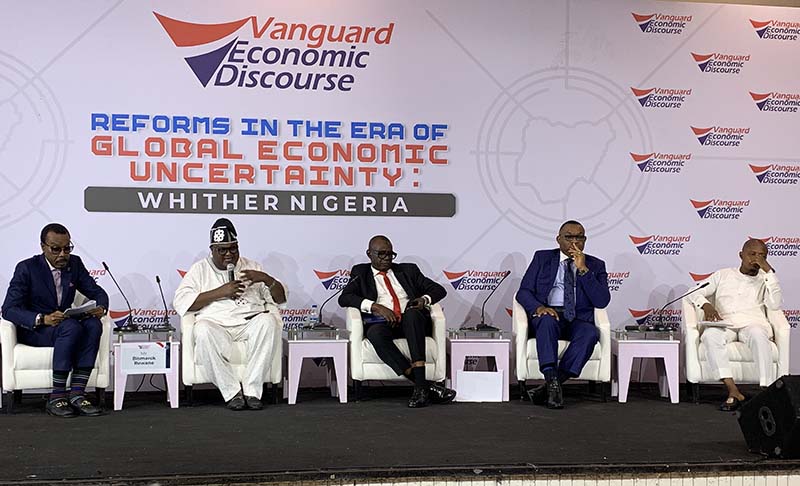
The experts who spoke at the 2024 edition of the Vanguard Economic Discourse held in Lagos last week include Governor of the Central Bank of Nigeria, CBN, Mr Olayemi Cardoso, the President of the Nigeria Association of Chambers of Commerce, Industry, Mines and Agriculture, NACCIMA, Mr. Dele Oye, the President of the Nigerian Labour Congress, Comrade Joe Ajaero, the President of the Association of Bureau De Change Operators of Nigeria, ABCON, Aminu Gwadebe, and the Managing Director of Financial Derivatives Company, Mr. Bismarck Rewane. The sessions were chaired by Nigeria’s eminent economist, Dr. Ayo Teriba.
While Cardoso defended the decision of the CBN to float the Naira, insisting that this was needed to achieve transparency in the forex market, create market-driven exchange rate, and long-term stability of the nation’s currency,
NACCIMA President, Dele Oye, argued that the CBN should note that the few countries that floated their currencies have strong fundamentals including an investment-friendly environment that ensure dollar inflow and also huge external reserves.
On its part, Dr. Ayo Teriba said that the CBN should focus on building the external reserves, stressing that without adequate reserves the country cannot achieve a stable exchange rate.
In the same vein, FDC CEO, Bismarck Rewane, averred that while reforms are needed to ensure an efficient market structure, Naira will not appreciate without an increase in dollar supply.
While stressing the important role of bureaux de change operators in the retail segment of the forex market, ABCON President, Aminu Gwadabe, advocated for more stakeholder engagements, and collaboration between the regulators and operators, adding that the apex bank should be fair in its relationship with BDCs.
Forex reforms are producing results — Cardoso
Speaking, CBN Governor, Cardoso, who was represented by Dr. Blaise Ijebor, the CBN’s Director Risk Management Department, highlighted the positive impact of recent measures to reform the forex market, assuring that these measures will lead to long-term stability of the Naira.
He said: “We have also embarked on major reforms to liberalize the foreign exchange market, which have enhanced transparency, reduced arbitrage opportunity, promoted stability, and improved liquidity in the market.
“The settlement of all valid FX forwards, which was one of my commitments when I came as a Governor of the Central Bank of Nigeria, has also improved the confidence of stakeholders. We are already seeing the results of this reform in the growth of FX flows into the country.
“In fact, the FX flows into the country in Q1 of 2024 was 136% of the total inflows that we had in the whole of 2023.
“We continue to be committed to a transparent and functional FX market where price discovery is based on market-driven frameworks and we are confident that this will lead to long-term stability of the Naira, which I know is what all of us see. Let us be able to know exactly what the rate of the naira is at any given time.
“So we are beginning to see these steps, these improvements, things get better. It will take some time. But if we stay focused on the reforms, and we are disciplined about the reforms, the pains might be there, but they will be short-lived and we will begin to see more and more results of this in time to come.”
Pro-business reforms will enhance FX inflow — NACCIMA
NACCIMA President, Dele Oye however advised the CBN to take cue from global trend and defend the Naira, adding that the focus should be on introducing bold, pro-business reforms that signal a favourable investment climate and hence increase dollar inflow through foreign investment.
He said: “We also have the floating of the naira. I want to say here that there are only 10 countries in the world where they freely sell their currencies, and these include the EU. So you have the US, EU, Japan, Norway, Australia, and others. Then you also have a set of countries that have stronger fundamentals than Nigeria.
What the country needs is significant foreign exchange inflow in the short time and there are two options to achieving this. The first option is borrowing but this is less desirable because it will lead to increased debt burden. The second option is to attract foreign investment and this is more sustainable.
“However, to achieve sustainable foreign investment, whether in the long term or short term, the government must introduce bold pro-business reforms to create a conducive investment environment. And these include improving trade infrastructure, reducing tariffs, liberalising critical sectors of the economy, and enhancing regulatory processes.
Oye also averred that the government must move from protectionism to a business-friendly approach.
“Implementing these measures requires a collaborative approach involving pro-business reforms, fiscal responsibility, increased revenue generation, and a diverse debt portfolio. By showcasing these commitments, Nigeria can restore investor confidence and move towards sustainable economic growth,” he said.
FG should leverage national assets for dollar inflow – Teriba
In the same vein, Dr. Teriba called for a program to use national assets to attract dollar inflows into the country in order to build the nation’s reserves, which he noted is a critical factor to achieving a stable exchange rate.
He said: “We are extremely rich in assets and our asset riches are unmatched by any other African country, but we keep those assets idle.
Nigeria needs to leverage more on its assets and part of the reform programs is to announce a program for turning to assets to unlock liquidity from our real estate. Kenya is taking 35 percent of its state-owned companies to the stock market this year, Saudi already did. How are we going to get liquidity from our real estate, state-owned companies and how are we going to get liquidity from our infrastructure?
“The reason why we need reserve is a lesson most developing countries have had since the Asian crisis of the late 90s. Many of the Asian economies lost GDP, their currencies were devalued, and companies went into liquidation.
“The lesson was that if you do not have adequate foreign reserves, then you lay yourself open to the risk of costly devaluation, recession and costly business failure. So they moved on since then, to build walls of reserve that guaranteed their currencies would be stable. It is a question of should I insure or not, the cost of insuring is the premium, the cost of the reserves you keep is known, but the cost of not insuring is what you would lose in the event of risk strikes.
“When Nigeria had $60 billion, the exchange rate was stable, growth was six, seven percent, and inflation was single digit. That $60 billion was stable because we had favourable oil prices. That era is gone.
“If you are among the few who can call up assets with which to attract reserves, please do, maybe we would have $200 billion and behind that wall, exchange rate would be stable, inflation would be moved.”
Nigeria must earn dollar, have transparent market — Rewane
Speaking, MD/CEO of Financial Derivatives, Bismarck Rewane, noted that while reforms are necessary to achieve an efficient forex market, the country must however earn dollars otherwise the Naira will not appreciate.
Rewane said: “If Nigeria doesn’t have the dollars, it’s done. Period. Second thing is the structure. I think, there should be an attempt to sanitize the market, change the structure, where there are fundamental issues. Secondly, there’s a big difference between if you are fighting terrorism and if you are against the value of the currency.
“So, my suggestion is that there should be communication between the operators, the policy makers and the regulators. Two, that the structure of the markets, the more the players, the more efficient the markets.
“Again, if there is no supply, you can have the best structure in the world, the currency wouldn’t appreciate. If there is supply, because you earn the money from oil, from invisible services and all of that, you should earn that. So, currency would appreciate.
“So, currency volatility is a natural part of markets. Look at other countries, look at the Ghanaian cedi, look at the South African rands. So that’s not true. If the central bank cannot print dollars, even if they would like to, actually they cannot, the only thing they can do is to earn the dollar and have an efficient transparent market.
“In which case, you have an auction. If there’s a bidding system, out of that auction, the price is covered, you will find a good price. Intervening, defending and all of that are only temporary measures.”
Forex reforms should be fair based on collaboration – ABCON
On his part, ABCON President, Aminu Gwadabe, advocated forex reforms based on fairness and collaboration between regulators and the operators.
He said that while ABCON welcomed recent measures by CBN to reform the BDC business, namely increase in minimum capital requirement and introduction of two categories of operators, he however noted that the measures were not fair and also not based on global practices.
“A BDC is not a deposit taking institution. We are raising the capital base of a BDC from N35 million to N500 million, that is Tier 2, the Tier 1 is to N2 billion. This is highly against global standards. In the U.K, minimum capitalisation of BDCs is 50,000 pounds. And at N2,000 per pounds, that is about N100 million. In Uganda, the capitalization of bureau de change is $13,000, in India it is $67,000. It is good for regulators to look at standards.
“Our reaction to the new policies, just like I said earlier, is that this may lead to loss of professionalism, investment and skills.
“These are players or operators that have been in the market since 1986. They just woke up one day and said they had withdrawn our licence and we should come and reapply. We felt it’s not fair. This is not right, we feel the CBN should review this. There are so many other things in the reform, we are not against reform.
Reform is to put in place orderliness, sanity, transparency and so many other things. We appeal to the central bank of Nigeria to review the minimum capital requirement in order to reflect global standards and also address the deadline as it is too short.
As Bureau de change, we are resilient, we are willing to work and partner with the CBN and also with the security agencies. Part of our appeal to the central bank is engagement, how can you come from nowhere, yesterday all of us could not sleep from N35 million to N500 million.
“What you are trying to avoid, if care is not taken, you are saying BDCs are money launderers, agents of terrorism financing, you will meet it in the future because at the end of the day, these people that have stolen money will hijack the sector and that is another money laundering that you are going to face in the future.
“Our request is for the Central Bank of Nigeria to engage with us to see how we can help them. We are not fighting the central bank, we are only saying let’s work together.”
Disclaimer
Comments expressed here do not reflect the opinions of Vanguard newspapers or any employee thereof.