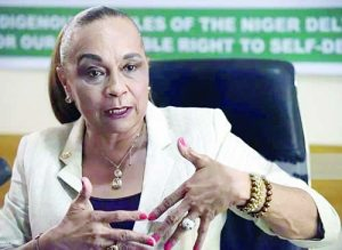
Annkio-Briggs
•Faults ethnic agitation for removal of Ndiomu
•Ijaw contribution birthed NDDC, PAP, ministry, others’
By Charles Kumolu, Deputy Editor
Rights activist, Ankio Briggs, in this interview, condemns what has become the culture of fighting the leadership of Niger Delta interventionist agencies by ethnic agitators. She says such agitations for change of leadership impedes the development of the region, saying the Urhobo, Isoko, Ijaw, Itsekiri and other tribes do not need to fight anyone occupying any position. With particular reference to the Presidential Amnesty Programme, PAP, she says the current Coordinator, Gen Barry Ndiomu, retd, should be allowed to conclude his reforms.
Looking at the amnesty programme currently, would you say it is achieving its objectives?
The amnesty programme has come a very long way from when it started. Different people have headed the programme at different times. Up to an extent, it has achieved its purpose. First of all, it created an enabling environment for the Federal Government to listen to what the agitators were saying at the time and also allowed the federal government access to the oil and gas because at that time, it was only getting 700,000 barrels out of the Niger Delta. When looked at from that angle, government and the international oil companies have gained what they set out to gain – to get access and get the economy of Nigeria back again. Moving forward, it’s quite debatable from time to time whether the programme has achieved what it ought to have achieved for the youths who were then armed. However, we cannot lose sight of the fact that there are more youths now that are not armed but the Nigerian system has not taken onboard the needs of those youths. For the specific reason of the amnesty, the present adviser of the Presidential Amnesty Programme, PAP, has just graduated some pilots. After graduating them, let us hope that we will be able to find jobs for them. For the federal government to say it has given amnesty, it has to be involved in the process of ensuring that people are employed out of what they have been trained to do, not doing so gives room for concern.
Many have attributed the near elimination of youth restiveness in the Niger Delta to the amnesty programme. How do you think the stability can be sustained?
It can be sustained by doing whatever that has been done and doing it better. That would mean to constantly ensure that youths in Niger Delta who, out of frustration and anxiety for the future, can make Niger Delta restive, are continuously engaged in education, bringing and sustaining employment, orientation and taking on board the development of the Niger Delta because so far, the development of the Niger Delta is lacking. You must not forget that the Niger Delta is a hard place to develop, especially the creeks, mangroves and swamps where most of the riverine people live. That means that whatever has to be done to develop those areas – to create jobs, give education, healthcare and human capital development has to be sustained, but it depends on the federal, state and local governments. We cannot also discount the oil companies that are creating a situation where they claim that they are selling off their assets. Also, that has already started making the youths concerned about the future. These are the things that bring about the crisis and they begin to slowly simmer. Of concern also is the fact that the oil companies are now abandoning the assets which are the pipelines and the devastation that they have kept in our swamps and creeks for up to 50 or 60 years. It is not going to be good for the region. These are some of the things that the government and the oil companies have to seriously look into. The Niger Delta, particularly the riverine areas where the pipelines and the oil operations are, is an area of huge concern and agitation will usually start from those areas. For me, knowing my people, I do know that these are the things that have to be looked at if we are to continue to keep the Niger Delta region free from agitation.
There seems to be a growing culture in the region whereby people of other tribes attack the leadership of the amnesty programme, leading to constant change of leadership. Do you think it is called for?
I don’t believe in attacking an individual who is at the head of the amnesty every single time. I don’t believe that it is the best thing for the Niger Delta region. Recently, I read in the paper that other ethnic nationalities are calling on the government to call the Ijaw to order or whatever the case may be. I think that I would want to say to the people of the Niger Delta, including every single nationality in the Niger Delta that first of all, we have to be fair to ourselves, we have to be truthful to ourselves. There is no arguing that from 1998 or 1997, before Abacha died, that anybody can pretend that they didn’t know that the Ijaw in the Niger Delta actually got up and began to resist the oil companies. It started with the Ijaw Youth Council, a movement that demanded for resource control and demanded for the oil companies to stop devastating the creeks and swamps which are our sources of livelihood. We are not the only people in the Niger Delta, but we are majorly the people in the swamps and creeks. It will be unfair not to recognise and appreciate the fact that the Ijaw contributed a lot to drawing attention to the Niger Delta injustice, just the same way Adaka Boro did in the 60s, Ken Saro Wiwa did for the Ogoni by bringing up the Ogoni people issues and actually highlighting it to the world. The Ijaw started doing the same thing from 1998 contributing to the fact that today, we have the Niger Delta Development Commission, NDDC, or our contribution to the fact that we have the Ministry of Niger Delta or the amnesty programme. I think it will be unfair to pretend that we didn’t play the roles that we played. We are not the only ethnic nationality in the Niger Delta. We are not claiming that everything should come to the Ijaw but it is not fair to allow the Ijaw to sit back. If you would recall under former President Olusegun Obasanjo, when Odi happened, Obasanjo ordered the military to enter Odi and burn down every single house. When you recall those things, other people too have paid their own sacrifices. The Ijaw faced a very heavy onslaught from the military and the federal government. We have a situation where the Ijaw are made to look as if we are the problem of the Niger Delta. Let’s not pretend that the Ijaw have not contributed a lot and I think that it is not in the interest of anybody in the Niger Delta whether they have contributed to the struggle or not. It is not in our collective interest to be seen fighting ourselves. As someone from the Ijaw ethnic nationality, I am constantly preaching for the unity and synergy for all the ethnic nationalities to work with one another and take a stand that is in the interest of all. People called us (Ijaw) all sorts of names – criminals and arm lovers. There was nothing our youths were not called. I think that one thing we should avoid in the Niger Delta is being singled out or singling other people out, we need to work together. We shouldn’t be our own enemies, we should be our own neighbours, brothers looking out for our collective goal. I also think that other ethnic nationalities should not disregard the fact that today we have amnesty, it is because everybody said the Ijaw are the criminals, the pirates and the kidnappers. That was the situation before amnesty was granted. We all saw the guns that Asari brought, Farah Dagogo, Ateke, Shoot at Sight, Afrika, all these names I am mentioning are all Ijaw and the guns were all coming from the Ijaw hands. I don’t know how anybody will deny that by bringing those guns out, we had not proven that we were the people who agitated to the point where the Yar’adua government had no choice but to offer amnesty. I think those things cannot be denied or swept under the table, but we should not be fighting ourselves whether Itsekiri, Urhobo or Ikwerre.
Currently, people of other ethnic groups are attacking the leadership of Maj. Gen. Barry Ndiomu (retd), saying Ijaw should no longer lead the amnesty office. What do you make of it?
Sadly, Ndiomu is not the first person that people have called for his removal. Also the person before him, and it goes on and on. It is sad for me. When I say for me, I speak from the place of an insider. It is worrisome that every time we have a new person in the office of the amnesty, there will be one section that wants the person and another section that doesn’t want the person. These are sections instigated to distract the leader from doing what he is supposed to. Instead of calling for the removal of Ndiomu, I think what we should be doing is calling for funding for amnesty. The funding that is being held for the programme should be released so that Barry Ndiomu can continue to do what he has projected to do. Whenever his tenure ends, whoever comes up can continue from where he has stopped. But for people to constantly call for the removal of a person from the day sworn-in until the day he leaves, I think it is reckless on the part of the people doing it. Of what use is it if at the end of the day the person is removed and somebody else comes along? I don’t understand it and I think that we should let people do the work that they have been given. Yes, he has come up with new ideas that were not there before. He should be allowed to put those ideas down and let us see whether those ideas will work or not. But just to reject what he has come up with because you don’t like it, I think it’s defeating the purpose of the amnesty, a programme put in place so that people who came out and accepted it can start a programme and finish it. If a person is trained in an area and that person is not able to use the knowledge acquired, one will have to ask oneself what the problem is. There’s been consistent talk about removing Ndiomu whose ideas we have not even tested. I think he should be allowed to proceed with the ideas that he has brought on board as some of us believe that he is going to work. At this point, I think we should learn our lesson and allow Ndiomu to finish what he has proposed and let us see if it works or doesn’t. Looking at what he is doing, I think he is doing a good job.
Some ethnic agitators are claiming that Ijaw ethnic nationality is getting more attention from the federal government more than other ethnic groups. What can you say about it?
I don’t know what people mean by that. We definitely know the ethnic nationality that have more of the resources on their land and those that don’t. The Niger Delta belongs to all of us, but we cannot deny the fact that the Ijaw from 1998 or even before that time were already agitating. It was the agitation that led to the creation of Bayelsa State. The Ijaw were agitating for justice and equity for themselves and for the region. It is not true to say that the Ijaw have benefitted more. How have the Ijaw benefitted more? That should be the first question. If the Ijaw were in the forefront of agitating for change in the Niger Delta and change has come to the Niger Delta, I don’t see why anybody would say the Ijaw have benefitted more. Let’s count what the Ijaw have benefited that others haven’t. The 13 per cent that the federal government is allocating to the state isn’t just going to the states where Ijaw are, it is going to all the states where everybody is in the Niger Delta. That the Ijaw are in every state in the Niger Delta is the reality of where we are or perhaps how large we are. The call constantly to instigate agitation against the Ijaw in the Niger Delta is unfair in my opinion. What we should be doing is working together. We should live together as brothers and sisters. When we begin to foment these problems among ourselves, it doesn’t do us any good. But I won’t buy into the idea that the Ijaw are getting more. Are Ijaw constantly the governors of Edo State? Akwa Ibom State, Delta or Rivers states? No. Sometimes we don’t even have a representative in the legislative arm. The Ijaw are in areas where there are no roads and yet we are in states where other people have roads. Also, the devastation is mostly in the riverine areas.
Disclaimer
Comments expressed here do not reflect the opinions of Vanguard newspapers or any employee thereof.