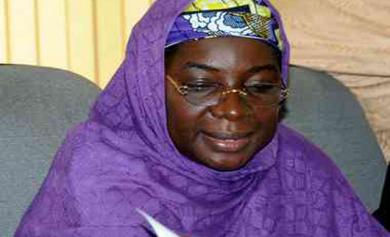
Education minister, Ruqayyatu Rufai
By Emmanuel Edukugho
As the only indigenous public examination body in Nigeria charged with the task of conducting school-based (June/July) and External candidates (November/December) Senior School Certificate Examinations (SSCE) and also Junior Secondary School (JSI) as well as the National Entrance Examination into Senior Secondary Schools (SS1) of Federal Unity Senior Secondary Colleges (NEEFUSSC), the National Examinations Council (NECO) is confronted with several challenges which tend to undermine its smooth operations.
Professor Promise Nwachukwu Okpala is the Registrar/Chief Executive, NECO, based in Minna, Niger State. In a media parley at the expansive NECO Headquarters, KM 8, Bida Road, Minna, flanked by top management personnel, the Research Professor of Educational Evaluation, who studied at the University of Nigeria, Nsukka for his undergraduate and University of Ibadan for graduate programmes bared his mind comprehensively on issues concerning the activities and operations of the organization.
He came into office in April, 2007 and had since embarked on changes that brought some positive turnaround of NECO.
Okpala explained that the Council is working towards a common purpose, common task for the Nigerian society, which is on educational issues, considering that education is not restricted to the four walls of the classroom, moreso as the larger society learns from the media due to the partnership involved in this business of eduction.

Education minister, Ruqayyatu Rufai
“We appreciate the need for frequent interaction to improve the quality of life in Nigerian society through education. The task is an enormous one”.
The question-and-answer session with NECO Registrar was revealing.
What are the challenges of NECO presently?
Our greatest challenges border on issues that will help us improve our operations. These are:
(1) Utility vehicles needed for distribution of sensitive materials, not for officers. Pick up vans, lorries, big, medium size. We keep materials with Banks, Police stations and traditional rulers. We have zero tolerance for malpractice, curb leakages, our papers to get to the right places, shift time table of examination from 9 a.m to 10 a.m to make for prompt delivery.
So at 5 a.m, the papers are there. If slow, there can be leakages, so we move with time. When we are on time, leakages are reduced. We make sure security presence is tightened, and staff motivated.
To see that our papers arrive on time, it operates at a cost. So we need more vehicles- healthy ones about 342 vehicles. Some places are reached by boats, motorcycles. We have 50 vehicles. We go to sister organizations for help, go to INEC, JAMB, etc. If you pool all these together, we have 60. About 50 per cent are hired from private sector.
There are big problems like checks by police who stop vehicles and want to see. At last, we will say its examination papers. More hours are wasted.
Marked vehicles are needed. We have only 50 per cent. We need more utility vehicles to help us check leakages. Our papers are sensitive and should not get late.
(2) ICT section: We need scanners. These are costly, about #30 Million. We have outdated ones. Scanners bought since 2000, the technology outdated, spare parts not available, and diminishing returns now. We need scanners to reduce time of releasing results. They are cost intensive, not like ordinary ones.
(3) Infrastructure: We need infrastructure at office levels. There are offices in six states and the National Headquarters. The 37 states (including FCT) need offices, not be tenants, working in snail speed. States are giving us help through Commissioners for Education. They are helping us to get buildings. But we want to be independent.
Why is performance of students in NECO worse than WAEC?
There are differences in operations. Like the concept of malpractice- more of malpractice, bad quality of result. Less malpractice, better quality of result. We are using the civil defense, lecturers in higher institutions as external assessors.
We insist on people with integrity. Invigilators and all those partaking in the examinations are staff of Secondary Schools. They won’t leave the students to write the examinations. We want people responsible to us. To start examination late, people can jump in from the bush.
Civil defense are mere observers. They have to report to us. Lecturers are assigned to schools. You can imagine the number of lecturers. They are expected to report three times in the course of examination. These are the people we are using.
Malpractices are prevalent so we need to move ahead. Social dynamics of Nigerian students today won’t give us the results we need. If we relax on malpractice, our results will not be valid. So we won’t relent. You can’t find NECO papers leaked. We are not particularly popular with teachers, we know.
The school curriculum seemed too bulky. What is your opinion about the curriculum and how does it affect performances?
If task is increased, it will affect performance negatively. To do well, reduce task. Go back to look at the content 10 years ago, it’s still the same- Mathematics, Physics, fundamentally the same. Not be in a hurry to tie performance with curriculum. Look inward as major stakeholders.
In describing a syllabus by the man hours being utilized, let us ask ourselves- are schools utilizing these man hours? Syllabus be cross checked with a view to either validate or alter it. But bear in mind our children can travel to UK, South Africa, and when transcripts are required, they want to see the question papers to have further insight into what is taught. Not just results- A, B, C, but want to know beyond results.
What about sanctions for exam malpractice and prosecution of offenders?
It’s difficult. Our culture differ. Impersonators can admit but after won’t come. They will bring people to beg. When courts need evidence beyond reasonable doubts, then it can be difficult. Not the children, but the schools are to be called to order. If mass cheating, copying in group whereby all pass, all fail, so we stop such schools- barred for two years. Problems of legal prosecution enormous.
Do you have strategies for curbing examination malpractice?
We are trying as much as possible not to embarrass ourselves and society.
The concept of malpractice is difficult to eliminate. Integrity, not law that can stop malpractice. Our concept is to see the extent to which we can reduce it. It is not a Nigerian thing. So we have to fight it with all our energies.
At what cost does NECO conducts its examinations?
Cost of conducting examination is a social cost because education is a social responsibility of government. Education is an enterprise that requires cost sharing. Social cost is different from economic cost. The charges we operate are approved by the government.
Education is a social service provided by government of the day. There is a limit we can go and source for funds. We alert our managers and get approval. If a scanning machine cost N30 million, no way we get it from students. We depend on grants from government after our presentation.
Any plan for early release of results like JAMB is doing?
It is not proper to compare us with JAMB- which is multiple choice- four, but NECO is nine. JAMB is one-day examination. We have common entrance examination which is one day exam. About 70,000 graduates mark our examination scripts. The best is to knock down the time to two months for release of results. The concept of early release of results is that of JAMB.
How is your quality assurance in the marking of examination scripts?
We organize coordination exercise for examiners. They go through the rudiments, guidelines, workshops for the high echelons. We have thousands of examiners, there is no way we can bring all of them to Minna. Process of marking scripts is taking seriously.
Scripts are marked with marking scheme for validity. A lot of scientific process built into marking, highly structured to guide the markers. We mark on the consensus of what the answer will be. We don’t mark flowery expressions, nor on temperament whether happy or sad.
Marks are split down to smaller units, and provided when answer is found. Scripts are marked with green, red, blue. We call it vetting. Randomly look at failure, border line cases and the excellent ones. There are levels of authority that ensure quality. It is only in machine scoring that one can be sure.
Is there a committee that looks into cases of withheld results and get them resolved expeditiously?
We have committee on malpractices. Committees also set up to look at results. Our results were ready two weeks before they were released. Scripts are brought in here and looked into, further insights into what happened. There are enough quality assurance in our examinations. But students will find reason for failure. Fees are charged for scripts to be re-marked. Lots of stages involved, but not in a hurry.
Any achievements so far?
Yes. We can run examination of this magnitude and not embarrassed in the last five years, because it touches on the integrity of the examination. Co-operation has come from all the staff, operating for five years, appreciating quality of our examination and confidence in the examination process.
Our examination don’t leak, good infrastructure on ground. In the next two years, it would be wonderful. Nigerians should be patient for the education sector to bring out results. Decay started long time. Repair can’t be automatic.
It will take time. NECO does not have the magic wand. It is doing a lot. The repair is gradual, result is gradual as the decay was gradual.
Disclaimer
Comments expressed here do not reflect the opinions of Vanguard newspapers or any employee thereof.