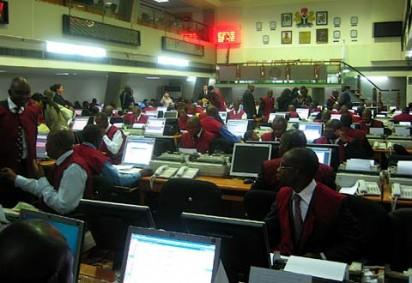
Nigerian Stock Exchange
By Dele Sobowale
Last week when investors on the Nigerian Stock Exchange were taking in the bad news that the All-Share Index, ASI, had reached its lowest level in eight years, the Council of the NSE made what was supposed to be a re-assuring announcement.
The NSE’s former Sole Administrator, Mr Emmanuel Ikazoboh, disclosed at the 15th Annual General Meeting, AGM, of the exchange that “the Investor Protection Fund, IPF, in its custody has risen to N600 million.” If the disclosure was intended to earn the speaker a round of applause, it failed miserably.
Instead, the announcement almost brought proceedings to a halt – as it should. In fact, it was the direct intervention of the former President of the NSE, Dr Oba Otudeko, which saved the Board from being voted out of office.
However, before addressing the N600 million joke announced as IPF, let us briefly return to some of the highlights of the report by the former Sole Administrator; it’s enough to draw tears – even from tearless eyes. According to him, the ASI which ended 2010 at 24,770.52 had fallen to 20,934.96 points by the end of October 2011.
While also telling the gathering that “the NSE-ASI struggled to maintain its footing, it was down 0.60 per cent in the first quarter, 0.84 in the second quarter, and another 17.8 per cent in the third quarter, recording a year-to-28 November 2011 decline of 18.84 per cent.”
It might be added that the ASI had since suffered more reverses since that statement was made and the loss to investors is not in billions but in trillions of naira.
Participants at the AGM might be forgiven for wondering if the announcement of N600 million as Investor Protection Fund hardly covers the losses of two major investors in the Stock Exchange; it might not even cover one. Meanwhile, there are millions of us in the same boat as the heavy investors in the Exchange.
The obvious question is: How does N600 million serve as adequate protection for losses in excess of N4 trillion considering Mr Ikazoboh’s own revelations; providing facts already at our disposal and which were even predicted right on the pages of VANGUARD Newspapers?
Added to that is the real possibility that the Exchange might not have bottomed-out yet; the decline might continue through December – which had been the traditional month for sell-offs. So, whatever the losses are, at the moment they might not represent the final tally of the disaster which had befallen the Exchange.
Just as hilarious is Mr Ikazoboh’s “assurance” that the “fund is presently in the coffers of a first generation bank” which demonstrates “the transparency and integrity the management of the Exchange seeks to bring on the operations of the market.”
At least somebody has, even if subtly, admitted that the operations of the NSE under previous Board and Management was as “transparent” as mud and the fate of investors was akin to putting a bunch of cats in charge of a fish shop.
In the past, which appeared like ancient history, but was actually only 2004, the three first generation banks operated with close to world class professionalism. They were conservative but solid. Or to borrow the slogan of one of them, they were BIG, STRONG and RELIABLE.
Today, the owner of the slogan is a basket case and a mere shadow of the Barclays Bank under whose banner it first set up shop in Nigeria. Few investors would be happy to discover that their deposit is in that bank. The second “first generation” bank, and the third to be established in Nigeria, like others, had to clean up its books after the Sanusi Lamido bomb shell of 2009. Its shares which traded at N57.40 per share in April 2008 was going begging at N2.53 per share on December 1, 2011.
That leaves us with the real First of all the first generation banks. Like the former Barclays, it started operating as the Bank of British West Africa. It was also conservative, may be stodgy in some respects. But, for generations, money in First bank was safer than any kept in Aso Rock; it was our own Fort Knox.
The first banking distress of the sector in 1997/1998 shook our faith in the bank. But, that was quickly restored by the former Managing Director, Joseph Sanusi, who also went on to head a conservative Central Bank. Perhaps it was a mere coincidence, but the departure of Sanusi for the CBN; followed by his replacement by Professor Soludo and the introduction of “con-soludo-tion” placed the “very first” bank in a dilemma which was not well resolved.
By the time Sanusi exposed the swindles underlying the operations of “Mega Banks” in 2009, none was spared. Even, First Bank Plc had to re-write its Annual Report and Accounts and admit errors made in the past.
It was like the angels of God going to Sodom and finding not even Lot upright. The question which should be on everybody’s mind is: has the First of the “first generation banks” cleansed its act? If one interesting interchange between the First Bank Plc and one of its depositors based at Ilara Mokin, D.C, is anything to go by, the N600 million, if kept there might be in the coffers but it might not be safe from questionable deductions from the account by the bank.
From that exchange between First Bank and its client, which was either inadvertently or deliberately copied to me, it appears that First Bank is once again adopting the principle of “if you can’t beat them; join them.” That was exactly the approach that brought down the Union Bank from its high pedestal to the low level it finds itself today.
In every sector, the leaders have the additional responsibility of, not only setting acceptable standards of professional practice; they also have the additional duty to establish the ethical posture. Nigerian banking is the only one worldwide where depositors are charged for daring to bring their funds to the bank; the bank which begged for it in the first place.
So poor Mr Ikazoboh, instead of providing assurance that the N600 million, inadequate as it is, has merely told us that the balance this time next year will be less than N600 million — even if no withdrawal is made from the account by the NSE and irrespective of the “first generation” bank where it is lodged.
That certainly cannot be anybody’s idea of safety. More to the point, Mr Ikazoboh seems to ignore the fact that the banks, regardless of generation, were the major contributors to the ruin of the Nigerian Stock Exchange. Through hastily packaged IPOs, they induced the bubble which sucked in a lot of investors.
And when that was not enough to mop up the excess shares, they adopted approaches to clean up the excess – instead of allowing market forces to determine the success or failure of any issue. The deepest drop in share values have occurred in that sector which depends on confidence – which is now almost totally lost.
Given restoration of confidence in the banking sector, the N600 million could be leveraged into several billions in credit within a year and a recovery could get underway. NESTLE, GUINNESS, NB PLC, and FLOUR MILLS shareholders don’t need the IPF because they have operated their businesses with professionalism and integrity.
It is those whose shares have been subjected to price manipulation in the past and who constitute the largest sector of the NSE that continued to drag the ASI towards the basement and for those N600 million is like peeing in the desert to grow food. It simply won’t happen.
However, we still have a problem on our hands – what can be done with N600 million; other than keeping it in a bank which will slice off a bit of it? To answer that question, we need to know what exactly the IPF was intended to do.
Right now, what we have on our hands is the economic equivalent of someone wanting to cross the Pacific Ocean in the middle of typhoon season in a paper boat. The amount, N600 million is too little and might be too late and it runs the risk of being misdirected – if not again mis-appropriated.
Incidentally, this is not a condemnation of Mr Ikazoboh, who actually deserves a National Award for courage. He was not part of the rot. He was drafted to help clean up the mess left behind. Few people would have been able to stand before a gathering to deliver bad news – knowing in advance what the reaction would be. He had been given an almost impossible task to perform; he did his best – as far as we know. He deserves every shareholder’s gratitude for his efforts.
Disclaimer
Comments expressed here do not reflect the opinions of Vanguard newspapers or any employee thereof.