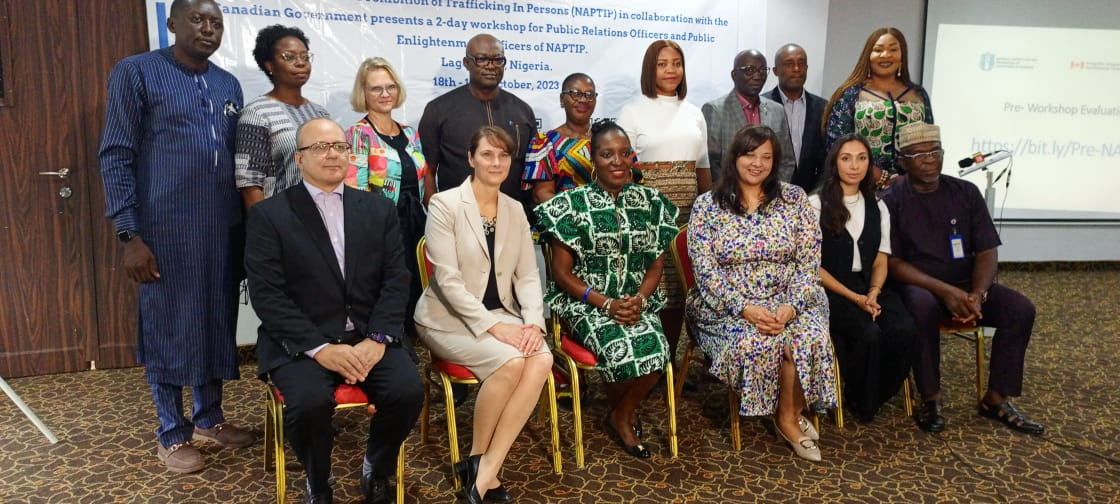
DG NAPTIP, Dr Fatima Waziri-Azi(m) flanked by Canadian partners, at a two-day workshop for the agency’s Public Relations and Public Enlightenment Officers , in Lagos.
*Trains Commands PROs, others
By Evelyn Usman
Director-General of the National Agency for the Prohibition of Trafficking in Persons, NAPTIP Dr. Fatima Waziri-Azi, yesterday in Lagos, disclosed that the agency had secured 631 convictions, in its fight against human trafficking in Nigeria.
Among the convictions were two high-profile transnational human traffickers based outside the country.
She made the disclosure at the flag off of a two-day workshop for Public Relations and Public Enlightenment Officers of the agency, in collaboration with the Canadian government.
Describing the convictions as part of the zenith of the agency’s achievements, the DG disclosed that out of the figure, 80 convictions were secured in 2022 and 55 between January and October 18, 2023.
She revealed that “ For the first, on March 8, 2023, we extradited a high profile human trafficker back to Italy to serve out her 13 years sentence and this we did with the collaboration of the Federal Ministry of Justice, International Police, INTERPOL and the Nigeria judiciary.
“Three weeks ago, we secured the conviction of a high-profile transnational criminal, a Nigerian based in Belgium, responsible for trafficking tens of girls all over Europe. She was sentenced to 12 years imprisonment and a fine of N24 million naira.
She explained that the training of the public relations and enlightenment officers drawn from the 32 states commands across Nigeria, was the first of its kind in the history of NAPTIP, adding that it became necessary for everyone to speak with one voice and under one vision, as the vocal anti-human trafficking law enforcement agency in Nigeria.
“ We have had in the past where we have this disconnected silos, different PROs and Public Enlightenment officers doing their own thing and we felt it was important bringing everyone together to enhance their capacity in the area of strategic communication so that we can be seen as one agency, speaking with one voice, under one vision.
Waziri –Azi highlighted objectives of the training to include: “raising awareness on the issue of human trafficking , with a view to dispelling news and raising public consciousness through effective storytelling, social media content and community engagement, in order to ensure that the harsh reality of the crime was not hidden.
Other benefits according to her, are “preventing vulnerability which is paramount by crafting messages that resonate and encourage. Too often, victims and witnesses of human trafficking remain silent due to fear of coercion or a lack of trust in authorities. Here, strategic communication plays a crucial role by assuring confidentiality.
“Shaping policy: effective communication can mobilize support for policy change , advocacy campaigns that spot life policy gaps, combined with data-driven reports can rally public support and push lawmakers to take action.
“International collaboration: trafficking knows no borders. Strategic communication serves as the bridge facilitating the exchange of best practices, insight and resources among nations”, she stated.
Earlier in her remarks, the Director-General, International and Intergovernmental Relations at Immigration Refugees and Citizenship, Canada, RCC, Heather De Santis , noted that the training showed the importance Canada and Nigeria attached to their collective efforts to address irregular migration, as well as ensuring that the borders and entering points in the movement of people were effectively and well managed.
She noted that “the government of Canada works diligently with domestic law enforcement agencies and bilateral international partners to not only enhance our own border management practices but also advance and support safe and regular global migration.
“This includes helping the fight against human trafficking and migrant smuggling. In doing so we work with regional and multilateral partners such as the United Nations to show our own best practices and strategies from Canada’s own national strategies to combat human trafficking from 2019 to 2024”.
Also speaking, the Director General, the International Policy and Partnerships Directorate, Canada Border Services Agency, CBSA, Natasha Manji, applauded NAPTIP’s efforts in the fight against human trafficking.
Like NAPTIP, Manji noted that her agency was also celebrating its 20th year anniversary. Having attained such a milestone, she noted that it called for review and reflection, with a view to creating an enabling footing that would stand in the next 20 years.
She said, “ For all of us here today, the shared priority in protecting our immigration and border management become paramount. People are in the move more than ever before and Canada continues to see increased legal pathways for movements of people in business, education, work and family. But we know that with the increased opportunity for movement comes increased interest by criminals to exploit people . These two sided realities make it much more important that we collectively find a way to partner in preventing, detecting, disrupting and probably prosecuting those criminals.
“No matter the capacity in which we work , it is not only to address the problems in front of us now, but also to think bigger and beyond ourselves. We need to ask ourselves what action we should take now that our citizens will be glad for in 20 years from now’.
Disclaimer
Comments expressed here do not reflect the opinions of Vanguard newspapers or any employee thereof.