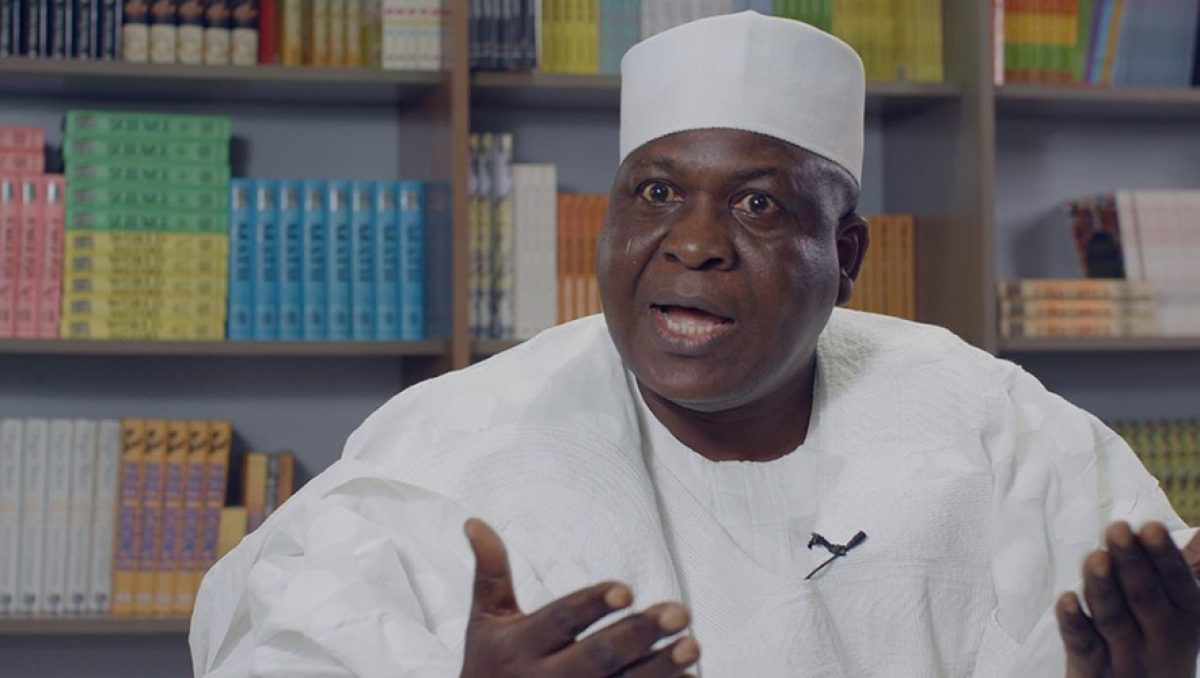
•’NYSC military content should be expanded’
By Chris Onuoha
Retired Col Hassan Stan-Labo is a veteran of the Nigerian Army with a wealth of operational experience covering 31 years as part of the Army’s Elite Infantry Special Forces Corps. His combat duty tours took him to Liberia, Sierra Leone, West Darfur and Bakassi Peninsula.
Hassan is a recipient of the prestigious Rockefeller Foundation Award for Service and the Convener of FIX NIGERIA NOW ! In this interview, he speaks about mass kidnappings especially of students in the country.
With regards to prevailing security issues in the country, the most worrisome now is the kidnapping of helpless students. What is your view concerning mass kidnappings and implications for the polity?
It is rather unfortunate that we have failed to put in place proper security protocols required in the protection of schools and safety of our children. In 2014, immediately after the Chibok girls abduction, Gordon Brown, who was then UN Special Envoy for Global Education, led a delegation to Nigeria and recommended to us the Safe School Initiative. The initiative provided for the building of community security groups consisting of teachers, parents, police, community leaders, youths groups and the glergy to promote safe zones for education.
It was aimed at ensuring safety at schools, rebuilding confidence in parents, restoring hope and faith in the school system by mitigating these vices. If you may ask, what has been Nigeria’s response since 2014. In our usual nonchalance to matters of national importance, Nigeria was able to articulate the National Plan on Financing Safe School initiative in 2022. This is a three-year plan to be implemented from 2023 – 26.
My view on the continuous kidnapping of students is that it does far-reaching damage to the psyche of students and parents. It could impact on enrolment levels if parents are not too sure their kids are safe.
Basic requirements for safe school environment could include initial risk assessment conducted by a professional security expert to identify needs, and help in the formulation of a plan of action and implementation. Other requirements would include communication, access control, signage, perimeter fencing, CCTV, visitors, data access, security lightening and education on emergency procedures.
In view of our our peculiar insecurity situation in Nigeria, what should be considered include inspection of route; inspection of Infrastructure; locations; inspection of bus; awareness of safety; display of emergency numbers; first aid & school clinic and police deployment.
Families whose children are held hostage are lamenting with little or no help in sight. What is the real role of government in the matter and why the seeming nonchalance to quick response?
The seeming nonchalance in response time can partly be blamed on our inability to avail our land forces combat groups adequate multi-modial mobility transport assets to enhance response time under emergencies.
It should include all terrain transport assets; all season transport assets; helicopters; motor bikes animal transport assets among others. Additional governmental effort would border on its ability to mitigate the on-going resurgence of killings and banditry all over the country.
Firstly, I will strongly recommend a redefinition of the security problem on ground. A redefinition would reveal social, economic, political, religious and even cultural dimensions that make up the eclectic mix in Nigeria’s security challenge. A redefinition would avail a clearer picture and perspective to the ongoing killings and genocidal effort as seen in Southern Kaduna and also the Plateau and Benue serially motivated killings.
It would also avail incite into the complicit role played by key persons in government both at the national and sub-national levels, while paying lip service to our plight. The recent exposè on a former governor and the granted interview by another former governor making a strong case for amnesty for armed bandits are clear indications of complicit behaviour by government officials.
The situation at hand demands for the engagement of all stakeholders in a fruitful dialogue aimed at unearthing the root cause of this recurring problem. Such a discussion must have total representation of all segments of the society.
The include government representatives; community heads; religious leaders; youth groups; women groups and the citizenry. All groups above must leave such a meeting knowing what message to carry back to their larger constituents.
State government should also avail support to the security agencies as may be required, prosecute bandits and terror suspects.
On the side of community heads, they should have good grassroots touch and establish good Intel network, hold regular townhall meetings to review the security situation and be in close liaison with security agencies within own AOR. Religious leaders should serve as mobilisation (rallying) tool, serve as dissemination (mouth piece) tool and serve as motivation point. For youth and women groups, they should ‘see something and say something’, also know your neighbours and neighbourhood. Military role should be to encourage and support non-kinetic effort by field commanders, decrease the capacity of non-state actors to challenge the authority of the state in the use of force, dominate all forested and ungoverned spaces within the country and avail solutions to the national security challenges that include border protection, land, air and maritime. Others are small & light arms proliferation/mopping, role for veterans in the ongoing war and the role for vigilante in the ongoing war.
The case of Chibok girls and Leah Sharibu easily come to mind. What do you think is the right way to contain this challenge?
I have in the past enumerated reasons for the seeming ineptitude and likely solutions. The problem borders on lacklustre attitude, poor interpretation of the battle, indecisiveness, non-proactiveness, manpower deficit, log and equipment deficit, and poor inter service synergy. Some of the solution to this is to enhance manpower by expanding on existing training facilities, prioritise the national interest in decision-making rather than resorting to sectarian sentiments, listen and adhere to security professionals and experts rather than politicians and, lastly, domesticate and implement the UN Global Safe School Initiative passed on to us by the UN Special Envoy Gordon Brown.
NYSC was established for national integration but over time, insecurity has marred the objective. What would be your best advice and would you advocate for states to manage their graduates internally?
The NYSC is a laudable platform for national integration and must continually undergo fine-tunings and review aimed at improving its service to the nation. I am of the view that the entire scheme is long overdue for an indept overhaul or regig. I want to see the military content of the program expanded to include some basic rudiments of military activities as shooting and manuvres.
This discussion however is for another day. For states to manage their own graduates would be defeatist to the objective of the programe which is national integration. The NYSC management should continue rather vigorously their ongoing education of Corps members at orientation camps on the need for personal safety, alertness and consciousness of thier environment at all times. Host communities, traditional rulers, security agencies, clergy men etc. must take ownership of these children by way of real support, a show of love and acceptability in the community.
Tell us what you think the government is not doing right as it concerns the safety of students and the citizenry in general.
One major and fundamental gap yet unfilled by past and present administration is our failure to articulate a National Security Sector Reforms Template document. This document would amongst other things avail adequate prescriptive requirements and procedural protocols in overcoming challenges in the security sector.
The document would need to be put together by professionals and experts with vast operational and administrative experience covering various dimensions.
It would address the perennial lingering fundamental issues in the sector which I refer to as ‘The Big 5’ namely: Funding, Manpower, Training, Logistics & Equipment, Welfare & Motivation.
Secondly, at the political-strategic level cutting across National and sub-national levels of government, the POLITICAL WILL to act in the national interest must be available without sentiments. Leadership is not meant for weaklings and it calls for men with GUTS.
The C-in-C must be bold, brave, decisive and proactive while yielding to professional advice from his Service Chiefs and not from politicians who often come forth with underlying motives. Thirdly, the government at all levels must come clean if citizens are expected to take ownership of the security situation.
In the last administration, it was glaringly clear that the Presidency and some governors up North were complicit in their actions. They constituted a clog in the wheel of progress pretending to be acting in our collective interest.
Commanders on the ground should be wary of dealing with state governors and politicians in general especially those demanding negotiations and amnesty for bandits, kidnappers and terrorists.
Disclaimer
Comments expressed here do not reflect the opinions of Vanguard newspapers or any employee thereof.