By Dennis Agbo
Erudite professors, professionals and statesmen from Enugu state have suggested that for the state and country to move forward in development, the people should be self-motivated to take the bulls by the horns and individually start to remedy what they consider as clogs in the wheels of societal progress.
The academia also noted strongly that no region in Nigeria, such as the south east, should be proud to claim that it is marginalized by the rest of the country, if within its domain some parts of it have equally repudiated on its neighbours and claimed supremacy on their fellow brethren. They agreed that Nigeria, at 63 years, has lagged behind; far from the position it would have been, if not for the singular and collective undoing of the country by the citizens themselves.
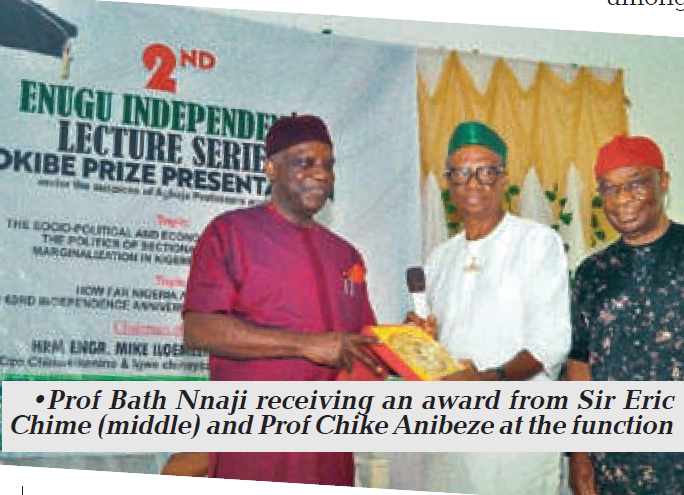
The thought-provoking revelations were made at the 2nd Independence lecture series and Okibe Prize presentations under the auspices of Agbaja Professors Worldwide, convened on October 2nd at the Enugu Sports Club.
Agbaja Professors Worldwide is made up of the academia from Udi and Ezeagu local government areas in Enugu state, which are culturally referred to as the Agbaja clan in Enugu state.
Delivering the lead lecture, “How far Nigeria and Nigerians @ 63rd Independence Anniversary,” the guest speaker, Prof. Mike Iloeje stated that it takes one tree to start a forest, stressing that even in diversities, no one can deny that the overwhelming view by a majority of Nigerians is one of gloom and doom; and at best, one of cautious optimism.
“In my view, the major problem with Nigeria is that Nigeria is gradually dying. Yes, Nigeria is on a sick bed; very, very sick; in the throes of death; gradually and gradually dying; and very soon if we all do not come together and do something about it, Nigeria may finally die. And what do the doctors say is the cause of this 63-year sickness? What is Nigeria sick of? Three diseases: All emanating from the same source and quickly metastasizing throughout the whole body; causing a myriad of other illnesses.
“In my view, the major problem with Nigeria is threefold: corruption, insecurity and the economy. Yes; corruption, insecurity and the economy; and these three diseases have been compounded by ethno-religious intolerance! A solution to the first two will bring about a cure for the third one,” Iloeje diagnosed.
He stated that the socio-economic and political health of any country and the ease-of-life of its citizens cannot be factually discussed without reference to the country’s Gross Domestic Product, GDP, disclosing that since our independence in 1960, the average growth rate of our GDP has been a paltry 1.7% per year. ”From 1960 until 2022, the GDP in Nigeria averaged 147.15 Billion USD, reaching an all-time high of 574.18 Billion USD in 2014 and a record low of 4.20 Billion USD in 1960. In a recent World Bank report published early this year, Nigeria’s GDP was 477.39 Billion USD in 2022. This GDP represents only a miserable 0.21% of the world economy.
“Yes, Change is possible. Can we really not stamp out from our universities the cankerworms of sex-4-grades, examination mal-practice, jaundiced appointments and promotions, mis-appropriation and embezzlement of funds, etc? As we gather today to review our country’s 63 year’s journey towards nationhood, let each one of us volunteer himself or herself to do one specific act to make the Nigeria of our dreams possible. For it takes just one tree to start a forest. I am that one tree; and so are you,” Iloeje charged.
The second guest lecturer and former Minister for Power, Prof Bath Nnaji, in his lecture dwelt on the negative consequences of dominance and marginalization and segregation, both as members of the country and in individual communities.
Nnaji stated that while the south east criticize the alienation of the Igbo from the Nigerian mainstream because of their voting pattern, the region needs to take a step back and engage in some introspection.
“In this era of Diversity, Equity, and Inclusion (DEI), can we say in good conscience that our dear State has been exemplary? Can we say with sincerity that the State Governors we have had since 1999 considered the entire state their primary constituency as shown by their key appointments and provision of infrastructure, as well as the location of certain facilities and institutions? Do we look for our best and use them for the good of our state without regard to zonal, cultural, historical, political, and other parochial considerations? I am afraid not many of us in this audience can answer these questions in the affirmative.”
He stated that the “Emi lo kan” mindset was typical of how a person who gains a top leadership position from a particular clan treats the rest of the groups in the State.
“While the Agbajas, the Nsukkas, the Greater Agwu people tend to be more inclusive amongst themselves, Nkanuland is viciously polarized. This is to the extent that they have used artificial labels to segregate themselves. Someone from outside certainly cannot identify the differences in people, unless the person is told who belongs to which group because they all share the same color as black people and have red blood running through their veins.
“Our people should work towards all the advantages bestowed on our communities for inclusion. It does not detract from who we are, or what we are. In Enugu State, we the Wawa people must remember our history and feeling of being dominated by our brothers from other parts of East Central State, and eventually by our brothers from Anambra State, which lent credence for our agitation for Wawa State, which eventually became Enugu State. We should not forget that it is the same marginalization that led to the creation of Ebonyi State,” Nnaji recalled.
Discussants of the lectures included Prof Agu Gab Agu of faculity of Law, ESUT; and the spokesman of Ohanaeze Ndigbo Worldwide, Dr. Alex Chiedozie Ogbonnia.
Chairman of Agbaja Professors, Prof. Chike Anibeze stated that the function of the group is to promote education and learning, related activities in Agbajaland and linkages with extensions worldwide.
“The second Enugu Independence lecture is in keeping with understanding of situating Enugu in the discussion of national activities related to Nigeria’s journey from independence to the present time,” said Anibeze.
Disclaimer
Comments expressed here do not reflect the opinions of Vanguard newspapers or any employee thereof.