By ADOBI MUO
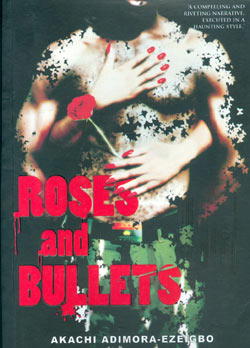
Akachi Adimora-Ezeigbo’s fifth and latest novel published by Jalaa Writers’ Collective, Lagos, in 2011 holds a memorable title, Roses and Bullets, and a picturesque front cover. The stout 518-page narrative presented in four segments is based on Nigeria’s most nightmarish post-colonial experience.
The novelist uses the over 40-year-old civil war as a basis for her story. The author’s prodigious effort suggests an attempt at completely exorcizing herself of the lingering terrible memory of the Nigeria civil war.
 This is a process she may have started, albeit tangentially, considering her thematic engagements in some of her previous works best exemplified by “The War’s Untold Story”, a short story in Echoes in the Mind and in the novel Children of Eagle.
Roses and Bullets is set in eastern Nigeria. When it opens, the young protagonist, Ginikanwa, is agitated by a letter she had just received from her father. In this the author initially presages the civil war which Ginika’s later verbal rebellion intensifies.
The broader fictional universe in which a bloody conflict rages between Nigeria and Biafra parallels the restricted world of Ginika with all its pains and anxieties as she directly contends with knotty issues arising from the war.
Her education is put on hold as Ginika relocates to her village where she meets and marries Eloka. Eloka had to go to the war front leaving his young wife at the mercy of a philandering father-in-law and a mother-in-law whose huge appetite for a grandchild puts an undue pressure on the young Ginika.
In her quest for succor, Ginika is drugged, raped and impregnated by a Biafran soldier and consequently rejected by her husband’s family, her father and her husband, Eloka. In her bid to keep afloat, Ginika catches the roving eyes of Sergeant Sule who dies in a bid to possess the Biafran jewel.
In revenge, Sule’s colleagues arrest, gang-rape, wound and imprison her until the timely intervention of “Miss Miriam Taylor, her teacher and friend” saves her.
The end, however, illustrates man’s capacity for survival in the face of adversarial forces. Unexpectedly, the story, towards the end, takes a very unsettling and controversial twist involving murder and suicide. The magnitude and consequence of that double calamity compel the reader to interrogate the rationale for such avoidable development.
The psychological and physical consequences of war are extensively worked out on Ginika as best portrayed in her “dreadful” appearance when she was rescued from the military base almost lame. Roses and Bullets systematically questions the rationality of man by drawing out his animalistic tendencies from its ‘behind the scene’ position into the ‘stage’ all encapsulated in a lurid description that sends regular chills down a reader’s spine.
The novel takes the reader to the battle fields to witness the horrors of war and brings him/her back into different homes and lives to showcase the consequences. Voices of victims, within and outside several battle grounds, spoke audibly even in their eternal silence and subdued existence.
Severed limbs, headless bodies and bodiless heads, mangled, rotten and smelly flesh all unite to invigorate the colorful testimonies of starvation, rape, sexual promiscuity, disease, alienation, exile, oppression, rejection and inordinate greed all announcing the bestiality of the so-ca
lled civilized man.
However, within the fictional oeuvre of Roses and Bullets the repulsive and the attractive are both displayed. Enervating pain and invigorating pleasure cohabit like Siamese twins in a realistic portrayal of human existence. Bliss is punctuated by grief while anguish is replaced by delight.
The vivid description, dramatic account and detailed pictorial representation of the enviable love relationship between Ginika and Eloka infuses necessary elements of pleasure in that painful tale and creates an atmosphere of warmth that functions to douse the palpable tension provoked by the war.
That aspect is primarily responsible for the sublime quality of the novel. In addition, the unalloyed support readily and willingly offered to Ginikanwa by Chito’s family is another aspect that lucratively works to locate good even in the midst of evil.
This also furnishes the narrative with an indispensable human face. Simultaneously, the book elicits delightful laughter as much as it engenders sorrowful tears. It therefore assumes the status of a typical human story beyond being a tale of war.
To merely read the novel as a narrative of a past event or a historical piece is to reduce its overall significance and thus do grievous injustice to the pulsating force and enlightening mission of the novel.
Even today, the budding roses of our world are regularly battered by ruthless bullets triggered off by mutual suspicion mostly constructed upon our differences. It is therefore not a story of ‘before’ but a tale of ‘now’ and a narrative of ‘after’, as long as humanity continues to bow to divisive factors of language, ethnicity, religion, class and gender.
Roses and Bullets is categorically a very engaging book, extremely difficult to close once it is opened due to the potent ‘what next?’ spirit invoked into the plot. It possesses an indescribable power of conviction in its competent employment of lucid language, dynamic manipulation of familiar symbols and images and dramatic projection of events in contending with its overall thematic concerns.
The novel is indubitably imbued with the thematic properties and inventive abilities that may possibly make it a swift replacement for House of Symbols as Adimora-Ezeigbo’s magnum opus.
In Roses and Bullets, the audacious, resourceful, inspiring and unrepentant story-teller, Akachi Adimora-Ezeigbo, is at her artistic best.
Disclaimer
Comments expressed here do not reflect the opinions of Vanguard newspapers or any employee thereof.