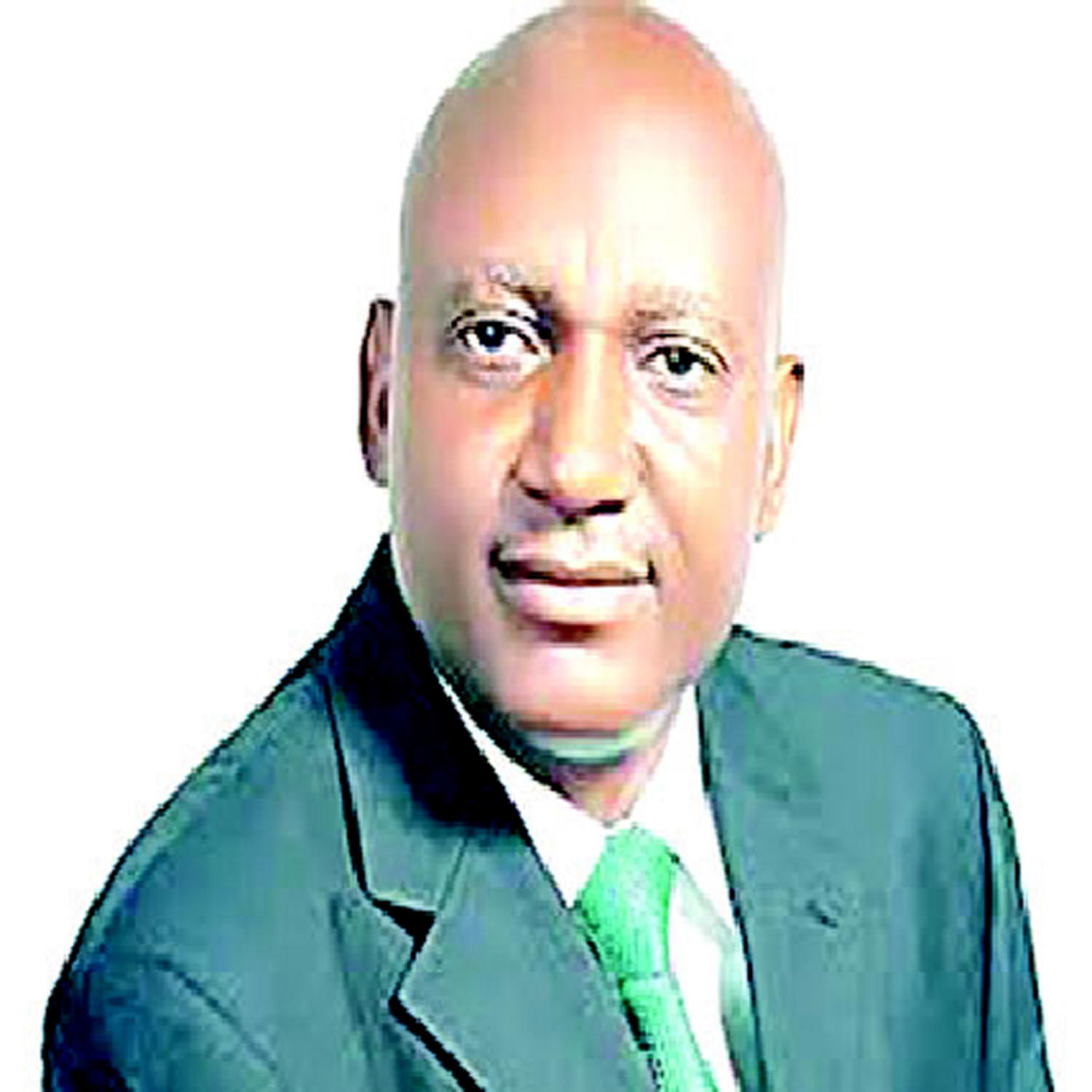
•Austin Nweze
BY CHARLES KUMOLU, DEPUTY EDITOR
The re-emergence of forceful change of government in Africa has revived the conversation around the suitable type of government for the continent outside democracy.
One of the prominent people who spoke recently about liberal democracy as practised in Nigeria and other African nations was ex-President Olusegun Obasanjo.
His statement that the system of government doesn’t seem to be working anymore has further set the tone for debates around recent developments. In this interview, a public policy expert, Faculty Member at the Lagos Business School and Head, Centre for Applied Economics, Pan African University, Dr. Austin Nweze, provides answers to questions about liberal democracy in Nigeria.
Recent events have led to arguments that liberal democracy isn’t working in Nigeria and Africa as a whole. In fact, former President Olusegun Obasanjo was one of those who alluded to that a few days ago.
What does that mean to you as an intellectual and public policy expert?
From inception when African nations began to gain their independence, the colonialists prepared an easy way for them to disrupt their growth. Be it Anglophone, Francophone or others, it is the same story. Democracy is alien to us. And I often say that there is a level of literacy that you require for democracy to work.
Illiteracy and poverty do not mix with democracy. If you check out nations that have evolved over the years, you will find that they were able to take care of some basic things before venturing into democracy. Liberal democracy as we know it and as it is being practiced in Nigeria, cannot and has never developed any economy. What it does is to sustain a developed economy.
It is not a means to development. It is a way to maintain already developed economies. You require a certain level of literacy to be able to run your economy. You require a certain level of literacy to understand a policy. Government communicates with the people via policies. Policymakers need to be well-grounded.
Going to school is not about education alone. John Adams described two types of education. The first type of education is education which enables you to make a living. The second type is the one that enables you to live. One allows you to go to school, graduate and get a job. The other type is your values, which is more critical. What we have today is a crisis in values. The second type of education that we require is lacking. It is something we need to have. We have no input in the system of government we are practicing.
Should there be a rethink of democracy on the continent?
When you are making a system of government for a people, you must consider their heritage. Their culture should be an integral part of the system of government. I will use Botswana as an example. Botswana gained independence in 1966. They had only 22 kilometres of roads at independence. What did they do? Three kingdoms make up Botswana. The name, Botswana, is derived from the various names of the kingdoms.
In history, Cecil Rhodes, who ruled Rhodesia, was a bandit. He wanted to take over Botswana but the three kings of Botswana had a friend who was a Rev Fr. He arranged a meeting to ensure they saw the Queen of England, who was Queen Victoria at the time. They travelled by ship to London to meet with the queen. They told the queen they were being proactive. They didn’t want Rhodes to take over Botswana. They told the Queen of England they wanted to be a protectorate of England. The queen agreed and said Britain would provide security for the three kingdoms.
That was how Rhodes could not conquer Botswana after conquering Zimbabwe, Northern Rhodesia, Southern Rhodesia, and Zambia. Eventually, when they gained independence, what they did was adopt the process they used in selecting the chiefs who served their communities. They infused it into their electoral process. They embedded that practice so that before you become a politician, the same process would apply. And it has worked for Botswana. At a point, recently, Botswana was the fastest-growing economy in Africa.
They had rapid development, but they still maintained their heritage. What did we do in Nigeria? We abandoned our culture and everything about us and decided to imbibe an alien democratic culture. In our villages, there was a process of selecting village heads back then.
Most of them were former headmasters and other retired civil servants. Can you imagine if that process was taken and brought into the political process? We all have different ways. They removed our culture, our heritage from our democracy. How do you expect it to work? What the colonialists did was to train those who were loyal to them, those they could use and empowered them to do their bidding.
$25, 000. In The White Malice by Susan Williams, you will find how our post-independent leaders were manipulated. You would find how Patrice Lumumba became a victim and how Mobutu Sesekou came to power.
They empowered them. For $25, 000, they sacrificed Patrice Lumumba. That was what Sesekou took in addition to power. When people say we should stop blaming the colonialists for our leadership challenge, we should keep blaming them for being responsible for our woes.
They didn’t allow us to develop our system of government in line with our culture. The democracy we borrowed is without our culture and our heritage.
Are you saying Nigeria should have evolved its model of governance, imbibing cultural practices that are peculiar to its own people?
Yes, that is what we should have done. And that is what we could still do. We don’t need to have the same system everywhere because of cultural differences. Eventually, as we develop as a nation and become more sophisticated and cosmopolitan, we can now have a uniform system of government for everyone.
Sometimes when you meet some people from other parts of the country, you wonder if they share the same values with you. We needed to have infused our culture and heritage into our democracy. Unfortunately, we removed them and we are all learning to climb the ropes and sending our prayers to the banks.
Barack Obama famously said Africa is a nation of strongmen instead of strong institutions. Some have argued that for Nigeria and other African countries to succeed, they should have strong men in the mold of benevolent dictators. Does that fit into the homegrown democracy you are calling for?
It is the strongmen that would build strong institutions. Lee Kwan Yew was able to do that because he didn’t abandon his culture and his heritage.
The Chinese are predominant in Singapore. There are Chinese, Indians and Malays in Singapore. Policies are made so that every ethnic group can express itself and work towards a common goal. It worked in Malaysia and Singapore. What helped Singapore was that Lee Kwan Yew borrowed some good aspects of democracy but he didn’t abandon his culture.
He infused everything into the model he created. For instance, one of the studies showed that Confucianism helped to discipline Hong Kong because Lee Kwan Yew borrowed a lot from Hong Kong. That is what people didn’t know. Hong Kong was under the British at the time.
The Hong Kong authorities had the laissez-faire system. Government involvement in business was less than 10 percent. He asked himself: Why did Hong Kong work? One of the things he learnt was Confucianism. It is known as Confucius philosophy, which implies that people should learn discipline.
They should learn to respect the rule of law. Where there is no respect, trouble follows. He also learnt from other countries as well. It was not just about the man, it was about understanding his people, not forgetting their culture and forcing them to be disciplined. When I visited Singapore, I saw all the things the man wrote in his book. I couldn’t even buy chewing gum.
All the talk about Singapore is a holistic thing. About 83 percent of the military live in their own homes. That was how they started fighting corruption. The police, army and paramilitary were made to live in their own homes. As you graduate, you have savings. He wanted them to have about 14 percent savings, but he didn’t start with 14 percent overnight.
He started with two percent. But can we do that in Nigeria? The cab driver that took me from the airport to the hotel, I told him I had heard so much about his country, what is the secret? He said ‘’we are obedient sons of Singapore.’’ When a citizen of a country tells you that, you have to understand that they built a nation. If you cannot pay minimum wage as a small business, government will pay the balance for you after an assessment.
Government did that so that the gap between the private sector and public sector earnings is not much. That is the secret of Singapore. They have strong institutions.
What really inspired this report is the re-emergence of coups in Africa. The consensus is that development was provoked by poor leadership offered by African leaders under the guise of democracy. So should there be homegrown alternatives to democracy?
The issue boils down to good governance. The system we borrowed is responsible for leadership failure. African leaders should go back to the basics. They should look at our culture. Most countries that have developed became what they are today because they built their military.
After building that, you now have democracy to sustain that development. There is nowhere in the world where liberal democracy as we pretend to practice in Nigeria and Africa has ever developed a nation. It breeds poverty and other forms of instability. The system that suits you should be developed. The British have a highbred system with a monarch as the head of government for their own democracy.
When America was gaining independence, Alexis Tocqueville told them not to toe the line of the British by adopting their form of government. He said they should make their constitution, place it on a gold seat and worship the constitution. That was what America did. Sweden has its brand of democracy. During the 2014 National Conference, I proposed a collegiate system where decisions are made because of the way we are in the country.
In a collegiate system, the six regions can form a government. All the parties should have the same number of persons contesting for a position. These six people are the ones that will become President and Vice. All will contest and win the election, when you win, you decide among yourselves who should take the first shot. And you all have a six-year tenure.
If you take the first shot and do one year, you will hand over to the next person without any ceremony. Others will become ministers. The one who will become President for that one year handles the military. It can be scaled down to the state.
The collegiate system will work for us. We can give it a try without forgetting our culture because the selection process is more important than the position you occupy. The process that brings you to power must be excellent if you must be called “His Excellency.’’
Obasanjo’s postulation on the perceived failure of liberal democracy was cited earlier. Former President Goodluck Jonathan also followed suit last Tuesday, blaming post-independence leaders for failing to build a nation…
When things happen, you must begin to think deeper to find out not the symptoms but the root causes. Nigerians made fundamental mistakes. Our people didn’t allow the British to stay with us and inculcate in us some of those values required to build a good civil service system. We were in a hurry to throw them away and we ended up throwing the baby and the bathwater away.
That was a fundamental mistake. We were even lucky. In Algeria and Tunisia, the French burnt the files they used in governing them. They did it so that Africans wouldn’t have records of anything. We can blame our past leaders, but what lessons are we learning? What are we going to do today? Is it too late in the day to go back to the fundamentals? If it is not, let’s start with our culture.
Can we define what our culture should be?
We had an opportunity in the last elections, but we missed it. We wouldn’t be discussing this today if we didn’t miss the opportunity the elections presented. Unfortunately, we missed the opportunity by allowing questionable characters to take over power.
Disclaimer
Comments expressed here do not reflect the opinions of Vanguard newspapers or any employee thereof.