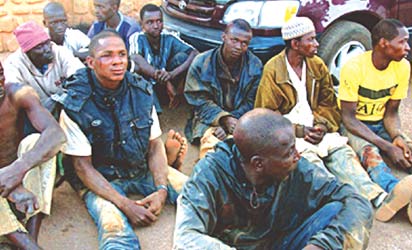
Arrested Boko Haram members
The Federal Government recently promised to upgrade our border posts with a view to checkmating activities of illegal aliens into the country. The pronouncement came on the heels of serious agitations and complaints about the porosity of our borders and the threats it poses to the security of the nation coupled with on-going massacre of innocent Nigerians by the dreaded Moslem fundamentalists, Boko Haram.
In this interview with Crime Editor, Emma Nnadozie, the Public Relations Officer of Nigeria Immigration Service, JOACHIM OLUMBA, an Assistant Comptroller of Immigration, bares his mind on the challenges the prevailing situation poses to them and the way forward.
Boko Haram and inadequacies of border control
I would like to correct an erroneous impression here. This has to do with insinuations that Boko Haram is a phenomenon created and propelled by external forces. To many, the activities of the group are inspired and perpetrated by non-Nigerians. This is to say the least, a mere fallacy. I have always maintained that we have over-exaggerated the extent of foreign involvement in most of the security challenges bedeviling the country.
Boko Haram and some other trans-border crimes constitute a proportion of criminal activities prevalent in Nigeria. One must not forget the fact that before the group’s violent attacks, we had local militia which terrorized different parts of the country, including the Niger Delta Militants and OPC. What is totally strange in what we are witnessing today is the suicide attacks by the group.
It is also wrong to pretend that Nigerians cannot engage in suicide bombings. At least, the Boko Haram is proving this to be correct. A very close look at the utterances and modus operandi of the Boko Haram clearly shows that members of the group are largely Nigerians. The record of arrests made so far also buttresses this assertion. The decent vehicles they use for their deadly operations may also be a pointer to the fact that the group is receiving robust sponsorship from well- placed people.
Boko Haram may more or less be a creation of our local political environment. You will recall that the group intensified their violent attacks ever since the last general elections. A lot of Nigerians misconstrue the group’s assertion that their men who had been trained in Somalia were being expected in the country to mean that they engaged foreign insurgents.
On the other hand, it is not totally out of place to link the high level of insecurity in the country to the state of our borders. This is so because the weapons used in the prosecution of most violent crimes in the country are imported.
Given this fact, we might ask: where are border security agencies when these weapons are being brought into the country? Some foreigners are also believed to be involved in the perpetration of some trans-border crimes hence, one might be compelled to seek to know where immigration officers are when these people enter the country.
The answer is very simple. The fact remains that our borders are extremely porous. Most times, when we talk about the porous nature of our borders, most people presume that this is the making of our border security operatives. Some even accuse them of being corrupt and conclude that this is the primary cause of the high rate of trans-border crimes. These are all misconceptions. Our borders are basically porous because they are not only vast but contiguous and without demarcations.
The greater proportion is unmanned, giving criminally-minded people the opportunity to enter or leave the country with minimal difficulty. When we say our borders are porous, it does not mean that our security agencies are not policing our borders the way they are expected to do. Rather, what this means is that our borders are in a very difficult shape to man.
In fact, with all sense of modesty, one could say that immigration officers have performed considerably well the arduous task of policing our vast, porous and contiguous borders. Any fellow who is quite conversant with the nature of our borders will easily accede to the fact that officers and men of the Service have done fairly well given the enormity of challenges confronting them.
The point here is that the borders are vast, contiguous, non-delineated with inadequate manpower to police them. The rate of trans-border crimes would have been worse if not for the commitment and sacrifice of security operatives at our borders, especially Immigration Officers and men.

Mr Olumba
Other challenges
It is just that our porous borders are at the center and summit of these challenges. It is the most debilitating and has several implications. Let’s take the issues here one after the other. The nation has 4047 kilometer stretch of land borders, largely consisting of flat desert land in the northern flanks. In the south, we have vast areas of rain forest. There is also well over 850 kilometers of coastal boundaries. I cannot really figure out any country in the world with this complex and extensive combination of international boundaries.
Over the years, communities and settlements were allowed to develop along our borderlines without consideration for the necessary buffer zones. Some of these communities and settlements have been there for a couple of centuries. What we have today is a situation where people came together from border States in Nigeria and neighboring countries to establish settlements along borderlines. With this development, cross-border marriages were contracted followed naturally by cultural diffusion. Common markets and places of worship were consequently established.
As I speak to you, when you visit these numerous border settlements, you find several Nigerians whose relatives come from across the border and vice-versa. In many cases, you have houses built on Nigerian land partly extending to neighboring territories. This is quite complex and makes effective control absolutely difficult.
Then again, in many of these border areas, you have markets patronized by very large numbers of people from across the borders. Such markets are on sides, some in Nigeria and others in neighboring countries. On such market days, security agencies experience a large influx of people from the neighboring countries. These are people you cannot stop from entering the country considering their large numbers.
One could be certain to provoke crisis if you insist on stopping the large crowd of people trooping into the country to engage on commercial activities during those market days. Mind you, thousands of Nigerians also attend such markets across Nigerian borders on a weekly basis. One will not rule out the possibility of criminals capitalizing on this situation to enter the country. It is really difficult to detect all of them.
There is also the challenge of the ECOWAS protocol of free movement of persons, rights of residence and establishment. Under the protocol, citizens from an ECOWAS member state are authorized to gain entry into any member nation other than theirs without visa for a period of not more than 90 days. Those wishing to reside and establish business are also empowered to do so with flexible or relatively liberal conditions.

suspected Boko Haram members
With the ECOWAS protocol of free movement, people from member countries are treated not much as foreigners. For instance, they are allowed to enter Nigeria without visa, reside and establish business without the mandatory expatriate quota requirement for other foreigners coming to engage in business or employment in the country.
This is simply why we have large numbers of people from ECOWAS countries in Nigeria and you find Nigerians talking about influx of aliens. They are in Nigeria on the strength of the ECOWAS protocol of free movement of persons and rights of residence and establishment.
We also have millions of Nigerians entering, residing and conducting business activities in other ECOWAS countries. So, you cannot really stop other ECOWAS citizens from entering Nigeria except when one is convinced that their entry is likely to jeopardize our security or national interest.
The greatest impediment here is lack of logistic provisions and incentives for border control officers. A situation where Immigration officers are subjected to manning and patrolling 105 recognized border control posts and patrol bases with less than 100 functional vehicles you must agree with me is grossly insufficient.
Mind you, we are talking about policing over 4000 kilometers of land borders and 850 kilometers of coastal line. The Service patrol boats are also in unserviceable conditions while there are no sufficient funds to regularly maintain the patrol aircrafts for optimal operations.
Logistic requirements of Nigeria Immigration Service for proper policing of the borders
For effective and proactive policing of the vast, porous borders, Nigeria Immigration Service will require more than 300 high utility motor vehicles fitted with modern communication gadgets which must be functional at all times, 1000 motor cycles, functional patrol boats for marine operations and helicopters for air border surveillance and patrol.
The officers need to operate from good offices fitted with modern migration management equipment, complemented with decent residential accommodation. A situation where officers make barriers across border routes with sticks and stay under trees in harsh weather conditions cannot pave the way for effective border control.
Border Plazas to the rescue
It is very necessary to stress at this juncture that the position of the Comptroller General of Immigration is that effective border management could only be achieved with Border Plazas being put in place. These border plazas will replicate the migration processes and facilities we have at International airports at our land border control posts. These facilities include the passport readers and scanners that are integrated to a central data base. With these equipment, biometric records of all those who enter or leave the country are maintained and the Service will be in a position to actually know those entering or leaving our country.
Proper training for officers
Apart from challenges in the area of logistics support, Immigration officers are not receiving the proper training they require to combat trans-border crimes such as irregular migration, human trafficking and human smuggling, terrorism and all the likes. Border Control Officers and Divisional Immigration Officers in all the 774 local government areas across the Federation require capacity building on intelligence-gathering and anti- terrorism.
Performance of the present administration of the Service
First of all, it must be emphasized that challenges ranging from our contiguous borders to dearth of logistics, motivation and training of Immigration officers would require the intervention of the Federal state and local governments. Many State governments do not incorporate Nigeria Immigration Service in the scheme for improvement of security. Perhaps, the Boko
Haram insurgence is only a wake-up call for the nation to get right all that is required for proper and effective policing of the borders and the entire length and breadth of the country. Be that as it may, I will say that the present administration of the Service under the able leadership of Mrs. Rose Chinyere Uzoma, has done considerably well given the level of support she has garnered from the federal government and the circumstances under which she operates.
It is noteworthy to point out that under her administration so far, the federal government awarded three major contracts namely; the multi-billion naira e-passport supply and maintenance contract, the upgrade of Immigration air border surveillance aircrafts with night vision and ICT equipment and contract for the provision of PKD facility at some land border control posts.
Besides, the e-passport intervention programme undertaken by the Service under Mrs. Uzoma on a grand-scale was also able to build the capacity of Immigration officers and men in the area of computer operation.
Another major achievement by the Comptroller General is the deployment of additional thirty-six Immigration attachés to Nigeria’s foreign missions.
Coming to the Comptroller General’s achievements in the area of staff welfare, I can say the story is also a delightful one. The first phase of the post-housing scheme of the Service will soon be completed in Abuja to alleviate the difficulties faced by officers and their families. The Immigration Staff Welfare Multipurpose Society is being reactivated and strengthened to cater for the numerous needs of officers and men of the Service. The most significant achievement in this regard appears to be the upgrading of an unprecedented number of stagnated Inspectors of Immigration.
Identifying Nigerians in our borders
Immigration officers and men are trained not to encounter any problem in identifying who is a Nigerian and who is not. When they run into such problem of determining the identity or nationality of any individual, the officers depend on intelligence information to crack the nut. The major issues here are that we do not have clearly demarcated borders and the routes into the country are countless.
Illegal immigrants in the country
Let me start by correcting the impression that illegal immigrants abound in the country. A foreigner staying in the country in an irregular manner is that person who is not in possession of valid travel documents. These are the people who ought to be described as illegal immigrants. However, most Nigerians simply jump into conclusions that there is a preponderance of illegal immigrants without actually verifying whether these people have valid travel documents or not.
Many of these foreigners presumed to be illegal immigrants have appropriate and valid documents. We must also take cognizance of the ECOWAS protocol on free movement and rights of residence and establishment. People from the West African sub-region are effectively utilizing this protocol and that is why you will always have citizens from ECOWAS member states traveling and residing across the region.
Nigerians are no exception as one will find them in their large numbers in all ECOWAS Countries. In fact, many of these Nigerians are driving the economy of most of the countries within the ECOWAS sub-region. They operate and own macro, medium and micro business and commercial enterprises in most of these countries. For this reason, it is very difficult to buy the idea of fishing out irregular migrants of ECOWAS extraction in our midst for repatriation. This is because of the backlash it will have on our own nationals residing in their own countries.
Disclaimer
Comments expressed here do not reflect the opinions of Vanguard newspapers or any employee thereof.