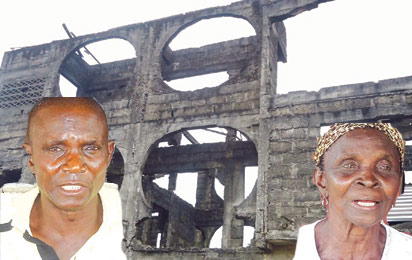
one of the burnt house and survivors, Mr Okoro & Mrs Ihuoma
By JIMITOTA ONOYUME
“The first time I saw this type of carnage was during the Nigerian civil war “, Mama Ihuoma Okoro said as she told the story of how her Ogbakiri community in Emohua local government area of Rivers state was razed down completely over chieftaincy crisis. According to her, the problem which started in 1999 lasted for about two years and within this period, no structure was left standing.
“Ogbakiri fought, they burnt houses. Peace has come. Ikwerre chiefs settled it. I lost so many things. The last time something like this happened here was during the Nigeria/ Biafra war. The town is peaceful now”, she managed to say in English language.
Corroborating her account, a youth leader in the area, German Okoro said the situation was really very bad as the whole six communities that make up Ogbakiri were involved in the fight. He said houses and valuables were destroyed. “We are made up of six communities. Ogbakiri is now peaceful. We had chieftaincy problem. Every community in Ogbakiri was involved in the fight. “
One of the youths Chike Awuse lamented the death toll in all the villages. He said if the whole Ogbakiri had a population of one million, then about eight hundred thousand persons died in the crisis. He joined in the prayer of many that the community should not see such level of destruction again.
“ People died during the Ogbakiri crisis. If Ogbakiri people were about one million, then about eight hundred people died. The first time it was chieftaincy tussle and later cultism joined,” he said.
Also commenting on the ugly incident, a female member of the community, Blessing Awuse said the whole houses in the area were burnt down.” It was chieftaincy problem that caused the first one. The second one was over cultism. The town is peaceful now. They burnt down the whole houses.”
At one of the communities visited, a youth leader who spoke to Saturday Vanguard under condition of anonymity said it was so bad that after burning down houses in the area and the warring youths could not find anything of value to destroy again, they had to start pulling down PHCN cables.
“One of the communities connected light to their area. But during the war, youths vandalised the cables. Today there is no electricity in that community. Government should help to restore the light and extend it to all parts of Ogbakirki .This darkness is affecting our economy”, he said.
Just when many thought that peace had returned to the area after the state government, Ikwerre council of chiefs and other stakeholders had brokered peace in the area, another crisis broke out and this time, it was mainly driven by youths who became members of various cult groups. The battle for who controls which area in the six communities led to several loss of lives. Ogbakirki became a no-go area for even indigenes of the land.
“Terror was the order of the day”, according to a native who spoke under cover. For about five years, cultists literarily called the shots in the area. They raped, maimed and killed at will. Another community source who also spoke under condition of anonymity said it was like the devil was in charge of the area.

one of the burnt house and survivors, Mr Okoro & Mrs Ihuoma
According to him, there was a particular incident where some cultists of the same fraternal group saw a pregnant lady and an argument ensued among them over the sex of the baby in her womb, whether it would be a boy or a girl. Finally they concluded that to resolve the issue, the pregnant woman should be killed on the spot to determine the sex of the pregnancy. They did it . This was how bad it was in our community”, the source said.
Continuing, the source said people had to flee for their lives. “It was really bad. Sometimes, they would kill and dump the corpse in a well where everybody drank water from.”
The various cult groups had camps in the communities where they kept their hostages. It was a reign of terror in the area as the cultists caused many to relocate to other parts of the state. One of those that moved to Omoku told Saturday Vanguard that they were not in a hurry to go back; apparently for fear that the cultists were still in charge.
The intervention of the Joint Task Force under Brigadier General Sarkin Yarkin Bello saved the situation. And the federal government’s amnesty programme has also been a stabilising factor in the area. The JTF smoked out the cultists and rendered them powerless.
The JTF was effectively funded by governor Chibuike Amaechi to help achieve peace in the state. It dislodged cultists who masqueraded as militants in all parts of the state causing problems all over.
General Bello took the crusade for peace to their doorsteps; the likes of Ateke Tom had to flee his Evil Forest in Okochiri, Okrika part of the state. It was the same feat the JTF achieved in Ogbakiri that was perceived to be a strong hold of a former militant leader, Farar Dagogo.
When Saturday Vanguard hinted some youths of Ogbakiri that the army General, Sarki Bello had been nominated for a national honour for his effort at bringing peace to so many communities in the region, they lauded the wisdom of the federal government, describing it as a necessary action. They recalled that General Bello gave ex combatants the option of dialogue. The JTF- led General Bello brought peace to Port Harcourt and most communities in the Niger Delta region.
A youth leader of the Community, German said he received the JTF when they came to the community and he was impressed with their conduct all through the period they were in the area. According to him, they conducted themselves and went about the task of achieving peace diligently.
“They would forever be celebrated by the community “, he said. According to him, the Egbelu River otherwise known as Calabar river that connects Tombia and Ogbakiri was a no- go area before the JTF moved to the area.
Another source told Saturday Vanguard that people avoided the River for their dear lives because of the fear of militants who took charge of the area. “Then it was a no go area because that was the route to where most of the ex militant leaders in the community built their camps and hid their hostages”, a community source told Saturday Vanguard. “JTF has contributed immensely to the peace in the area”, he said.
Like other youths in the area, Okoro who is president of one of the community youths also attributed the peace to the federal government’s amnesty programme. According to him, after the role of the JTF, the amnesty helped in consolidating the new atmosphere of peace.
He said no fewer than one hundred ex combatants keyed into the amnesty programme. He said the number would have been higher but most of the ex militants feared that the amnesty programme was a ploy to lure out ex militants in the region for arrest. “I coordinate the amnesty here in my community for Farrah. Some are doing for Ateke Tom.
In all, the programme has helped to consolidate the peace in Ogbakiri. The amnesty programme has helped to settle a lot of things. It made a lot of boys to come out to submit their arms. Now there is peace, I wish much more can be done”, he said.
Peace has finally returned to Ogbakiri. The rich ones are rebuilding their burnt houses while some have completed and moved in.The people now want development.
They appealed to both the Rivers state and federal government to come their aid. They want the entire Ogbakiri to be connected to the national grid; they also want link roads and other comfort of the contemporary age like good schools, link roads in the various communities.
Disclaimer
Comments expressed here do not reflect the opinions of Vanguard newspapers or any employee thereof.